
Artificial Intelligence
Generative AI vs Traditional AI is an important comparison for anyone trying to understand how modern artificial intelligence systems work.
Both approaches can analyse data, identify patterns, and support automated decisions. However, they usually solve different types of problems.
Traditional AI often predicts, classifies, recommends, detects, or follows predefined rules. In contrast, generative AI creates new content such as text, images, code, audio, summaries, and structured data.
Therefore, the better approach depends on whether you need a decision, prediction, classification, recommendation, or newly generated output.
What Is Traditional AI?
Traditional AI is a broad practical term for systems designed to complete a specific analytical, predictive, or decision-making task.
For example, a traditional system may classify an email as spam, predict whether a payment looks suspicious, recommend a product, recognise an object, or calculate the most efficient route.
Some systems use predefined rules. Meanwhile, others learn patterns from historical data through machine learning.
In this guide, traditional AI includes rule-based systems, predictive models, classification systems, optimisation tools, recommendation engines, and task-specific machine learning applications.
Common Traditional AI Tasks
- Classifying emails as spam or legitimate.
- Predicting customer demand.
- Detecting unusual financial activity.
- Recommending products or videos.
- Recognising objects in an image.
- Scoring loan or insurance risk.
- Optimising delivery routes.
- Identifying equipment failures.
- Filtering inappropriate content.
In most cases, the system returns a category, score, recommendation, prediction, or action.
What Is Generative AI?
Generative AI is designed to produce new content based on patterns learned from training data.
Depending on the model, the output may include:
- Written text.
- Images and illustrations.
- Computer code.
- Audio and speech.
- Video.
- Product designs.
- Summaries and reports.
- Structured data.
For example, a user can ask a generative model to write an email, create a software function, summarise a document, generate an image concept, or draft a customer-support response.
However, the output is not automatically correct. Therefore, users should review generated material before publishing, sending, deploying, or relying on it.
How Traditional AI Works
A traditional AI system usually receives structured or clearly defined input and produces a specific result.
For instance, a fraud-detection model may evaluate the transaction amount, location, device, account history, and purchase pattern. Afterwards, it may return a risk score.
Transaction data
        ↓
Rules or predictive model
        ↓
Risk score
        ↓
Approve, review, or block
The system does not need to create a new paragraph or image. Instead, it must make a reliable decision within a defined process.
How Generative AI Works
A generative model receives an instruction and available context. Next, it predicts and produces a suitable sequence of words, pixels, sounds, code tokens, or other output elements.
User prompt
        ↓
Instructions and context
        ↓
Generative model
        ↓
New text, image, code, audio, or data
        ↓
Human review and refinement
The quality of the result depends on the model, prompt, context, data, constraints, and review process.
As a result, a detailed instruction usually produces a more useful response than a vague request.
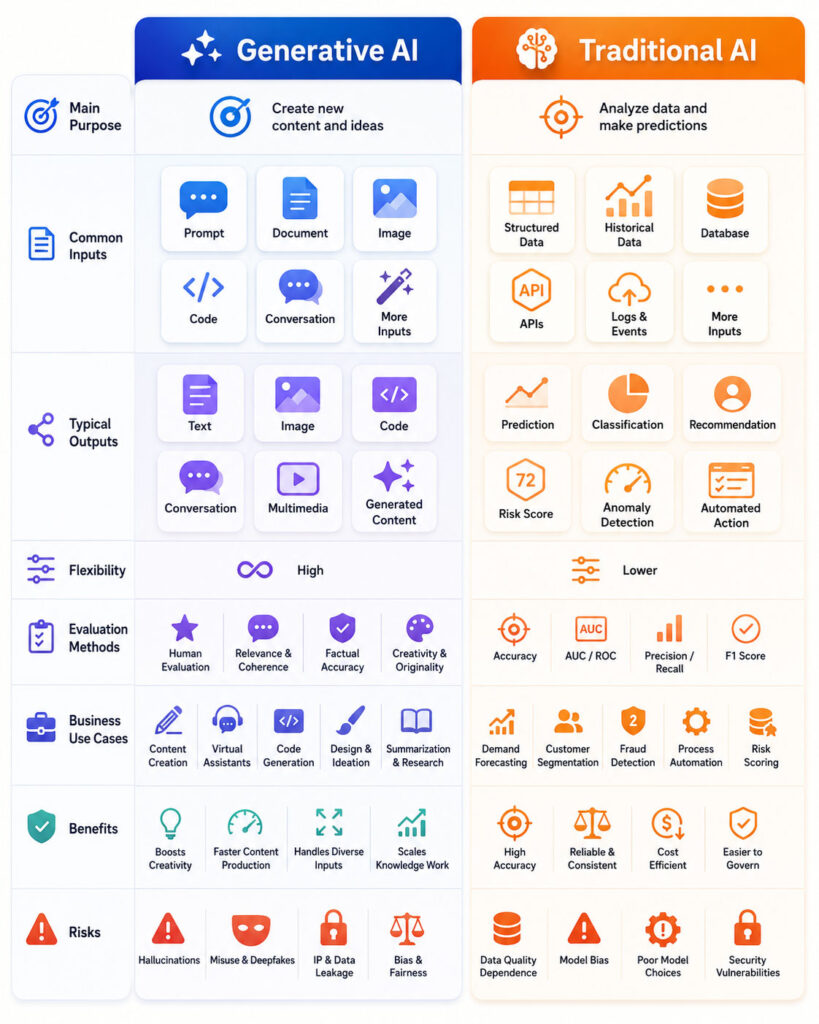
Generative AI vs Traditional AI: Quick Comparison
| Point | Traditional AI | Generative AI |
|---|---|---|
| Main Purpose | Analyse, classify, predict, recommend, or automate decisions | Create new content or transform existing content |
| Typical Output | Score, category, recommendation, alert, or action | Text, image, code, audio, video, or structured content |
| Common Input | Structured data, events, measurements, or known features | Prompts, documents, images, audio, code, or mixed context |
| Flexibility | Usually optimised for a defined task | Can support many content-oriented tasks |
| Evaluation | Often measured with task-specific accuracy and error metrics | Requires quality, relevance, factuality, safety, and human review |
| Main Risk | Incorrect predictions, bias, false positives, or model drift | Incorrect content, fabricated information, unsafe output, or data exposure |
This comparison provides a useful starting point. Still, real AI systems may combine several methods rather than fitting perfectly into one category.
Rule-Based AI vs Machine Learning
Not every traditional AI system learns from data.
A rule-based system follows logic created by developers or domain experts.
IF transaction_amount is very high
AND device is unknown
AND location is unusual
THEN request additional verification
By contrast, a machine learning model learns statistical patterns from historical examples.
Both approaches can work well. However, rule-based systems provide clearer control, while machine learning may identify patterns that are difficult to describe manually.
Is Machine Learning Traditional AI or Generative AI?
Machine learning supports both categories.
For example, a classification model can predict whether a customer may cancel a service. That system fits the traditional AI side of the comparison.
Meanwhile, a large language model can generate a retention email based on the customer situation. That system uses generative AI.
Therefore, machine learning is not limited to one side. It is a broader method used to build many types of intelligent systems.
Simple Example: Customer Support
A customer-support platform can use both approaches.
| Task | Suitable Approach |
|---|---|
| Classify the request as billing, technical, or account-related | Traditional AI |
| Predict whether the issue requires escalation | Traditional AI |
| Generate a draft response | Generative AI |
| Summarise a long support conversation | Generative AI |
| Check whether the reply follows policy | Traditional AI, rules, or a combined system |
Consequently, businesses do not always need to choose only one approach.
How the Outputs Differ
The clearest difference appears in the type of result each system produces.
Traditional AI usually selects from known outcomes or calculates a numerical result. For example, it may label an image as a vehicle, assign a fraud score, or recommend one product from a catalogue.
Generative AI, on the other hand, can create an original response for the current request. It may draft a paragraph, generate an image concept, write code, or restructure a document.
Traditional AI Output Examples
- Classification: Spam or not spam.
- Prediction: Expected sales for next month.
- Scoring: Fraud risk from 0 to 100.
- Recommendation: Products a customer may prefer.
- Detection: Whether an image contains a specific object.
- Optimisation: The most efficient delivery route.
Generative AI Output Examples
- Text: Emails, articles, summaries, and reports.
- Images: Illustrations, product concepts, and marketing visuals.
- Code: Functions, tests, documentation, and refactoring suggestions.
- Audio: Speech, sound effects, or music-like content.
- Video: Generated scenes, animations, or edited sequences.
- Data: Synthetic examples, structured records, or transformed formats.
However, generated output can look convincing even when it contains mistakes. Therefore, presentation quality should never replace verification.
How Training Data Differs
Both approaches can learn from historical data, but their training goals often differ.
A traditional predictive model may learn a direct relationship between input features and a target result.
For example, a demand model may use product, date, location, season, price, and previous sales to predict future demand.
A generative model learns patterns that help it produce new sequences or representations. Consequently, it can respond to prompts with newly generated material.
In both cases, poor-quality data can lead to unreliable results.
Traditional AI Accuracy
Traditional models often support clear task-specific evaluation.
For a classification system, teams may review:
- Accuracy.
- Precision.
- Recall.
- False-positive rate.
- False-negative rate.
- Processing time.
Nevertheless, one metric rarely tells the complete story.
For example, a fraud model could achieve high overall accuracy while still missing a small number of costly fraudulent transactions.
How Generative AI Quality Is Evaluated
Generative output often requires broader evaluation.
Teams may review:
- Relevance to the prompt.
- Factual correctness.
- Completeness.
- Writing or visual quality.
- Safety.
- Consistency.
- Originality.
- Compliance with instructions.
In addition, human reviewers may need to confirm whether the result matches business rules and audience expectations.
Benefits of Traditional AI
Traditional AI provides strong value when a business process has a clear target and measurable outcome.
1. Predictable Task Scope
The system usually focuses on one defined problem.
Therefore, teams can test it against specific requirements and monitor its success more directly.
2. Easier Performance Measurement
Predictions and classifications often have known correct outcomes.
As a result, developers can compare model results with verified historical data.
3. Lower Output Variability
A task-specific system generally returns a score, category, or action from a controlled set of possibilities.
Consequently, its output may be easier to integrate into business workflows.
4. Efficient Processing
Smaller predictive or rule-based systems can require fewer computing resources than large generative models.
However, actual cost depends on the model, traffic, infrastructure, and processing requirements.
5. Strong Fit for Automated Decisions
Traditional AI can work well for fraud detection, forecasting, routing, recommendation, monitoring, and quality checks.
Still, high-impact decisions may require human review and clear appeal processes.
Limitations of Traditional AI
- The system may support only one narrow task.
- New requirements may require new rules, features, or model training.
- Historical bias can affect predictions.
- Performance may decline when real-world patterns change.
- Complex models may become difficult to interpret.
- False positives and false negatives can create business problems.
Therefore, teams should monitor production results rather than relying only on initial test accuracy.
Benefits of Generative AI
Generative AI can support a wide range of content and knowledge-based tasks.
1. Faster Content Drafting
Users can generate initial versions of emails, reports, articles, product descriptions, and documentation.
As a result, teams can begin with a draft instead of a blank page.
2. Natural-Language Interaction
Many generative tools accept instructions written in everyday language.
Therefore, users can request summaries, comparisons, rewrites, and transformations without creating a traditional interface for every action.
3. Code and Technical Assistance
Generative models can draft code, explain errors, suggest tests, and create documentation.
However, developers must review the logic, security, dependencies, and compatibility before using the output.
4. Personalised Content
A system can adapt content to a particular audience, tone, format, language, or context.
Nevertheless, personalisation should follow privacy rules and avoid exposing sensitive information.
5. Knowledge Summarisation
Generative AI can condense long documents, meetings, support conversations, and research notes.
Still, important conclusions should be checked against the original source.
Limitations of Generative AI
Generative systems can produce useful content, but they also introduce distinctive risks.
- They may generate incorrect or fabricated information.
- Outputs can change between similar requests.
- Confidential information may be exposed through unsafe use.
- Generated code may contain security weaknesses.
- Copyright and licensing questions may require review.
- The model may reproduce bias or inappropriate patterns.
- Large models can require significant computing resources.
Consequently, organisations should define where generation is allowed and where human approval remains mandatory.
Generative AI Hallucinations
A hallucination occurs when a generative model produces information that sounds plausible but is unsupported, incorrect, or invented.
For example, it may create a nonexistent reference, incorrect product feature, false legal statement, or unavailable software function.
Therefore, users should verify important facts through trusted sources rather than accepting confident wording as proof.
Traditional AI Can Also Be Wrong
Traditional systems do not hallucinate in the same content-generation sense. However, they can still produce incorrect predictions or decisions.
A fraud model may flag a legitimate transaction, while a medical-image classifier may miss an important pattern.
As a result, both approaches require testing, monitoring, risk controls, and human oversight.
Data Privacy Considerations
AI systems often process customer, employee, business, or operational data.
Before sending information to any model, organisations should determine:
- Whether the data contains personal or confidential information.
- Where the provider processes and stores the data.
- How long the provider retains prompts and outputs.
- Whether the data may be used for model improvement.
- Which employees and systems can access the information.
- Whether regulations or contracts restrict its use.
Most importantly, users should never paste passwords, private keys, access tokens, or production credentials into an AI tool.
Security Risks
Traditional and generative AI systems can both create security concerns.
| Risk | Traditional AI | Generative AI |
|---|---|---|
| Incorrect result | Wrong prediction or classification | Incorrect or fabricated content |
| Input manipulation | Adversarial or misleading data | Prompt injection or malicious context |
| Data leakage | Exposure through logs, training, or integrations | Exposure through prompts, context, or generated output |
| Excessive automation | Unsafe automated decisions | Unsafe generated actions or agent behaviour |
| Model change | Drift as real-world patterns change | Behaviour changes across models, prompts, or versions |
Therefore, security should remain part of the complete AI lifecycle.
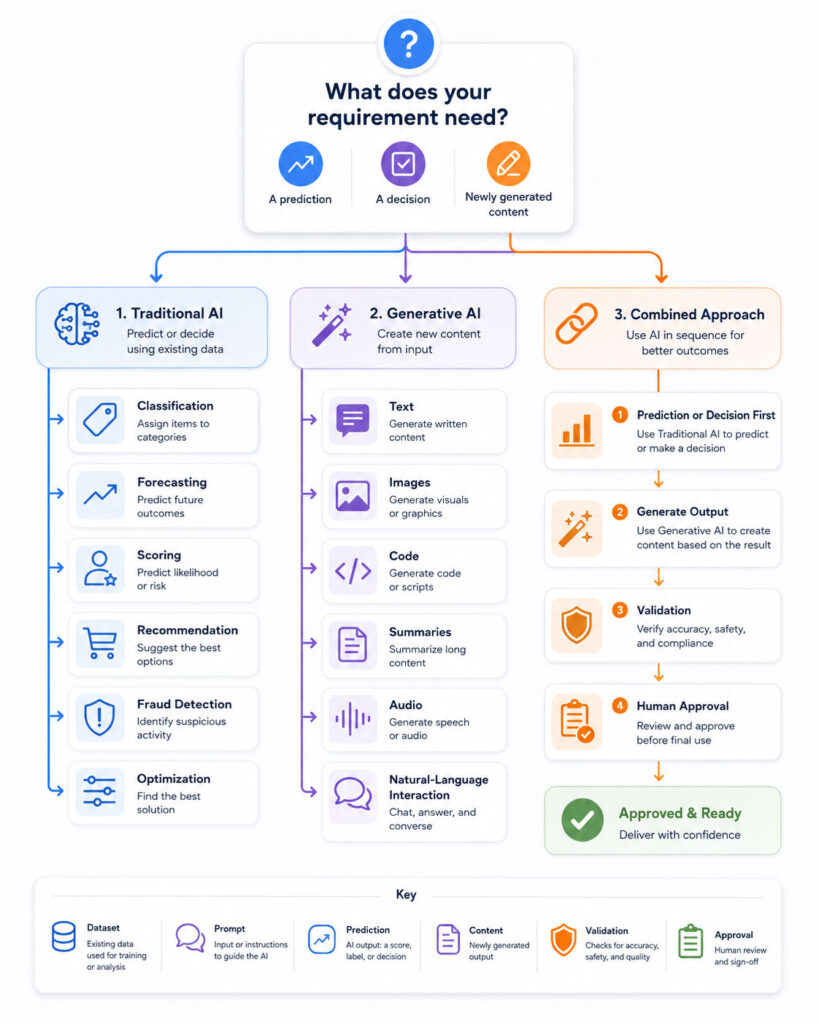
Generative AI vs Traditional AI Use Cases
The right approach becomes clearer when you compare the required result.
| Business Requirement | Recommended Starting Point |
|---|---|
| Predict customer demand | Traditional AI |
| Generate a marketing draft | Generative AI |
| Detect suspicious transactions | Traditional AI |
| Summarise customer feedback | Generative AI |
| Recommend products | Traditional AI |
| Create product descriptions | Generative AI |
| Classify support tickets | Traditional AI |
| Draft support replies | Generative AI |
| Optimise a delivery route | Traditional AI |
| Create a route explanation for the driver | Generative AI |
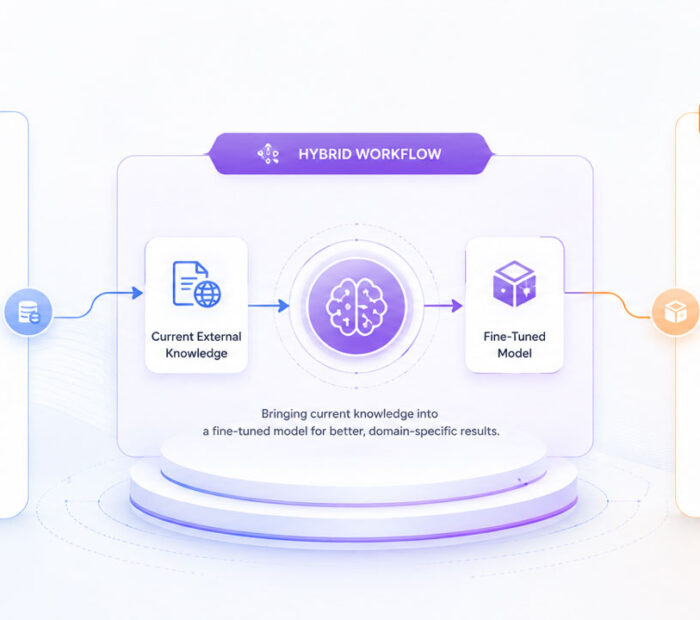
In many cases, a combined workflow provides the strongest result.
Can Generative AI and Traditional AI Work Together?
Yes. Many practical AI systems combine prediction, rules, search, automation, and generation.
For example, an insurance-support workflow may use traditional AI to classify a request and estimate risk. Afterwards, generative AI can create a plain-language explanation for an employee to review.
Customer request
        ↓
Classification model
        ↓
Risk and priority score
        ↓
Generative response draft
        ↓
Policy validation
        ↓
Human approval
This structure uses each approach for the task it handles best.
Combined AI for E-Commerce
An online store can use traditional AI to recommend products based on browsing and purchase patterns.
Next, a generative model can create a personalised product comparison or marketing message.
However, the system should avoid making unsupported claims or exposing private customer data.
Combined AI for Software Development
A development platform may use traditional analysis to detect code-quality issues, known vulnerabilities, or test failures.
Meanwhile, generative AI can suggest a possible correction, write a unit-test draft, or explain the warning.
Therefore, automated checks can validate generated suggestions before a developer accepts them.
Combined AI for Customer Service
Traditional AI can classify the issue, detect sentiment, estimate urgency, and select the relevant knowledge category.
Then, generative AI can draft a response using approved information.
Finally, rules or a human reviewer can check whether the reply follows policy.
Which Approach Is More Accurate?
Neither approach is universally more accurate.
Accuracy depends on the task, model, data, training process, evaluation method, and production environment.
A specialised prediction model may outperform a general generative model on a narrow classification task. In contrast, a generative system may handle flexible language tasks that a fixed classifier cannot support easily.
Therefore, compare systems using the actual business requirement rather than a general accuracy claim.
Which Approach Is More Expensive?
Cost depends on model size, infrastructure, traffic, storage, training, integration, monitoring, and human review.
A small rules engine or predictive model may cost less to operate than a large generative system.
However, development and maintenance costs can increase when traditional systems require many separate models or manual rules.
Consequently, organisations should measure the complete lifecycle cost rather than only the price of one API request.
Which Approach Is Easier to Control?
Traditional rules and task-specific models often provide more restricted outputs.
Because the system selects from defined results, teams may find it easier to apply fixed business controls.
Generative output offers greater flexibility. However, that flexibility creates more possible responses and failure modes.
Therefore, generative systems often need stronger prompting, content filters, retrieval controls, validation, and human review.
When Should You Use Traditional AI?
Traditional AI provides a strong starting point when the required outcome is predictable and measurable.
- You need classification, detection, scoring, or forecasting.
- The workflow has clear inputs and outputs.
- You need consistent automated decisions.
- Standard performance metrics can measure success.
- The system must operate with limited computing resources.
- Users do not need newly generated content.
In these cases, generative AI may add unnecessary complexity.
When Should You Use Generative AI?
Generative AI can provide value when users need flexible content creation or transformation.
- You need to draft, rewrite, summarise, or translate text.
- Users need a natural-language interface.
- The application creates code, images, audio, or structured content.
- Different requests require different response formats.
- Human reviewers can verify important outputs.
- The organisation can manage privacy, safety, and quality risks.
Nevertheless, use a traditional workflow when a fixed and verified result is more important than creative flexibility.
Questions to Ask Before Choosing
- Do we need a prediction or newly generated content?
- Can we define the correct result clearly?
- What data will the system process?
- How will we measure quality?
- What happens when the AI produces the wrong result?
- Does a human need to approve the output?
- Can the system explain or justify important decisions?
- What privacy and security rules apply?
- How much computing cost can the project support?
- Can an existing rule-based solution solve the problem more simply?
These questions help teams avoid selecting a technology before defining the problem.
AI Implementation Checklist
- Define one clear business problem.
- Choose measurable success criteria.
- Identify available and permitted data.
- Select the simplest suitable AI approach.
- Create a small controlled pilot.
- Test accuracy, safety, privacy, and performance.
- Add human review for high-impact outcomes.
- Monitor production results and user feedback.
- Document limitations and failure procedures.
- Review the system whenever data or requirements change.
A focused pilot usually provides more useful information than a large project with unclear goals.
How to Use Generative AI Safely
- Provide clear instructions and relevant context.
- Do not include confidential information unnecessarily.
- Verify factual and technical claims.
- Review generated code before deployment.
- Use approved sources for high-impact content.
- Keep humans responsible for final decisions.
- Record important prompts, versions, and approval steps.
- Test for unsafe, biased, or misleading output.
In addition, users should understand that a fluent response can still be incorrect.
How to Use Traditional AI Safely
- Use representative and lawful training data.
- Measure false positives and false negatives.
- Check performance across relevant user groups.
- Monitor model drift after deployment.
- Provide review and appeal options for important decisions.
- Protect model inputs, outputs, and logs.
- Review automated rules regularly.
- Keep a fallback process when the model becomes unavailable.
Although the output may appear more controlled, poor predictions can still cause real harm.
Common Generative AI Mistakes
- Using generation when a simple rule would work.
- Publishing output without verification.
- Sharing confidential data through prompts.
- Allowing generated actions without approval.
- Assuming the latest model always fits the task.
- Ignoring recurring operating and review costs.
- Treating creativity as factual accuracy.
Common Traditional AI Mistakes
- Using poor-quality or outdated training data.
- Optimising only for overall accuracy.
- Ignoring rare but high-impact errors.
- Applying one model to every user or situation.
- Failing to monitor changing real-world patterns.
- Automating decisions without meaningful human review.
- Keeping old rules that no longer match business needs.
Generative AI vs Traditional AI for Beginners
Beginners should first understand the problem type.
If the task asks, “Which category does this belong to?” or “What will probably happen next?”, it usually resembles a traditional AI problem.
If the task asks, “Create a new response, image, summary, or code sample,” it usually resembles a generative AI problem.
Afterwards, learners can study how datasets, models, prompts, evaluation, security, and human review affect both approaches.
Generative AI vs Traditional AI: Which One Should You Choose?
| Your Requirement | Recommended Starting Point |
|---|---|
| Predict a numerical result | Traditional AI |
| Classify or detect an event | Traditional AI |
| Recommend an existing item | Traditional AI |
| Create new text, code, image, or audio | Generative AI |
| Summarise or transform content | Generative AI |
| Automate a controlled business decision | Traditional AI with appropriate oversight |
| Provide a flexible conversational interface | Generative AI |
| Need both prediction and content generation | Combine both approaches |
Final Verdict
Traditional AI works best when a system must analyse data and return a defined prediction, classification, recommendation, or decision.
Generative AI works best when a system must create or transform text, images, code, audio, video, or other content.
Therefore, neither approach replaces the other. Each solves different problems, and many useful applications combine both.
Conclusion
Generative AI vs Traditional AI is mainly a comparison between content creation and task-focused analysis or decision-making.
Choose traditional AI for predictable outputs, forecasting, classification, detection, and optimisation. Alternatively, choose generative AI for drafting, summarisation, design, coding assistance, and natural-language interaction.
Most importantly, define the business problem before choosing the technology. A smaller and more controlled system can often deliver better value than a complex AI solution without a clear purpose.

AboutTPJ Technical Team
The Project Jugaad Technical Team creates practical, easy-to-follow content on software development, web technologies, artificial intelligence, cybersecurity, cloud platforms, and digital tools. Our articles are informed by more than 13 years of hands-on experience with .NET, Angular, SQL Server, AWS, WordPress, Linux hosting, application deployment, and real-world troubleshooting. Each guide is researched, reviewed, and updated to provide accurate, useful, and actionable information for developers, businesses, and everyday technology users.