Artificial Intelligence
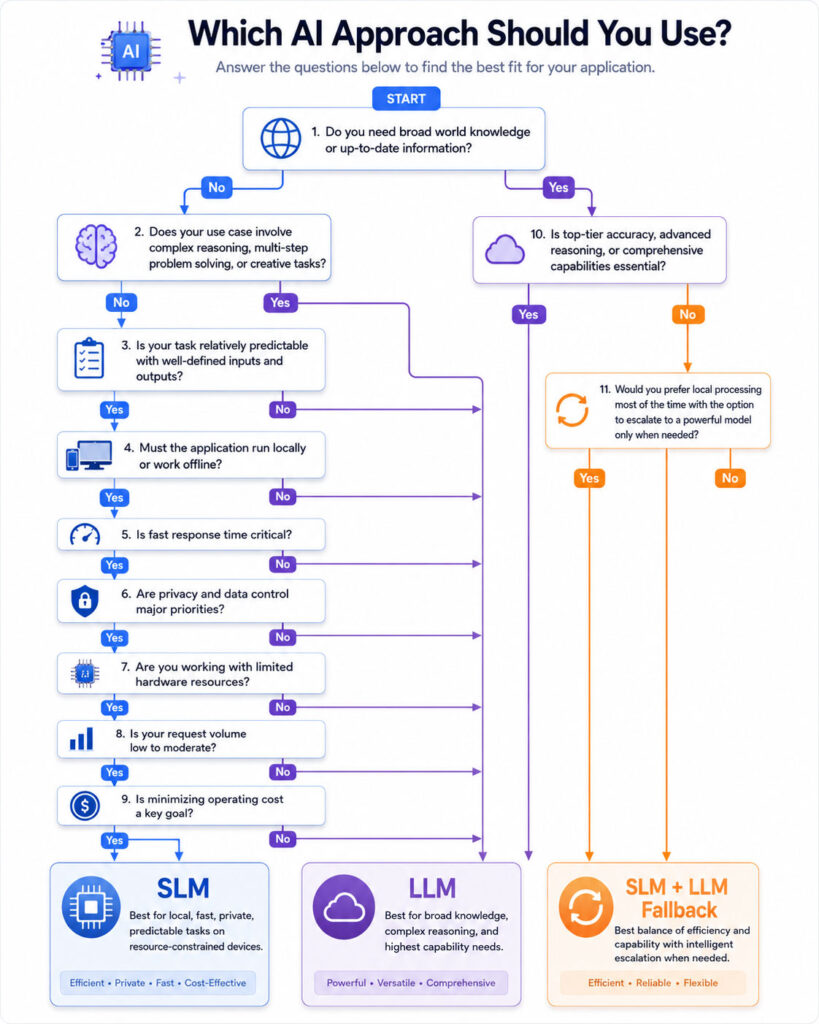
Artificial intelligence applications do not always need the largest available model. While large language models (LLMs) can handle broad and complex tasks, small language models (SLMs) may respond faster, cost less to operate, and run on devices with more limited computing resources.
The SLM vs LLM decision depends on the task, required accuracy, available hardware, privacy requirements, response time, deployment environment, and operating budget. Therefore, selecting the model with the highest parameter count does not automatically produce the best application.
SLM vs LLM: Quick Answer
- Choose an SLM for focused tasks, local processing, lower latency, limited hardware, offline features, and high-volume automation.
- Choose an LLM for broad conversations, complex instructions, advanced reasoning, creative work, and tasks covering many subjects.
- Use a hybrid approach when a smaller model can handle routine requests while a larger model processes difficult or uncertain cases.
The practical goal is usually to use the smallest model that can reliably meet the application’s quality, safety, and performance requirements.
What Is a Language Model?
A language model is an artificial intelligence system trained to recognise patterns in language and generate suitable outputs. Modern language models can answer questions, summarise documents, classify text, extract structured information, translate languages, generate content, and assist with code.
After training, developers can use a model directly, connect it to external information, or customise it for a specific workflow. However, every model has limitations and can still produce incomplete, inaccurate, or unsupported answers.
What Is a Small Language Model?
A small language model, or SLM, is a relatively compact model designed to perform language-related tasks using fewer computing resources than larger models.
There is no universal parameter threshold that separates an SLM from an LLM. The word small is relative and may describe a model designed to run efficiently on a laptop, smartphone, edge device, private server, or modest cloud instance.
SLMs often prioritise efficiency and focused performance. Developers may fine-tune, distil, quantise, or otherwise optimise them for classification, document extraction, command execution, customer-service routing, structured output, code completion, and local assistance.
What Is a Large Language Model?
A large language model, or LLM, generally contains greater model capacity and is trained on extensive datasets. As a result, operating larger models usually requires more memory and computing resources.
LLMs typically provide broader language capabilities, such as following varied instructions, discussing many subjects, generating long-form content, analysing complex inputs, and assisting with advanced coding.
However, greater size does not guarantee a correct answer. Architecture, training data, post-training, context handling, optimisation, and alignment also affect model quality.
Does Parameter Count Determine Model Quality?
No. More parameters can increase model capacity, but parameter count alone does not measure intelligence, accuracy, reasoning ability, or usefulness.
A specialised SLM may outperform a much larger general-purpose model on a narrow task. On the other hand, an LLM may perform better when users ask questions outside the smaller model’s specialisation.
SLM vs LLM Comparison
| Area | Small Language Models | Large Language Models |
|---|---|---|
| Model size | Relatively compact | Relatively large |
| Computing needs | Usually lower | Usually higher |
| Response speed | Often faster for focused tasks | May require more processing |
| General knowledge | Usually more limited | Usually broader |
| Complex reasoning | Varies and may be limited | Generally stronger on difficult tasks |
| On-device use | More practical | Often more difficult |
| Operating cost | Often lower for repetitive workloads | Often higher per request |
Accuracy and Task Performance
A large language model often performs well when a task requires broad knowledge, flexible instruction following, detailed writing, or several stages of reasoning. However, an SLM can provide comparable or better results on a focused task.
For example, a compact model designed to extract known invoice fields may perform more consistently than a general-purpose model that supports thousands of unrelated tasks. Therefore, teams should evaluate models using real application data rather than general benchmark scores alone.
Reasoning and Complex Instructions
LLMs generally handle ambiguous questions, unfamiliar situations, multi-step analysis, and complicated prompts more effectively. SLMs can perform well when instructions are clear, the task remains constrained, and the expected output follows a predictable format.
Application architecture can reduce limitations by dividing workflows into smaller steps, providing relevant context, using external tools, and validating each result.
SLM vs LLM for Speed and Hardware
Small language models generally require fewer calculations for each generated token and can run with less memory. Consequently, they can be practical for laptops, smartphones, embedded devices, edge servers, and modest cloud instances.
Large models commonly require powerful GPUs or other accelerators. Nevertheless, cloud providers can use specialised hardware, batching, and caching to improve response times.
Measure complete application latency, including networking, retrieval, tool calls, generation, and post-processing.
SLM vs LLM Cost
Small models often cost less to operate because they require fewer computing resources. This advantage becomes important when an application handles large numbers of short, repetitive requests.
However, total cost should include hosting, API usage, engineering, monitoring, updates, networking, storage, validation, and human review.
Privacy and Data Control
A locally deployed SLM can process information without sending every request to an external AI provider. Nevertheless, local deployment does not automatically guarantee privacy because applications may still record prompts, store generated content, send analytics, or connect to external services.
Similarly, an LLM does not automatically mean weak privacy. Private infrastructure, enterprise controls, encryption, regional processing, and limited retention can protect cloud deployments.
Offline and Edge AI
Small language models can support offline AI features when they run directly on a device. Possible applications include document search, device commands, field-service assistance, local translation, manufacturing support, and private note summarisation.
Customisation and Fine-Tuning
Smaller models can require fewer resources to customise. Developers may fine-tune an SLM for company terminology, classification systems, structured output, writing style, or tool-calling workflows.
Before fine-tuning either model type, first test whether better prompts, retrieval, deterministic logic, or representative examples already solve the problem.
Can Small Language Models Use RAG?
Yes. Retrieval-augmented generation can provide an SLM with relevant information from documents, databases, or search systems before it generates an answer.
Large models also benefit from RAG when answers must rely on private or current information. However, retrieval quality remains critical for both.
Tool Use and Structured Outputs
Many applications need models to select tools, call APIs, extract values, classify requests, or generate structured JSON rather than create long conversational responses.
An SLM can perform constrained tasks efficiently when available tools and schemas are clearly defined. Meanwhile, an LLM may perform better when user intent is ambiguous or choosing the right tool requires broader contextual understanding.
Reliability and Hallucinations
Both small and large language models can produce confident but incorrect information. Important answers should therefore be grounded in trusted information, while structured results should be validated before use.
Typical Use Cases
Small Language Models
- Support-ticket classification.
- Document field extraction.
- Offline assistance.
- Intent detection.
- Structured command generation.
- High-volume repetitive automation.
Large Language Models
- Broad conversational assistants.
- Complex research and analysis.
- Long-form content creation.
- Advanced coding assistance.
- Multi-step instructions.
- General-purpose enterprise assistants.
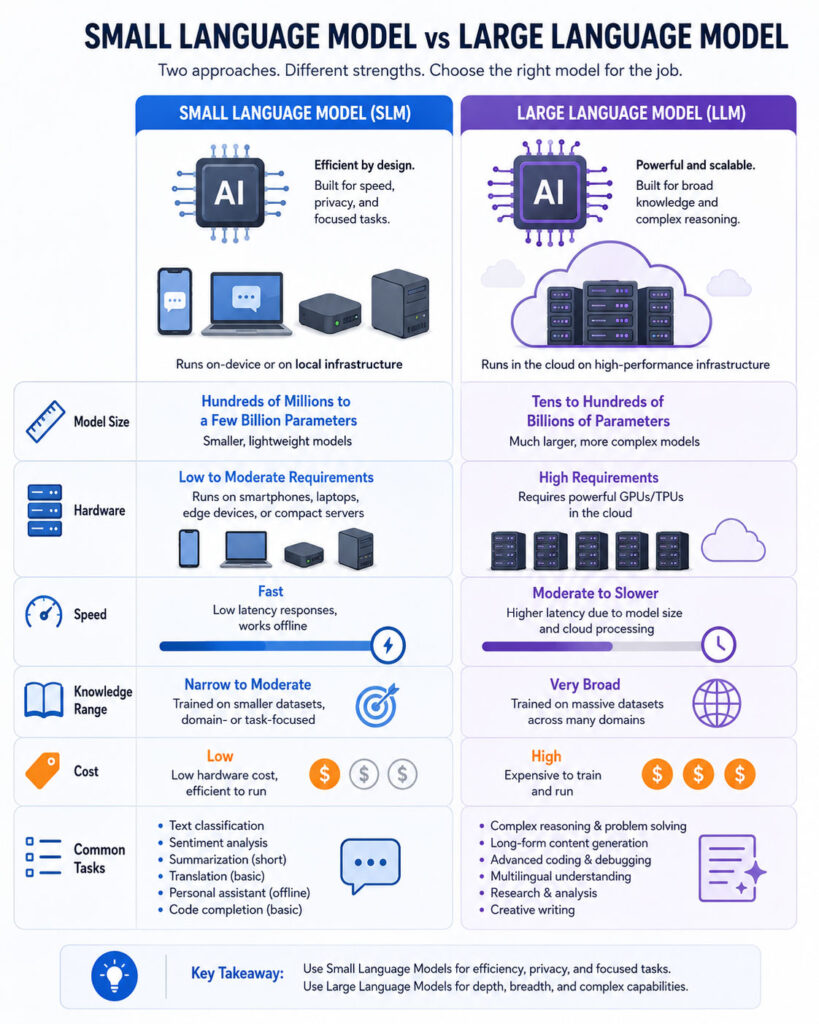
Choose a Small Language Model When Efficiency Matters
An SLM is a strong option when the task remains focused and expected inputs follow recognisable patterns. In these cases, a smaller model can reduce latency, hardware requirements, and operating cost without adding capabilities the application does not need.
Choose a Large Language Model for Broader Capabilities
An LLM is usually more appropriate when users can ask a wide range of questions or when tasks require broad knowledge, long-form generation, difficult reasoning, advanced coding, or flexible conversations.
Use a Hybrid SLM and LLM Approach
A hybrid architecture routes different requests to different models according to task complexity. Routine requests can go to an SLM, while difficult or uncertain cases move to an LLM.
For example, a small model could classify a support request and extract fields. If validation fails, the application can forward the request and required context to a larger model.
Model Cascades and Fallback Systems
A model cascade begins with the least expensive suitable option. The system accepts the result when it passes defined quality checks and escalates when validation fails.
This approach can reduce average cost while preserving stronger capabilities for the requests that actually need them.
Cloud, Private Server, or On-Device Deployment
Deployment location can matter as much as model size. A cloud API provides quick access to capable models without requiring dedicated AI hardware. Private hosting provides greater control but adds responsibility for scaling, updates, monitoring, and security.
On-device deployment reduces network dependence but requires careful management of storage, hardware compatibility, battery use, and model updates.
How to Evaluate an SLM or LLM
- Task success rate.
- Factual accuracy.
- Format reliability.
- Latency.
- Cost per successful task.
- Memory and processing requirements.
- Safety and permission compliance.
- Privacy and data movement.
- Fallback rate.
- User correction rate.
Common SLM vs LLM Mistakes
- Choosing the largest model without testing smaller alternatives.
- Selecting an SLM only because it costs less.
- Comparing models using parameter count alone.
- Relying only on public benchmarks.
- Testing with simple examples instead of real application data.
- Using AI for deterministic calculations or rules that normal code handles better.
- Using one model for every task when routing could improve efficiency.
Frequently Asked Questions
Are Small Language Models Less Accurate?
They may be less capable on broad or unfamiliar tasks, but a smaller model can provide strong accuracy when optimised for a focused workflow.
Can an SLM Run on a Smartphone?
Yes. Some compact and optimised language models can run on supported phones, tablets, laptops, and edge hardware.
Can an SLM Use RAG?
Yes. Retrieval can provide an SLM with current or organisation-specific information from documents and databases.
Can an SLM Replace an LLM?
It can for focused tasks that the smaller model completes reliably. However, broad conversations, difficult reasoning, and highly varied requests may still benefit from a larger model.
Choosing the Right Model for the Job
The SLM vs LLM comparison does not produce one universal winner. Small models offer efficiency, lower resource requirements, fast responses, and strong performance on focused tasks. Large models provide broader knowledge and stronger performance across complex or unpredictable requests.
For larger AI applications, a hybrid architecture can provide an effective balance by keeping routine work with the smaller model and escalating only when necessary.

AboutTPJ Technical Team
The Project Jugaad Technical Team creates practical, easy-to-follow content on software development, web technologies, artificial intelligence, cybersecurity, cloud platforms, and digital tools. Our articles are informed by more than 13 years of hands-on experience with .NET, Angular, SQL Server, AWS, WordPress, Linux hosting, application deployment, and real-world troubleshooting. Each guide is researched, reviewed, and updated to provide accurate, useful, and actionable information for developers, businesses, and everyday technology users.