
Artificial Intelligence
Multimodal AI allows an artificial intelligence system to process and connect more than one type of information. Instead of working only with written text, a multimodal model may analyse images, speech, music, video, documents, sensor readings, or other data within the same workflow.
This capability can make AI applications more useful because real-world information rarely appears in one format. For example, a customer may describe a damaged product in text and attach a photograph. Similarly, a doctor may review written notes alongside medical images, while a technician may ask a spoken question and point a camera at a machine.
However, combining several data types creates additional challenges. Each modality has its own structure, quality problems, privacy concerns, processing requirements, and potential failure modes. Therefore, a successful Multimodal AI system needs more than a model that simply accepts several file types.
Multimodal AI: Quick Answer
- Multimodal AI processes more than one data type, such as text, images, audio, and video.
- It connects information across modalities, such as answering a written question about an uploaded photograph.
- Some systems use one integrated model, while others connect several specialised models through an application pipeline.
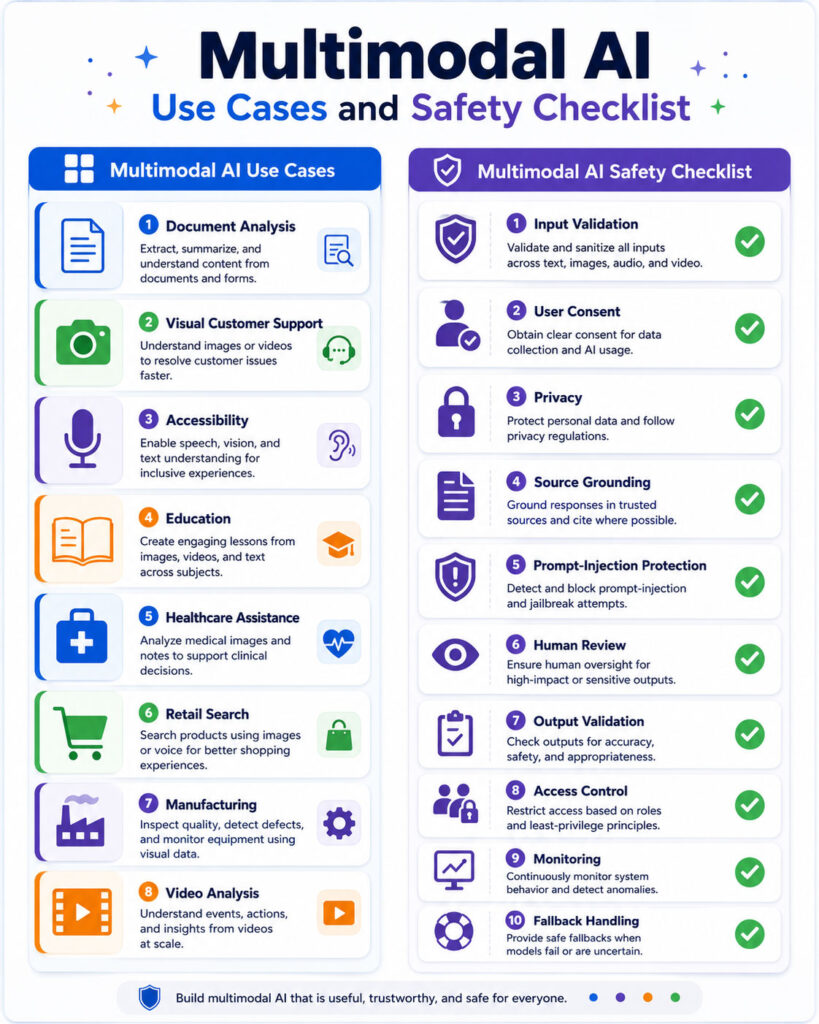
- Common uses include document analysis, visual search, accessibility, customer support, and video analysis.
- Multimodal output still requires validation because the system may misunderstand images, speech, context, or relationships between inputs.
- Security controls must cover every input channel, including hidden text, malicious files, manipulated media, and embedded instructions.
In practice, Multimodal AI provides the most value when combining several modalities reveals information that one input alone cannot provide reliably.
What Is a Modality?
A modality is a form or channel through which information is represented. In artificial intelligence, common modalities include:
- Written text.
- Images and graphics.
- Speech and general audio.
- Video.
- Computer code.
- Documents containing text, tables, and images.
- Depth and three-dimensional information.
- Thermal imagery.
- Location and motion signals.
- Medical scans and biological signals.
- Industrial and environmental sensor data.
Each modality has a different internal structure. For instance, text is commonly divided into tokens, whereas an image contains spatial pixel relationships.
Audio changes over time, while video combines visual frames with motion and often sound. Consequently, a multimodal system must transform these different formats into representations that it can compare, combine, or reason over.
What Is Multimodal AI?
Multimodal AI is an artificial intelligence approach that works with two or more modalities. The system may accept several input types, produce several output types, or perform both functions.
For example, an application may accept an image and a written question before returning a text answer. Another application may receive spoken instructions and generate an image.
Similarly, a document-processing system may analyse paragraphs, tables, signatures, diagrams, and layout information together.
The system becomes meaningfully multimodal when it connects information across those inputs. Simply running an unrelated speech recogniser and image classifier in the same application does not necessarily create integrated multimodal understanding.
Ultimately, the objective is to represent relationships between modalities. The phrase “red warning light” should connect with the relevant part of an image, while the sound of an alarm should connect with its visual and operational context.
Unimodal AI vs Multimodal AI
| Area | Unimodal AI | Multimodal AI |
|---|---|---|
| Input types | Usually one main data type | Two or more data types |
| Example input | Text only | Text with an image or video |
| Context | Limited to one modality | Connects evidence across modalities |
| Architecture | Often one specialised encoder or model | May use several encoders and fusion layers |
| Complexity | Usually lower | Usually higher |
| Testing | One primary input channel | Each channel and their interactions |
| Typical use | Text classification or image recognition | Visual question answering or video analysis |
A unimodal model may perform better on a narrow, specialised task. By contrast, Multimodal AI becomes useful when the application must interpret relationships that cross data types.
Multimodal Input and Multimodal Output
Multimodal input means that the system can receive several forms of information. For instance, a user may provide text, images, and audio in one request.
Multimodal output means that the system can produce different forms of content. It may return text, speech, images, structured data, or another supported format.
A system does not need both capabilities to qualify as multimodal. For example, an image-captioning model receives an image and produces text, so it already connects two modalities.
However, models that accept and generate several modalities can support richer interactions. A user may speak with an assistant while sharing a camera view and then receive spoken or visual guidance.
What Is a Multimodal Model?
A multimodal model is trained or designed to process relationships between several data types. It may contain separate components for each modality or use a more integrated architecture.
For example, an image encoder can transform a photograph into numerical features, while a language model processes a written question. Afterwards, a fusion mechanism allows the language component to use relevant visual information when generating an answer.
Some modern models are trained across large collections of paired or interleaved data. These collections may include images with captions, videos with transcripts, audio with labels, and documents containing text and visual layouts.
As a result, the model may learn to perform image description, visual question answering, cross-modal retrieval, document interpretation, and grounded content generation.
What Is Multimodal Machine Learning?
Multimodal machine learning is the broader research and engineering field concerned with learning from several information sources.
It includes problems such as:
- Representing different modalities.
- Aligning related information.
- Combining features.
- Handling missing inputs.
- Resolving conflicts between modalities.
- Generating one modality from another.
- Evaluating cross-modal understanding.
- Protecting systems from multimodal attacks.
Multimodal machine learning existed before today’s generative AI systems. Earlier applications combined video and audio for recognition, text and images for search, or sensor signals for robotics.
Nevertheless, modern foundation models have made these capabilities more accessible through general-purpose interfaces.
Why Multimodal AI Is Important
People naturally communicate through several channels. A spoken sentence contains words, tone, timing, volume, and surrounding visual context.
Likewise, a document can contain paragraphs, tables, diagrams, photographs, signatures, and layout information. Therefore, a text-only system may lose important evidence when meaning appears visually or acoustically.
Conversely, an image-only system may not understand the user’s written objective. Multimodal AI can combine these signals and provide a more complete interpretation.
In addition, it can reduce the amount of manual conversion required before a user interacts with an AI application.
However, additional modalities do not automatically guarantee better accuracy. Poor audio, misleading images, irrelevant files, or conflicting information can make a request harder rather than easier.
How Multimodal AI Processes Information
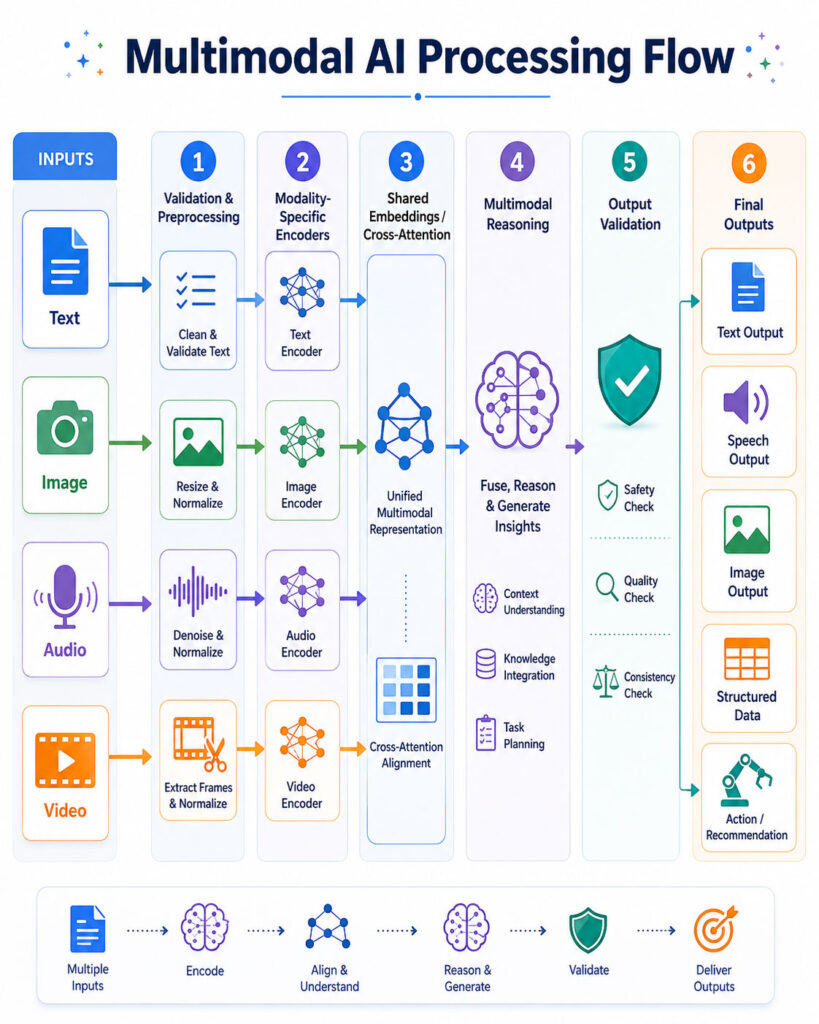
A simplified multimodal processing flow contains the following stages:
- The application receives text, images, audio, video, or another input.
- It validates the format, size, permissions, and security of each item.
- Pre-processing components prepare the input for the model.
- Encoders transform each modality into numerical representations.
- The system aligns or combines those representations.
- The model performs classification, retrieval, reasoning, or generation.
- Application rules validate the output.
- The result is returned as text, speech, an image, structured data, or an action.
The exact architecture varies by application. One system may use an integrated multimodal foundation model, whereas another may connect speech recognition, image processing, retrieval, and a language model through separate services.
What Is an Encoder?
An encoder converts raw information into a numerical representation that a machine-learning system can process.
A text encoder represents words or tokens. Meanwhile, an image encoder captures visual patterns such as shapes, objects, textures, and spatial relationships.
An audio encoder represents speech, sound, rhythm, or frequency patterns. Similarly, a video encoder must consider how frames change over time.
Therefore, video systems may process selected frames, temporal segments, motion features, audio tracks, or a combination of these inputs.
Multimodal models may use separate encoders for each modality and then map their outputs into a shared or connected representation space.
What Are Embeddings?
Embeddings are numerical vectors that represent important properties of an input. Related concepts can appear near one another in the embedding space even when they originate from different modalities.
For example, the written phrase “dog barking,” a photograph of a dog, and an audio recording of barking may receive representations that share related semantic information.
Multimodal embeddings can support:
- Searching images with text.
- Finding audio related to a photograph.
- Matching products across descriptions and pictures.
- Grouping similar media.
- Retrieving relevant video segments.
- Connecting sensor information with visual events.
However, embeddings mainly support representation and retrieval. They do not automatically provide reliable reasoning, complete factual knowledge, or proof that two items have the same meaning.
What Is Multimodal Alignment?
Multimodal alignment connects related content across different data types. It helps the model learn that a word, sound, object, and action may refer to the same underlying concept.
Training data can include paired items such as:
- An image and its caption.
- A video and its transcript.
- A spoken sentence and written transcription.
- A product photograph and description.
- A document page and extracted layout.
- A medical image and clinical report.
Good alignment allows the system to identify which part of one modality relates to another. By contrast, weak alignment can cause the model to mention an object that is not present or connect a spoken instruction to the wrong visual element.
What Is Multimodal Fusion?
Multimodal fusion is the process of combining information from different modalities. The point at which fusion occurs strongly affects system behaviour and complexity.
Common strategies include:
- Early fusion: Combines low-level or intermediate features before the main prediction stage.
- Late fusion: Allows specialised models to produce separate results and then combines their decisions.
- Intermediate fusion: Connects modality-specific representations through shared layers or attention mechanisms.
- Hybrid fusion: Uses several fusion methods at different stages.
No single strategy fits every task. Early fusion can capture detailed interactions, but it may require closely aligned inputs.
Late fusion, meanwhile, offers modularity and easier component replacement. However, it may lose subtle relationships between modalities.
Early Fusion
Early fusion combines information before each modality has completed independent processing. For example, aligned audio and visual features from the same time segment may be analysed together.
This approach can help when fine-grained interactions matter. Lip movement and speech audio, for instance, provide complementary timing information.
However, early fusion requires accurately aligned inputs. Missing frames, delayed audio, inconsistent sampling, or mismatched timestamps can therefore reduce performance.
Late Fusion
Late fusion allows specialised systems to analyse each modality independently. Afterwards, their predictions, confidence values, or structured outputs are combined.
For example, one system may analyse written customer feedback while another evaluates the tone of an audio call. A final component then combines both assessments.
Late fusion is generally easier to separate, test, and maintain. Nevertheless, it may fail to capture detailed connections, such as which spoken phrase relates to a specific area of a video frame.
Cross-Attention
Cross-attention allows information in one modality to focus on relevant information from another modality.
When answering a question about an image, the language component can attend to visual features related to the requested object, colour, location, or action.
As a result, cross-attention can support more precise interaction than combining one general image summary with a written prompt.
However, its reliability still depends on the visual encoder, alignment quality, training data, and the clarity of the input.
Multimodal AI Architecture Comparison
| Architecture | How It Works | Common Strength | Common Limitation |
|---|---|---|---|
| Specialised pipeline | Connects separate text, image, audio, or video models | Modular and controllable | Can lose cross-modal context |
| Shared embedding model | Maps several modalities into one related vector space | Cross-modal search and retrieval | Does not guarantee deep reasoning |
| Vision-language model | Combines image or video processing with language generation | Visual questions and descriptions | May miss fine visual details |
| Natively multimodal model | Learns across several modalities within an integrated system | Natural cross-modal interaction | Complex training and evaluation |
| Late-fusion ensemble | Combines outputs from independent models | Easy component replacement | Limited detailed alignment |
Ultimately, the best Multimodal AI architecture depends on the required modalities, task accuracy, latency, privacy, cost, data availability, and level of control.
Text in Multimodal AI
Text often provides the user’s objective, instructions, context, or desired output format. It can also represent transcripts, extracted document content, metadata, labels, and retrieved knowledge.
Language models can connect written instructions with other modalities. For example, a user can ask the system to identify an error in a screenshot or summarise the main events shown in a video.
However, text may contain ambiguous, misleading, or malicious instructions. Therefore, the system must separate trusted application rules from user content and text extracted from files.
Images in Multimodal AI
Images provide visual information about objects, scenes, colours, spatial relationships, diagrams, interfaces, and documents.
A multimodal model may answer questions about a photograph, extract information from a receipt, interpret a chart, compare products, or describe an interface.
Nevertheless, visual understanding remains imperfect. Small text, crowded scenes, unusual angles, reflections, hidden objects, low resolution, and detailed counting tasks can all cause errors.
Therefore, applications should request clearer images or use specialised computer-vision tools when precise measurement or detection is required.
Audio in Multimodal AI
Audio includes spoken language, music, environmental sounds, alarms, emotional cues, silence, and background noise.
A multimodal system may transcribe speech, identify speakers, detect sound events, combine tone with words, or answer questions about a recording.
Speech recognition converts spoken content into text. However, a transcript may lose tone, timing, overlapping speech, and non-verbal sounds.
Therefore, a system that processes the original audio can retain more information than one that analyses only a transcript.
Nevertheless, accents, weak microphones, echoes, background conversations, and compressed recordings can reduce accuracy. Sensitive audio also creates significant privacy and consent concerns.
Video in Multimodal AI
Video combines a sequence of images over time and may include audio, subtitles, metadata, and scene transitions.
Multimodal AI can use video to identify actions, summarise events, answer questions, locate important moments, generate captions, or monitor processes.
However, video processing is computationally expensive because even a short clip may contain hundreds or thousands of frames.
As a result, systems often sample selected frames or divide the video into smaller segments.
This sampling can miss brief events. Therefore, applications requiring precise incident detection should use appropriate frame rates, timestamps, specialised models, and independent validation.
Understanding Time and Sequence
Temporal understanding refers to how events unfold over time. It is essential for audio, video, conversations, and sensor streams.
For instance, a system should distinguish between “the person opened the door and then dropped the package” and “the person dropped the package before opening the door.”
However, models may struggle with long videos, repeated actions, subtle changes, or events separated by several minutes.
In addition, summaries can incorrectly combine unrelated moments. Therefore, applications should preserve timestamps and allow users to inspect the source segment supporting an important conclusion.
Documents as Multimodal Inputs
A document is often multimodal even when it appears to be mainly text. Its meaning may depend on layout, headings, columns, tables, charts, signatures, stamps, images, and handwritten notes.
Plain text extraction can lose these relationships. For example, a value may become separated from its table heading, while a footnote may appear in the wrong position.
Multimodal document analysis can instead consider the page image, extracted text, coordinates, and structural elements together.
Consequently, this approach is useful for invoices, receipts, application forms, contracts, insurance documents, reports, research papers, and identification records.
Optical Character Recognition and Multimodal AI
Optical character recognition, commonly called OCR, converts text within an image or scanned page into machine-readable characters.
OCR can support a multimodal workflow. However, it may misread handwriting, small text, unusual fonts, low-contrast scans, rotated pages, or damaged documents.
A language model may then produce a confident interpretation even when the OCR output contains errors. Therefore, important fields should retain coordinates, confidence information, and links to the original page region.
For financial, legal, medical, or identity documents, validation rules and human review may also be necessary.
Charts, Graphs, and Diagrams
Charts combine visual position, colour, labels, legends, axes, and numerical values. Therefore, understanding them requires more than extracting visible words.
A multimodal model may describe a trend, compare categories, or answer a question about a diagram.
However, it can misread an axis, overlook a legend, confuse colours, or estimate a value incorrectly.
When accurate numbers matter, provide the underlying structured data whenever possible. The model can then use the visual for context and the data for calculation.
Consequently, users should not rely on visual estimation for financial, scientific, or operational decisions that require exact figures.
Code and User Interfaces
Multimodal AI can analyse screenshots of websites, mobile applications, error messages, dashboards, and development tools.
For example, a developer may provide a screenshot and ask why an element is misaligned. Similarly, a support user may upload an error dialog and request troubleshooting steps.
The system can connect visible interface information with written instructions and code. However, a screenshot does not reveal hidden HTML, CSS, JavaScript state, network calls, logs, or backend behaviour.
Therefore, reliable debugging usually requires source code, browser-console messages, device details, and reproduction steps alongside the image.
Multimodal AI for Search
Multimodal search allows users to search through one modality while retrieving content stored in another.
Examples include:
- Searching a product catalogue with a photograph.
- Finding a video by describing an action.
- Locating an audio clip with a text query.
- Finding visually similar designs.
- Searching scanned documents by content and layout.
- Retrieving images that match a spoken request.
Shared embeddings can make cross-modal retrieval possible by representing related concepts in a comparable numerical space.
However, the quality of the result still depends on the embedding model, stored metadata, indexing method, and suitability of the training data.
Multimodal Retrieval-Augmented Generation
Retrieval-augmented generation can retrieve relevant text, images, document pages, tables, or video segments before a model generates an answer.
A multimodal retrieval workflow may:
- Receive a written or visual question.
- Create a search representation.
- Retrieve related text and media.
- Provide selected evidence to the model.
- Generate an answer grounded in that evidence.
- Return references to the original sources.
This approach can improve access to organisation-specific information. Nevertheless, poor retrieval may supply irrelevant or malicious content.
Moreover, the model may still misinterpret correct evidence. Therefore, important responses require source references and output validation.
Multimodal AI Use Cases
| Use Case | Modalities | Possible Result |
|---|---|---|
| Document processing | Text, page images, tables, and layout | Extracted and validated structured data |
| Visual customer support | Text, voice, photograph, and video | Troubleshooting guidance |
| Accessibility assistant | Camera, text, and audio | Scene description or spoken guidance |
| Medical decision support | Clinical text, scans, and measurements | Prioritisation or review assistance |
| Retail search | Product image and text | Similar or matching products |
| Video analysis | Frames, audio, and transcript | Summary, event detection, or search |
| Manufacturing support | Camera, sensor data, and maintenance text | Fault detection or repair guidance |
| Education | Text, diagram, handwriting, and speech | Interactive explanation and feedback |
| Content moderation | Text, image, audio, and video | Risk classification and review routing |
| Creative tools | Text, sketch, image, and audio | Generated or edited media |
Multimodal AI for Customer Support
A customer can describe a problem, upload a photograph, and share an error message. The system can then combine those inputs with product documentation and account information.
As a result, support agents may understand the issue more quickly and avoid repeating basic questions.
However, the AI should not independently approve refunds, warranty claims, account changes, or safety-critical repairs.
Instead, application rules should determine which actions require authorization or human approval.
The response should also distinguish between general suggestions and verified instructions for a specific product.
Multimodal AI for Accessibility
Multimodal applications can describe scenes, read text aloud, generate captions, interpret visual interfaces, and convert speech into written content.
In addition, they allow users to interact through the modality that best suits their needs. A person may speak instead of typing or receive an audio description instead of relying on an image.
However, inaccurate descriptions can create confusion or physical risk. Therefore, accessibility tools should communicate uncertainty, support correction, and preserve alternative non-AI methods.
Most importantly, developers should test these features with the people who will actually use them.
Multimodal AI in Education
A learner may provide a written question, photograph of handwritten work, diagram, or spoken explanation.
The system can then respond with guidance based on the combined input. For example, it may identify where a mathematical process went wrong without immediately revealing the final answer.
However, handwriting recognition, diagram interpretation, and subject reasoning can all fail.
Therefore, educational applications should encourage verification and teach learners how to assess AI-generated feedback.
Privacy controls are especially important when the system processes information from children or educational records.
Multimodal AI in Healthcare
Healthcare information can include clinical notes, medical images, laboratory values, recorded speech, waveforms, and patient history.
Multimodal systems may help organise records, identify information requiring review, support documentation, or assist qualified professionals.
Nevertheless, a general-purpose model should not be treated as an independent diagnostic authority.
Errors may result from incomplete context, population bias, low-quality images, unusual conditions, or incorrect data alignment.
Therefore, healthcare applications require clinical validation, privacy protection, access control, auditability, regulatory review, and human accountability.
Multimodal AI in Retail and E-Commerce
A shopper can upload a photograph and search for visually similar products. The system may combine colour, shape, material, text descriptions, inventory, and user preferences.
Multimodal models can also generate product descriptions, classify catalogue images, identify missing information, and support visual customer queries.
However, product recommendations should use verified pricing, availability, size, and specification data from the commerce system.
In other words, the system should not infer critical commercial details from an image alone.
Multimodal AI in Manufacturing
Industrial systems can combine camera images, vibration signals, temperature readings, maintenance records, and operator descriptions.
As a result, they may support anomaly detection, quality inspection, maintenance prioritisation, and troubleshooting.
Nevertheless, an AI-generated suggestion should not bypass safety procedures or equipment permissions.
Physical actions require deterministic controls and qualified review. Furthermore, systems should preserve the source sensor data and evidence used to create an alert.
Multimodal AI in Vehicles and Robotics
Robots and vehicles can combine cameras, microphones, depth information, radar, maps, location, movement, and spoken instructions.
Several modalities can improve environmental awareness because one sensor may provide information that another misses.
However, sensor disagreement, obstruction, poor lighting, weather, timing errors, and adversarial manipulation can create dangerous interpretations.
Therefore, safety-critical control should rely on validated perception and control systems rather than unrestricted generative responses.
Multimodal AI for Media and Entertainment
Media workflows can use scripts, transcripts, video frames, music, sound effects, subtitles, and metadata.
Multimodal AI can support search, editing, captioning, translation, highlight creation, content classification, and accessibility.
However, generated or edited media also raises copyright, identity, consent, and authenticity concerns.
Consequently, organisations should retain source records and disclose generated content where required.
Multimodal Content Generation
A multimodal generative system can use one type of content to create another. Examples include:
- Generating an image from text.
- Creating a written description from an image.
- Producing speech from text.
- Generating a transcript from audio.
- Creating video from a prompt or reference image.
- Adding sound effects to video.
- Editing an image through written instructions.
- Generating structured data from a scanned document.
Nevertheless, generated output should be reviewed for accuracy, ownership, safety, identity misuse, and disclosure requirements.
Benefits of Multimodal AI
- More natural user interaction.
- Richer context than one modality provides.
- Improved search across media types.
- Reduced manual transcription and data entry.
- Better support for accessibility features.
- More useful document and media analysis.
- Flexible input methods for mobile and field users.
- Ability to connect visual, spoken, and written evidence.
- Support for cross-modal generation and editing.
- Potentially stronger results when modalities provide complementary information.
Limitations of Multimodal AI
- Higher computational and storage requirements.
- More complicated data collection and training.
- Difficulty aligning information correctly.
- Errors within each modality can accumulate.
- Weak understanding of fine visual or temporal details.
- Privacy concerns across cameras, microphones, and documents.
- Limited explainability for cross-modal decisions.
- More complex testing and monitoring.
- Increased security attack surface.
- Dependence on representative multimodal data.
Multimodal Hallucinations
A multimodal hallucination occurs when the system generates information that is unsupported by the provided text, image, audio, video, or retrieved evidence.
Examples include:
- Describing an object that is not visible.
- Reading text that does not appear in the image.
- Assigning a spoken statement to the wrong person.
- Inventing a video event that did not occur.
- Reporting a chart value incorrectly.
- Connecting unrelated information across two documents.
The presence of an image or video does not automatically ground an AI response.
Therefore, the application should preserve supporting evidence and independently validate important claims.
Multimodal AI Security Risks
Every supported modality creates another input channel that attackers may manipulate. Therefore, security controls designed only for written prompts may not detect instructions hidden inside images, audio, documents, or video.
A malicious file may contain embedded text that tells the model to ignore the user’s request, reveal information, call a tool, or perform an unauthorised action.
The model may interpret that content as an instruction even though the application intended it to be untrusted data.
Consequently, applications must treat uploaded and retrieved content as untrusted unless it comes from a controlled source and has a clearly defined role.
Multimodal Prompt Injection
Multimodal prompt injection places manipulative instructions inside non-text content or extracted information.
Examples include:
- Instructions written in small text within an image.
- Hidden or low-contrast text on a document page.
- Malicious text inside a screenshot.
- Spoken instructions within an audio file.
- Subtitles or video frames containing adversarial content.
- Instructions embedded in retrieved PDF documents.
- Metadata or filenames designed to influence the workflow.
Therefore, content-derived instructions must never override application policies, user permissions, or business rules.
Protecting Against Multimodal Prompt Injection
- Separate trusted instructions from untrusted content.
- Do not allow uploaded files to define application permissions.
- Use deterministic authorization outside the model.
- Restrict available tools and data sources.
- Validate proposed actions before execution.
- Require confirmation for sensitive operations.
- Scan and sanitise supported file types.
- Limit file size, page count, duration, and resolution.
- Use isolated processing environments.
- Record tool requests and security decisions.
- Test instructions hidden across every supported modality.
- Provide safe failure behaviour when content is suspicious.
File Upload Security
A multimodal application may accept images, audio, video, archives, and complex documents. Each format can contain malformed data, excessive resource requirements, embedded scripts, or parser vulnerabilities.
Therefore, applications should apply controls such as:
- Allowlisted file types.
- Server-side content-type verification.
- Maximum file size and duration.
- Malware scanning.
- Safe file-name generation.
- Metadata removal where appropriate.
- Isolated conversion and thumbnail generation.
- Processing timeouts.
- Page, frame, and pixel limits.
- Restricted storage permissions.
In particular, a file should not be trusted merely because its extension appears valid.
Privacy and Consent
Images, voice recordings, video, documents, and location data can reveal sensitive information about users and other people who did not directly interact with the application.
For example, a photograph may reveal faces, addresses, vehicle numbers, computer screens, medical details, or confidential documents.
Similarly, an audio recording may include background conversations and identifiable voices.
Therefore, applications should clearly explain which information is processed, where it is sent, how long it is retained, and whether it is reused for another purpose.
Moreover, the application should collect only the modalities necessary for the requested feature. A text question should not automatically activate a camera or microphone.
Biometric and Identity Risks
Faces, voices, movement patterns, and other biological characteristics may become biometric identifiers depending on how an application uses them.
Identity matching and emotion inference can create legal, ethical, and accuracy concerns.
Furthermore, performance may vary across populations, environments, accents, lighting conditions, camera quality, and health conditions.
Therefore, systems should not infer identity, health, intent, or protected personal characteristics without a legitimate purpose, suitable evidence, consent, and applicable safeguards.
Deepfakes and Synthetic Media
Multimodal generation can create realistic images, speech, and video.
These tools support creative work, accessibility, education, and entertainment. However, they can also enable impersonation, fraud, and misinformation.
Organisations should therefore consider:
- Consent from represented individuals.
- Disclosure of generated or edited content.
- Watermarking or provenance information where available.
- Restrictions on impersonation.
- Protection of voice and image samples.
- Review of high-risk publishing workflows.
- Incident handling for fraudulent content.
Detection tools can help, but they should not be treated as perfect proof that media is authentic or synthetic.
Bias Across Modalities
Bias can enter through text, images, audio, video, labels, and data-collection processes.
For instance, an image model may perform differently across lighting conditions or skin tones. Speech recognition may also vary across languages, accents, ages, noise levels, or disabilities.
When several modalities are combined, one biased signal may influence the final result even when another modality provides conflicting evidence.
Therefore, evaluation should include representative users, devices, environments, languages, and content types.
Conflicting Multimodal Information
Different modalities can contradict one another. For example, a photograph may show one product while the written description identifies another.
Likewise, a transcript may not match the audio, or a video timestamp may conflict with metadata.
The system should not silently choose one source without a defined rule. Instead, it may:
- Ask the user to clarify.
- Report the conflict explicitly.
- Prefer an authoritative structured source.
- Use confidence thresholds.
- Send the case for human review.
- Return evidence from each modality separately.
Conflicting information is especially important in legal, financial, medical, and security workflows.
Missing Modalities
A production system must handle incomplete input. A user may upload an image without text, provide audio without a transcript, or submit a document with missing pages.
Therefore, the architecture should define which modalities are required and which remain optional.
When a modality is missing, the system can request it, continue with reduced capability, or route the task to another process.
However, it should never fabricate information that would normally come from the missing input.
Multimodal AI Evaluation
Evaluating Multimodal AI requires testing each modality and the interactions between them.
A model may answer written questions well and identify objects accurately. Nevertheless, it may fail when it must connect a particular question with one region of an image.
Therefore, evaluation should include:
- Text-only inputs.
- Image-only inputs.
- Audio-only inputs.
- Video-only inputs.
- Correct multimodal combinations.
- Irrelevant additional inputs.
- Conflicting inputs.
- Missing inputs.
- Low-quality media.
- Adversarial and malicious content.
- Unusual layouts and languages.
- Real application tasks.
Measure Task Success
Generic benchmarks can help compare models. However, production decisions should use business-specific tasks.
Possible measurements include:
- Correct fields extracted from documents.
- Relevant products returned by visual search.
- Accurate time segments found in video.
- Support cases resolved correctly.
- Unsafe actions prevented.
- Human corrections required.
- Processing latency.
- Cost per successful request.
- Performance across user groups.
- Failures caused by missing or conflicting modalities.
A fluent response should not count as success when the underlying conclusion is incorrect.
Grounding and Evidence
Important multimodal answers should link back to supporting evidence.
For a document, this evidence may include the page number and bounding box. For video, it may include timestamps, while audio evidence may include the relevant transcript segment.
Grounding helps users verify the response and identify incorrect interpretations.
However, a reference does not prove that the model interpreted the source correctly. Therefore, users should still inspect the evidence before making high-impact decisions.
Human Review
Human review is valuable when the system handles ambiguous, sensitive, unusual, or high-impact information.
Reviewers should receive the original evidence, model output, confidence or validation signals, and a clear method for correcting the result.
However, human review should not become a meaningless approval click.
Instead, the interface must make errors visible and provide enough context for an informed decision.
Choosing a Multimodal AI Model
Begin with the application requirement rather than selecting the model with the longest list of supported file types.
Consider:
- Required input and output modalities.
- Accuracy on the actual task.
- Supported file formats and limits.
- Language support.
- Audio and video duration.
- Image resolution and document page limits.
- Latency requirements.
- Data-retention and privacy controls.
- Regional processing requirements.
- Tool and structured-output support.
- Cost per successful workflow.
- Model-version stability.
- Safety controls and monitoring.
- On-device, private, or cloud deployment options.
Ultimately, the most capable model is not always the most appropriate model for the application.
Integrated Model vs Specialised Pipeline
An integrated multimodal model can simplify interaction because one model handles several input types and their relationships.
A specialised pipeline, by contrast, can provide greater control.
For example, an application may use a dedicated OCR engine, speech-recognition model, object detector, retrieval system, and language model.
Use an integrated model when flexible cross-modal reasoning matters. However, use specialised components when a task requires precise, measurable, efficient, and replaceable processing.
In practice, many production systems combine both approaches.
Example Multimodal Application Pipeline
- The user uploads an equipment photograph and describes the problem.
- The application verifies the file and removes unnecessary metadata.
- A vision component detects the equipment and visible warning indicators.
- OCR extracts a model number and error code.
- A retrieval system finds the correct maintenance manual.
- A multimodal model connects the image, user description, and documentation.
- Deterministic rules remove instructions that exceed the user’s permission level.
- The application returns suggested checks with supporting manual references.
- A qualified technician approves any safety-critical action.
This workflow does not depend on one model for every responsibility.
Instead, it combines specialised extraction, retrieval, multimodal interpretation, and application-level safety controls.
Structured Multimodal Output
Applications often need structured data instead of an unrestricted paragraph.
A document-analysis result may follow a schema such as:
{
"documentType": "invoice",
"invoiceNumber": "INV-1042",
"invoiceDate": "2026-06-15",
"currency": "INR",
"total": 12850,
"sourcePage": 1,
"requiresReview": false
}
The application should validate data types, required fields, ranges, totals, dates, and source references before saving the result.
However, a valid JSON structure does not guarantee that the extracted values are correct.
Latency and Cost
Multimodal inputs can be more expensive to process than short text prompts.
Large images, long audio recordings, and high-resolution video increase upload time, storage, preprocessing, and model workload.
Therefore, teams can reduce unnecessary cost by:
- Resizing images appropriately.
- Compressing media without removing required detail.
- Limiting video duration.
- Sampling frames according to the task.
- Removing irrelevant document pages.
- Using a smaller model for classification or routing.
- Caching stable results.
- Retrieving only relevant media segments.
- Sending structured data instead of repeated screenshots where possible.
Nevertheless, optimisation should not remove evidence required for an accurate result.
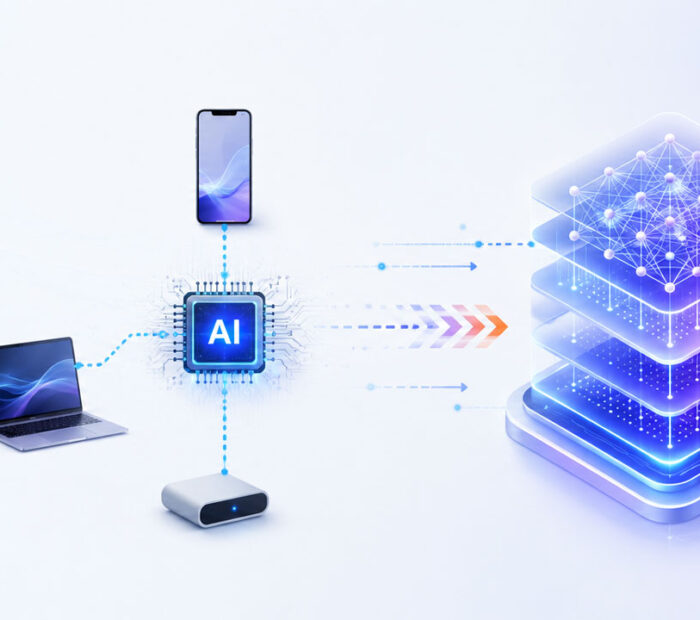
On-Device vs Cloud Multimodal AI
On-device processing can improve privacy, offline availability, and response time for tasks such as speech recognition, image classification, and camera effects.
Cloud processing, meanwhile, can support larger models, longer videos, broader knowledge, and more computationally demanding workflows.
A hybrid system may perform initial filtering, transcription, redaction, or detection on the device before sending selected information to a cloud model.
Therefore, users should understand when their media leaves the device and which cloud services process it.
Monitoring Multimodal AI
Production monitoring should include more than response time and server errors.
Teams should track:
- Requests by modality.
- Unsupported file types.
- Upload and preprocessing failures.
- OCR and transcription quality.
- Input duration and dimensions.
- Output validation failures.
- Human correction rates.
- Prompt-injection detections.
- Unsafe tool requests.
- Latency and cost by workflow.
- Model and component versions.
- Performance across languages and devices.
However, applications should avoid storing complete private media merely to create operational dashboards.
Multimodal AI Implementation Checklist
- Define why several modalities are necessary.
- List required and optional inputs.
- Choose integrated or specialised components.
- Validate every uploaded file.
- Define privacy, consent, and retention rules.
- Separate trusted instructions from untrusted content.
- Restrict tools and external actions.
- Preserve source references and timestamps.
- Test missing and conflicting inputs.
- Evaluate low-quality and adversarial media.
- Validate structured output.
- Provide human review for high-impact cases.
- Measure cost per successful task.
- Monitor quality by modality.
- Prepare fallback behaviour.
- Document model and data limitations.
Common Multimodal AI Mistakes
- Adding image or audio support without a useful requirement.
- Assuming more input automatically creates better accuracy.
- Trusting OCR or transcription without validation.
- Sending full videos when a short segment is sufficient.
- Ignoring alignment between frames, speech, and timestamps.
- Treating uploaded content as trusted instructions.
- Allowing a model to execute sensitive actions directly.
- Collecting camera or microphone data without clear consent.
- Failing to test missing or conflicting modalities.
- Using general-purpose vision for precise measurement.
- Assuming a cited image region proves the conclusion.
- Storing sensitive media longer than necessary.
- Using one accuracy score for every modality.
- Failing to support human correction.
- Selecting a model only because it supports more file types.
Is Multimodal AI the Same as Generative AI?
No. Multimodal describes the types of information a system processes or produces, whereas generative AI describes a system that creates new content.
For example, a multimodal classifier may analyse text and images without generating content.
Conversely, a text-only language model may generate content without being multimodal.
However, many modern systems are both generative and multimodal.
Is a Vision-Language Model Multimodal?
Yes. A vision-language model connects visual and textual information.
For example, it may caption images, answer questions, compare visual content, or follow image-related instructions.
However, not every vision-language model supports audio, video, or non-text output.
Can Multimodal AI Understand Video?
Yes. Supported systems can analyse selected frames, audio, transcripts, and temporal relationships.
However, long videos, brief events, fine movement, and precise counting remain challenging.
Therefore, applications should preserve timestamps and verify important observations.
Can Multimodal AI Read Documents?
Yes. It can analyse page images, extracted text, layouts, tables, charts, and other document elements.
Nevertheless, scans, handwriting, complex tables, missing pages, and OCR errors can reduce reliability.
Therefore, important fields should be validated against the original document.
Does Multimodal AI Replace OCR?
Not always. A multimodal model can read visible text, but a specialised OCR system may provide better coordinates, confidence values, throughput, and consistency for large document-processing workloads.
Consequently, many applications use OCR together with a multimodal model.
Is Multimodal AI More Accurate?
It can be more accurate when several modalities provide complementary evidence.
For example, an image can clarify a written description. However, irrelevant, poor-quality, or conflicting inputs can reduce accuracy.
Therefore, performance depends on the task, model, data, architecture, and validation process.
Can Multimodal AI Work Offline?
Compact multimodal models can run on supported local devices for selected tasks.
However, capability depends on model size, memory, battery, hardware, and software support.
Consequently, large or complex multimodal workloads commonly use cloud infrastructure.
What Is Multimodal RAG?
Multimodal retrieval-augmented generation retrieves evidence such as text, images, document pages, or video segments before generating an answer.
This approach can ground responses in organisation-specific information.
However, both retrieval and interpretation still require evaluation.
What Is the Biggest Risk of Multimodal AI?
There is no single universal risk.
Important concerns include incorrect interpretation, private-media exposure, malicious embedded instructions, biased results, unsafe actions, and synthetic-media misuse.
Therefore, the most serious risk depends on the application and the consequences of an incorrect result.
Will Multimodal AI Replace Specialised Models?
Multimodal foundation models may replace some disconnected workflows.
Nevertheless, specialised models will remain useful for tasks requiring efficiency, precision, predictable output, local operation, or regulatory validation.
As a result, production systems will often combine general multimodal reasoning with specialised components.
Final Verdict: Multimodal AI
Multimodal AI allows artificial intelligence systems to connect text, images, audio, video, documents, and other forms of information. Therefore, it can create more natural interactions and provide context that a single modality cannot deliver.
The technology supports document analysis, visual search, accessibility, education, customer support, healthcare assistance, manufacturing, media processing, and creative tools.
However, every additional modality increases processing, privacy, security, and evaluation requirements.
Choose Multimodal AI when the application genuinely needs to connect evidence across data types. By contrast, use specialised models when a narrow task requires greater precision, efficiency, or control.
Finally, protect the complete workflow rather than trusting the model alone. Validate inputs, separate untrusted content from instructions, preserve supporting evidence, restrict sensitive actions, test every modality, and include human review where mistakes could cause meaningful harm.
AboutTPJ Technical Team
The Project Jugaad Technical Team creates practical, easy-to-follow content on software development, web technologies, artificial intelligence, cybersecurity, cloud platforms, and digital tools. Our articles are informed by more than 13 years of hands-on experience with .NET, Angular, SQL Server, AWS, WordPress, Linux hosting, application deployment, and real-world troubleshooting. Each guide is researched, reviewed, and updated to provide accurate, useful, and actionable information for developers, businesses, and everyday technology users.