
Artificial Intelligence
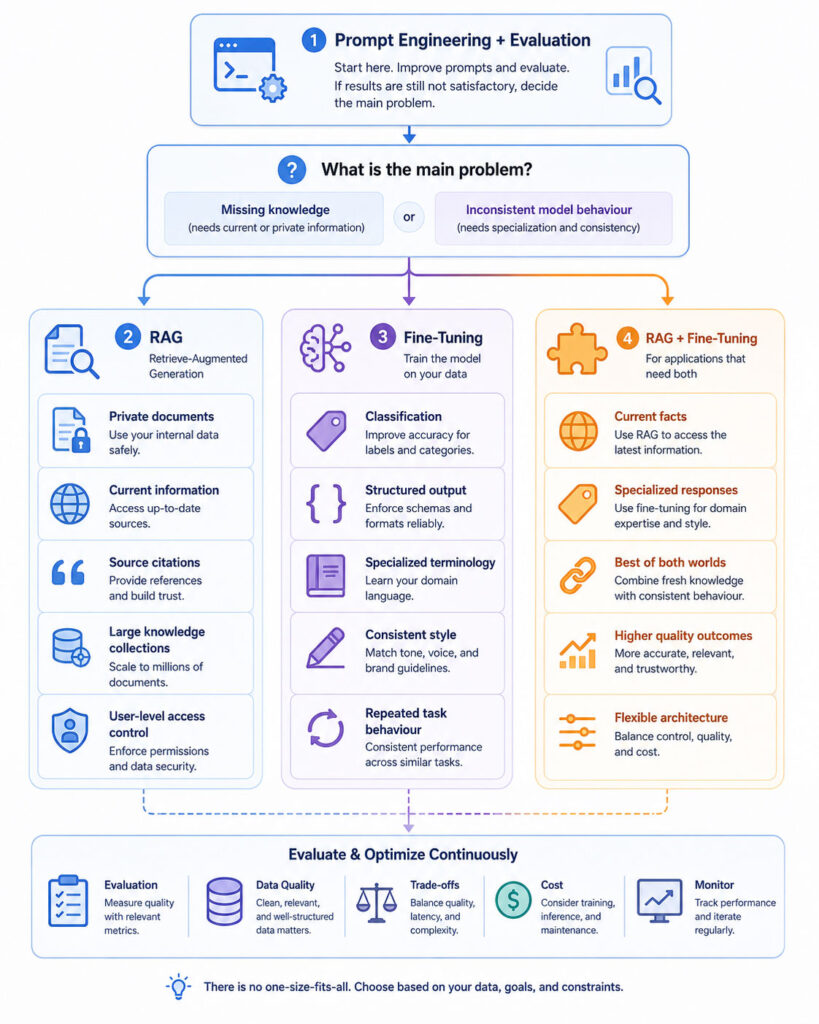
RAG vs Fine-Tuning is one of the most important decisions when building an artificial intelligence application around a large language model.
Although both approaches can improve a general-purpose model, they solve different problems. RAG gives the model relevant external information when a user submits a request. Fine-tuning, by contrast, trains the model with examples so that it follows a desired behaviour more consistently.
Therefore, RAG is usually better when an application needs current, private, or frequently changing knowledge. Meanwhile, fine-tuning is more suitable when the model must learn a response style, output format, classification task, or specialised workflow.
What Is Retrieval-Augmented Generation?
Retrieval-Augmented Generation is an architecture that combines information retrieval with a generative AI model.
Instead of asking the model to answer only from its pretrained knowledge, the application first searches an external source. Afterwards, it sends the most relevant information to the model as additional context.
User question
      ↓
Search external knowledge
      ↓
Retrieve relevant information
      ↓
Add information to the model prompt
      ↓
Generate a grounded response
The external knowledge may come from:
- Company policies.
- Product documentation.
- Customer-support articles.
- Web pages.
- PDF files.
- Database records.
- Source-code repositories.
- Knowledge-management platforms.
- Frequently updated business data.
As a result, the model can answer questions about information that was not included in its original training data.
Simple RAG Example
Consider an employee who asks an internal AI assistant:
How many paid leave days can a new employee use
during the first year?
A general model may not know the organisation’s current leave policy. Therefore, a RAG application can search the latest human-resources documents, retrieve the relevant policy section, and provide it to the model.
Employee question
      ↓
Search current HR documents
      ↓
Retrieve leave-policy section
      ↓
Generate an answer from the retrieved policy
      ↓
Show the source document
When designed correctly, the answer remains connected to an authoritative source instead of depending on an outdated assumption. In addition, the application can show the supporting document so that the employee can verify the response.
What Is Fine-Tuning?
Fine-tuning continues the training of a pretrained model by using a smaller, task-specific dataset.
During training, examples demonstrate how the model should respond to particular inputs. Consequently, the process adjusts model parameters so that the desired response patterns become more likely.
A supervised fine-tuning dataset often contains input-and-output pairs:
Input:
Classify this request:
"My invoice includes an incorrect tax amount."

Expected Output:
{
"category": "billing",
"subCategory": "tax_error",
"priority": "medium"
}
After learning from many high-quality examples, the fine-tuned model may produce the required structure more consistently than the original model.
Common Fine-Tuning Goals
Fine-tuning can help a model:
- Follow a specialised response format.
- Classify text into business-specific categories.
- Use a particular writing style or tone.
- Apply domain terminology consistently.
- Extract structured information from unstructured text.
- Respond according to demonstrated business rules.
- Handle recurring task patterns more reliably.
- Use shorter prompts while maintaining the desired behaviour.
However, fine-tuning should not be treated as the main method for inserting frequently changing facts into a model. Instead, changing information should usually remain in an authoritative external source.
Simple Fine-Tuning Example
Suppose a support system must classify every customer message into one of twelve internal categories.
Initially, a general model may perform reasonably with a detailed prompt and several examples. Nevertheless, output consistency may vary across thousands of requests.
To improve reliability, the team can create a training dataset containing representative customer messages and their approved categories.
Customer message → Approved category
Customer message → Approved category
Customer message → Approved category
Customer message → Approved category
Once tuned, the model can apply the organisation’s category definitions more consistently. Even so, the application should continue validating the returned category before using it in a business workflow.
RAG vs Fine-Tuning: Quick Comparison
| Point | RAG | Fine-Tuning |
|---|---|---|
| Main Goal | Provide relevant external knowledge at request time | Change or improve model behaviour for a task |
| Model Parameters | Normally remain unchanged | Are adjusted during training |
| Knowledge Freshness | Can use current and frequently updated data | Reflects the training dataset until the model is tuned again |
| Private Data | Retrieves authorised information when needed | Uses selected data during the training process |
| Source Citations | Can return links or references to retrieved sources | Does not naturally identify which training example supports an answer |
| Data Requirement | Needs useful documents and an effective retrieval system | Needs high-quality representative training examples |
| Best For | Knowledge assistants, document search, policies, products, and current facts | Classification, style, structured output, terminology, and task consistency |
| Main Failure | Retrieves irrelevant, incomplete, or unsafe context | Learns poor patterns, overfits, or performs inconsistently outside training coverage |
| Updating | Update the knowledge source or index | Prepare data and run another tuning process |
The two approaches are not competitors in every situation. In fact, many production systems combine them because each one addresses a different limitation.
The Main Difference: Knowledge vs Behaviour
The easiest way to compare RAG and fine-tuning is to separate knowledge from behaviour.
Use RAG when the model needs access to information such as:
- Current product prices.
- Latest company policies.
- Private technical documentation.
- Frequently changing regulations.
- Customer-specific records.
- Recent support incidents.
By contrast, use fine-tuning when the model needs to learn how to:
- Classify a request.
- Return a fixed JSON structure.
- Write in an approved style.
- Apply specialised terminology.
- Follow a repeated decision pattern.
- Extract specific fields from documents.
Therefore, RAG mainly changes the information supplied for the current request. Fine-tuning, on the other hand, mainly changes how the model behaves across many requests.
Does Fine-Tuning Add New Knowledge?
Fine-tuning can expose a model to domain-specific examples and terminology. However, it is not a dependable replacement for a searchable knowledge source.
Unlike a database, the model does not store training examples as precise records that users can query directly. Moreover, information learned during tuning can become incomplete, difficult to update, or mixed with the model’s existing knowledge.
For example, fine-tuning a model on a product catalogue does not guarantee that it will reproduce every product price, stock level, and specification correctly. Consequently, current business facts should usually remain in a database, search index, or another authoritative source.
Does RAG Change Model Behaviour?
RAG can influence a response by supplying context and instructions. However, it does not normally change the model’s underlying parameters.
For example, retrieved content can tell the model what the latest policy says. Nevertheless, it may not make the model return one strict output format consistently across every request.
Prompt instructions and examples can improve the result. Still, fine-tuning may become useful when prompt-based control remains inconsistent at scale.
How a Basic RAG Pipeline Works
A RAG system commonly has two main flows: data preparation and user queries.
RAG Data Preparation Flow
- Collect approved documents or records.
- Extract readable text and useful metadata.
- Divide large content into smaller chunks.
- Create searchable representations.
- Store the chunks in a search index or vector store.
- Update the index when the source data changes.
Documents
↓
Parsing and cleanup
↓
Chunking
↓
Embeddings and searchable metadata
↓
Search index or vector store
First, the application prepares the source data. Next, it makes that information searchable. Finally, it keeps the index aligned with the original documents.
RAG Query Flow
- Receive the user’s question.
- Check the user’s identity and permissions.
- Convert or rewrite the query when required.
- Search the approved index.
- Rank the most relevant results.
- Add selected chunks to the prompt.
- Ask the model to answer from the supplied context.
- Return the answer with supporting sources.
Each stage affects the final answer. Therefore, even a strong language model cannot fully compensate for poor retrieval.
What Are Embeddings?
Embeddings are numerical representations that capture aspects of meaning.
When a document chunk and a user query have similar meanings, their embeddings can appear close within a high-dimensional vector space. As a result, vector search can retrieve relevant content even when the wording differs.
For example, a search for:
How can an employee request time off?may retrieve a section titled:
Annual leave application procedureHowever, semantic similarity alone does not guarantee business relevance. Therefore, metadata filters, keyword search, access permissions, and reranking may also be required.
What Is Chunking?
Chunking divides large documents into smaller searchable sections.
If chunks are too small, they may lose essential context. On the other hand, very large chunks can include unrelated information and consume excessive model context.
Therefore, chunking should consider:
- Document headings.
- Paragraph boundaries.
- Tables and lists.
- Page structure.
- Topic changes.
- Maximum context limits.
- The questions users are likely to ask.
A fixed character count may work for an early prototype. Nevertheless, structure-aware chunking often produces better production results.
What Is a Vector Database?
A vector database or vector-capable search system stores embeddings and retrieves similar content efficiently.
In addition, it may store metadata such as:
- Document title.
- Source URL.
- Department.
- Publication date.
- Product identifier.
- User-access group.
- Language.
- Content type.
However, RAG does not always require a dedicated vector database. Depending on the data, a relational database, keyword search engine, graph database, API, or hybrid search system may provide a better solution.
Keyword Search vs Vector Search
Keyword search finds content containing the same or closely related words as the query. Vector search, by contrast, finds content with similar meaning.
| Search Type | Strength | Limitation |
|---|---|---|
| Keyword Search | Exact terms, identifiers, product codes, names, and phrases | Can miss content that uses different wording |
| Vector Search | Semantic similarity and natural-language questions | Can retrieve conceptually similar but factually unsuitable content |
| Hybrid Search | Combines exact matching with semantic similarity | Requires ranking and weighting decisions |
For many business applications, hybrid search provides a stronger starting point than relying on only one retrieval method.
What Is Reranking?
Initial search may return many possible document chunks. Afterwards, a reranking step examines those candidates more carefully and moves the most relevant results to the top.
User question
      ↓
Retrieve 30 possible chunks
      ↓
Rerank the candidates
      ↓
Select the best 5 chunks
      ↓
Send them to the model
Consequently, reranking can improve relevance without filling the model prompt with every search result.
Benefits of RAG
1. Uses Current Information
RAG can retrieve recently updated content without retraining the language model. For example, a product record can change in a database and become available after the relevant index updates.
2. Connects Private Knowledge
An organisation can connect internal documents, support information, and authorised databases. Therefore, the assistant can answer business-specific questions that a public model could not answer independently.
3. Supports Source References
Because the application knows which content it retrieved, it can show document titles, links, sections, or citations. As a result, users can verify important claims more easily.
4. Updates Without Retraining
The team can add, remove, or correct documents without running a full model-tuning process. Consequently, RAG is practical for information that changes frequently.
5. Separates Knowledge from the Model
The model generates language, while external systems remain responsible for authoritative facts. This separation makes data ownership, permissions, corrections, and lifecycle management easier.
6. Works Across Large Collections
A retrieval layer can search more information than fits inside one model request. However, it should send only the most relevant material to the model.
Limitations of RAG
1. Retrieval Can Fail
The correct answer may exist in the knowledge base but remain undiscovered because of poor chunking, indexing, query formulation, or ranking.
2. Retrieved Content Can Be Incomplete
A response may require information from several documents. Nevertheless, the retriever may return only one part of the answer.
3. Context Can Be Irrelevant
Semantically similar content is not always appropriate. For example, the system might retrieve an outdated policy or a document written for another country.
4. More Components Increase Complexity
A production RAG system may require ingestion pipelines, parsers, embeddings, indexes, access controls, reranking, monitoring, and evaluation. Therefore, a seemingly simple document assistant can become a substantial software platform.
5. Retrieval Adds Latency
The application must search and process external information before generation begins. Consequently, response time can increase.
6. Sources Can Contain Unsafe Instructions
Retrieved documents are untrusted input. For instance, a malicious or compromised document may contain instructions intended to manipulate the model or trigger an unsafe action.
Benefits of Fine-Tuning
1. Improves Task Consistency
A fine-tuned model can learn from many approved examples of the desired task. Therefore, it may classify, extract, or format results more consistently.
2. Supports Specialised Output Formats
Fine-tuning can help when every response must follow a particular structure. For example, the model may need to produce a specific JSON schema, support-ticket category, or document template.
3. Learns Domain Language
Training examples can demonstrate industry terminology, abbreviations, writing patterns, and preferred phrasing. As a result, responses may better match the target audience.
4. Reduces Prompt Size
A fine-tuned model may require fewer examples and instructions in every request. At high usage volumes, shorter prompts can reduce repeated input tokens and may also lower latency.
5. Can Improve Smaller Models
A smaller model fine-tuned for one narrow task may provide sufficient quality at a lower inference cost than a larger general-purpose model. However, teams must confirm this benefit through evaluation rather than assumption.
Limitations of Fine-Tuning
1. Requires High-Quality Training Data
The model learns from the examples supplied during tuning. Consequently, incorrect labels, inconsistent formatting, biased decisions, and weak responses can become part of its behaviour.
2. Does Not Stay Current Automatically
When policies, prices, products, or regulations change, the fine-tuned model does not update itself. Therefore, the team may need to prepare another dataset and repeat the tuning process.
3. Can Overfit
A model may perform well on examples similar to its training data but struggle with unfamiliar wording, edge cases, or new inputs.
4. Evaluation Requires Care
A lower training loss does not automatically mean that the application performs better for real users. Therefore, the team needs separate validation and test datasets.
5. Adds Model Lifecycle Work
Fine-tuned models require versioning, evaluation, deployment, monitoring, rollback, and periodic review. In addition, each new version can introduce regressions.
6. Source Attribution Is Difficult
The model cannot normally point to a specific training example as the authoritative source for a generated factual claim.
7. Data Can Be Memorised
Sensitive, repeated, or distinctive training examples may create privacy and memorisation risks. Therefore, secrets and unnecessary personal information should not be included in a tuning dataset.
Fine-Tuning Methods
Fine-tuning is a broad term that includes several methods.
Supervised Fine-Tuning
Supervised fine-tuning uses approved input-and-output examples. Through those examples, the model learns to produce responses similar to the demonstrated outputs.
Common applications include:
- Classification.
- Entity extraction.
- Structured output.
- Specialised writing.
- Task-specific instruction following.
Parameter-Efficient Fine-Tuning
Parameter-efficient methods update a smaller subset of model parameters or add trainable adapters. As a result, they can require fewer computing resources than changing the complete model.
However, available methods and serving requirements depend on the selected platform and model.
Full Fine-Tuning
Full fine-tuning updates all or most model parameters. Although this approach can provide greater flexibility, it requires more computing resources, storage, expertise, and deployment planning.
Preference and Reinforcement-Based Tuning
Some tuning workflows use human preferences, model-generated preferences, or task-specific reward signals. In this case, the process aims to make higher-quality responses more likely according to an evaluation rule.
However, the reward system must measure the desired behaviour accurately. Otherwise, the model may optimise for an incomplete or misleading signal.
RAG vs Fine-Tuning for Current Information
RAG is normally the stronger choice for current information.
Examples include:
- Live product availability.
- Updated prices.
- Changing policies.
- Current regulations.
- Recent news.
- Latest support incidents.
- Frequently updated technical documentation.
Instead of teaching these facts to the model, the application should retrieve them from an authoritative source.
RAG vs Fine-Tuning for Private Data
RAG often provides greater control over private knowledge because the application can retrieve information according to the current user’s permissions.
For example, one employee may access human-resources policies but not confidential financial records. By comparison, fine-tuning private data into a shared model creates a different challenge because model behaviour does not naturally follow document-level access controls.
Therefore, fine-tuning should not replace secure authorisation.
RAG vs Fine-Tuning for Classification
Fine-tuning can be effective when a model must classify large volumes of inputs according to specialised categories.
For example:
- Support-ticket routing.
- Document-type classification.
- Risk-level assignment.
- Content-moderation categories.
- Industry-specific intent detection.
RAG can still provide category definitions and examples. However, fine-tuning may improve consistency when prompting alone remains insufficient.
RAG vs Fine-Tuning for Customer Support
A customer-support assistant often benefits from both approaches.
RAG can retrieve:
- Product manuals.
- Warranty policies.
- Troubleshooting instructions.
- Customer order information.
- Current service notices.
Meanwhile, fine-tuning can help the model:
- Apply the approved support tone.
- Classify the issue.
- Follow escalation rules.
- Return a required response structure.
- Recognise internal terminology.
Consequently, RAG supplies the facts, while fine-tuning improves repeated support behaviour.
RAG vs Fine-Tuning for Code Assistants
RAG can connect a coding assistant to current repositories, internal libraries, documentation, standards, and project issues. Fine-tuning, on the other hand, can improve a specific coding style, transformation task, or classification pattern.
However, current project files should remain retrievable rather than being embedded permanently into a tuned model.
RAG vs Fine-Tuning for Legal and Compliance Work
RAG can retrieve current statutes, policies, contracts, and approved guidance. In addition, it can provide links to supporting sections.
Fine-tuning may help extract clauses, categorise documents, or produce a standard review format. Nevertheless, high-impact outputs require qualified human review because neither approach guarantees legal correctness.
RAG vs Fine-Tuning for Healthcare Applications
RAG can retrieve approved clinical references, protocols, and patient-specific information according to strict access controls.
Meanwhile, fine-tuning may improve a narrow documentation or classification task. However, healthcare systems require validation, privacy controls, auditability, and professional oversight.
Therefore, an AI-generated response should not replace clinical judgement.
RAG vs Fine-Tuning for Writing Style
Fine-tuning is usually more suitable when a system must apply one consistent voice across many responses.
RAG can retrieve a style guide and examples. Still, the model must read and follow that guidance during each request.
A useful implementation sequence is:
- Begin with a clear system prompt.
- Add several representative examples.
- Measure style compliance.
- Fine-tune only when prompting does not provide sufficient consistency.
RAG vs Fine-Tuning for Structured Output
Prompting and schema-constrained generation should normally be tested first.
If the model continues producing incorrect categories or inconsistent fields, supervised fine-tuning may improve the task. However, server-side validation remains necessary even after tuning.
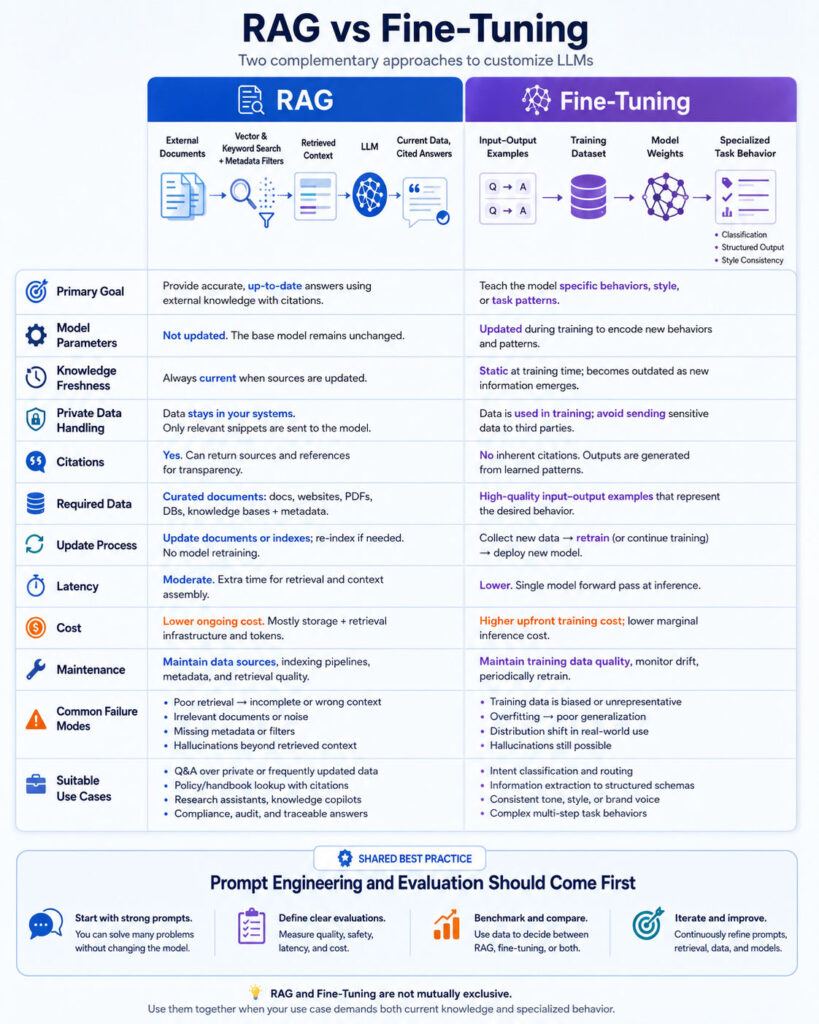
Can You Combine RAG and Fine-Tuning?
Yes. RAG and fine-tuning can complement each other.
A hybrid system may use RAG to retrieve current facts and a fine-tuned model to apply a specialised task or communication style.
User request
      ↓
Retrieve current authorised information
      ↓
Send context to a fine-tuned model
      ↓
Generate a task-specific response
      ↓
Validate output and show sources
For example, an insurance assistant may retrieve the latest policy terms and customer details. Afterwards, a fine-tuned model can transform that context into an approved claim-summary format.
When a Hybrid Approach Makes Sense
Consider combining the approaches when:
- The application requires current knowledge and consistent formatting.
- Private documents must support a specialised classification task.
- The model should use retrieved information with domain-specific terminology.
- Prompt instructions have become too large or inconsistent.
- A smaller specialised model needs external knowledge.
- The application must generate grounded answers and structured workflow data.
However, a hybrid architecture creates more components to test and maintain. Therefore, use both only when evaluation demonstrates a clear benefit.
Start with Prompt Engineering
Before building RAG or fine-tuning a model, establish a strong prompt-based baseline.
Define:
- The task.
- The expected audience.
- The allowed information sources.
- The required output format.
- Examples of correct responses.
- Examples of unacceptable responses.
- Rules for uncertainty and refusal.
In some cases, prompting may solve the requirement without additional architecture. Furthermore, the baseline helps measure whether RAG or fine-tuning creates a real improvement.
Recommended Decision Order
- Define the business task.
- Create a representative evaluation dataset.
- Test the base model with a clear prompt.
- Add structured outputs or tool controls where applicable.
- Use RAG when the model lacks required knowledge.
- Improve retrieval, ranking, and context instructions.
- Consider fine-tuning when behaviour remains inconsistent.
- Combine both only when each solves a measured problem.
This sequence prevents teams from selecting an expensive solution before understanding the actual failure.
How to Build a RAG Proof of Concept
- Select one narrow use case.
- Collect a small set of approved documents.
- Create realistic user questions.
- Identify the correct source passages.
- Parse and clean the documents.
- Choose a chunking strategy.
- Create keyword, vector, or hybrid search.
- Retrieve a small number of relevant chunks.
- Prompt the model to answer only from the context.
- Display the supporting sources.
- Measure retrieval and answer quality.
- Review security before adding more data.
A focused prototype provides clearer learning than indexing every company document immediately.
How to Prepare Data for RAG
RAG quality depends heavily on source quality. Therefore, review the following issues before indexing:
- Outdated documents.
- Duplicate files.
- Conflicting policies.
- Scanned pages with extraction errors.
- Missing headings.
- Unclear tables.
- Incorrect permissions.
- Unsupported file types.
- Personal or confidential information.
If the source collection contains conflicting information, the AI response can also become inconsistent. Consequently, document governance is part of RAG quality control.
RAG Metadata and Access Control
Each indexed chunk should retain enough metadata to support filtering, traceability, and permissions.
Useful fields may include:
- Source document identifier.
- Title.
- Department.
- Version.
- Effective date.
- Country or region.
- Access group.
- Language.
- Product or customer identifier.
Most importantly, the retrieval layer should filter unauthorised information before it reaches the model.
How to Build a Fine-Tuning Proof of Concept
- Define one measurable task.
- Test the base model with strong prompts.
- Collect representative input examples.
- Create approved target outputs.
- Remove duplicates and sensitive data.
- Separate training, validation, and test sets.
- Train the smallest suitable experiment.
- Compare it with the original baseline.
- Review unexpected behaviour and regressions.
- Test safety and edge cases.
- Estimate production inference costs.
- Version the dataset, prompt, and model.
Fine-tuning should begin only after the team can describe what success means. Otherwise, the project may optimise a model without solving a measurable business problem.
How Much Fine-Tuning Data Do You Need?
There is no universal number that suits every task.
The required amount depends on:
- Task complexity.
- Base-model capability.
- Consistency of the expected output.
- Variation in real user inputs.
- Quality of labels.
- Number of categories.
- Similarity between training and production data.
A smaller set of accurate and diverse examples can provide more value than a large collection of inconsistent records. Therefore, start with high-quality examples and expand the dataset according to evaluation failures.
Training Data Quality Checklist
- Examples match real production requests.
- Outputs follow one consistent policy.
- Labels have been reviewed.
- Common and rare cases are represented.
- Duplicate examples are controlled.
- Sensitive data has been removed or handled appropriately.
- Unsafe responses are excluded.
- Training and test records do not overlap.
- The dataset reflects current business requirements.
RAG Evaluation Metrics
A RAG system should evaluate retrieval and answer generation separately.
Retrieval Evaluation
Retrieval metrics can determine whether the correct information appears within the returned results.
Useful measures include:
- Whether a relevant chunk was retrieved.
- Position of the first relevant result.
- Precision of the retrieved set.
- Coverage of required source information.
- Performance of metadata filters.
- Retrieval latency.
Generated Answer Evaluation
The generated response can be measured for:
- Groundedness: Whether the claims follow the supplied context.
- Correctness: Whether the answer is factually accurate.
- Completeness: Whether it addresses every important part of the question.
- Relevance: Whether it stays focused on the user’s request.
- Citation accuracy: Whether the cited sources support the claims.
- Safety: Whether the answer avoids prohibited or harmful behaviour.
A good answer cannot recover information that the retriever failed to provide. Therefore, teams should inspect retrieval quality before changing the model.
Fine-Tuning Evaluation Metrics
Fine-tuning evaluation should match the task.
For classification, teams may measure:
- Accuracy.
- Precision.
- Recall.
- F1 score.
- Performance for each category.
For structured output, useful measurements include:
- Valid JSON rate.
- Schema compliance.
- Required-field accuracy.
- Correct value extraction.
Meanwhile, writing and generation tasks may be evaluated for:
- Tone consistency.
- Instruction compliance.
- Task completion.
- Factual correctness.
- Safety.
- Human preference.
In addition, test the tuned model against tasks that should not change. This process helps identify unwanted regressions.
RAG Costs
RAG costs may include:
- Document extraction and processing.
- Embedding generation.
- Search or vector storage.
- Index updates.
- Retrieval and reranking.
- Additional prompt tokens.
- Monitoring and evaluation.
- Infrastructure and engineering support.
Although RAG avoids training a new model version, it introduces an ongoing search and data-management platform.
Fine-Tuning Costs
Fine-tuning costs may include:
- Dataset preparation.
- Human review and labelling.
- Training compute.
- Experiment tracking.
- Model storage.
- Specialised inference.
- Retesting after model or policy changes.
- Periodic retraining.
However, a fine-tuned model may reduce repeated prompt size or allow a smaller model to handle the task. Therefore, calculate the complete lifecycle cost rather than comparing only one training job with one retrieval request.
RAG Latency vs Fine-Tuning Latency
RAG adds a retrieval stage before model generation.
As a result, total response time can include query rewriting, search, filtering, reranking, prompt assembly, and model inference.
A fine-tuned model may respond without a separate retrieval step. Consequently, it can provide lower latency for a narrow task.
Nevertheless, the fine-tuned model still needs retrieval when the answer depends on current or private information.
RAG Security Risks
RAG introduces several important security concerns:
- Users may retrieve documents they are not authorised to view.
- Malicious documents may contain prompt-injection instructions.
- Search indexes may expose deleted or outdated data.
- Generated responses may reveal sensitive source information.
- Source links may point to untrusted content.
- Logs may capture private queries and retrieved passages.
Therefore, access controls must apply during retrieval rather than only in the user interface.
Fine-Tuning Security Risks
Fine-tuning also requires careful data governance:
- Sensitive information may enter the training dataset.
- Incorrect or malicious examples may poison model behaviour.
- The model may memorise distinctive training data.
- Biased examples may produce biased outputs.
- Training files may remain accessible longer than intended.
- A tuned model may be used outside its approved purpose.
Consequently, organisations should review data classification, retention, access, licensing, and privacy requirements before training.
Common RAG Mistakes
- Indexing documents without removing outdated versions.
- Using one fixed chunk size for every content type.
- Depending only on vector similarity.
- Ignoring metadata and user permissions.
- Sending too many irrelevant chunks to the model.
- Displaying citations that do not support the answer.
- Testing only simple questions.
- Assuming RAG prevents every hallucination.
- Ignoring prompt injection inside retrieved documents.
- Evaluating only the final answer instead of the retrieval stage.
Common Fine-Tuning Mistakes
- Fine-tuning before testing a strong prompt.
- Using fine-tuning to store changing facts.
- Training on inconsistent or unreviewed examples.
- Using the same records for training and testing.
- Adding confidential data unnecessarily.
- Measuring training loss without task-level evaluation.
- Ignoring uncommon production inputs.
- Expecting tuning to remove the need for validation.
- Failing to version datasets and models.
- Assuming a tuned model will always outperform a stronger base model.
When Should You Choose RAG?
Choose RAG when:
- The answer depends on private documents.
- Information changes frequently.
- Users need source references.
- Access permissions vary by user.
- The knowledge collection is too large for one prompt.
- Facts must remain in an authoritative external system.
- Content must be corrected without retraining a model.
When Should You Choose Fine-Tuning?
Choose fine-tuning when:
- The task is narrow and repeatable.
- You have high-quality approved examples.
- The model must follow a specialised style or structure.
- Prompting does not provide sufficient consistency.
- Classification or extraction quality needs improvement.
- Shorter prompts provide meaningful value at scale.
- The platform supports the required tuning method and deployment.
When Should You Use Both?
Use RAG and fine-tuning together when:
- The application needs current facts and specialised behaviour.
- Retrieved documents must be transformed into a fixed output.
- The model needs domain language while using changing sources.
- Customer support requires current policies and a consistent response style.
- A smaller tuned model needs external knowledge.
When Might You Need Neither?
A normal model with a well-designed prompt may be sufficient when:
- The task is simple.
- The required information already fits in the prompt.
- Usage volume is low.
- The output does not require strict consistency.
- Current or private knowledge is not required.
- The cost of additional architecture exceeds the business value.
Therefore, always compare the proposed solution with a simple baseline.
RAG vs Fine-Tuning Decision Guide
| Your Requirement | Recommended Starting Point |
|---|---|
| Answer questions from current company documents | RAG |
| Use frequently changing product information | RAG |
| Show supporting sources | RAG |
| Apply user-level document permissions | RAG |
| Classify requests into specialised categories | Fine-Tuning after testing prompts |
| Return one consistent structured format | Prompt and schema controls, followed by Fine-Tuning if needed |
| Adopt a specialised writing style | Fine-Tuning when prompting remains inconsistent |
| Use current facts with a specialised response style | RAG and Fine-Tuning |
| Simple task with limited examples | Prompt Engineering |
| Model must perform external actions | Tool Calling, possibly combined with RAG |
Implementation Checklist
- Define the user problem clearly.
- Create representative evaluation questions.
- Establish a prompt-based baseline.
- Identify whether the main gap involves knowledge or behaviour.
- Choose RAG for external knowledge.
- Choose fine-tuning for specialised behaviour.
- Apply access controls and data governance.
- Measure quality before and after each change.
- Test security, edge cases, and failure scenarios.
- Estimate development and operating costs.
- Version prompts, datasets, indexes, and models.
- Monitor production performance continuously.
Final Verdict
RAG is usually the better approach when an AI application needs access to current, private, traceable, or frequently changing information.
Fine-tuning, by contrast, is more suitable when the model must learn a specialised task, response style, classification scheme, terminology, or output structure.
However, neither method automatically guarantees accurate or safe responses. RAG depends on strong retrieval, while fine-tuning depends on strong training data.
Therefore, begin with prompt engineering and representative evaluations. Afterwards, add RAG or fine-tuning only when each approach solves a clearly measured problem.
Conclusion
The RAG vs Fine-Tuning decision becomes easier when you separate knowledge from behaviour.
Use RAG to give the model the right information at the right time. Alternatively, use fine-tuning to teach the model how to perform a repeated task more consistently.
For advanced applications, combine them carefully by retrieving authoritative knowledge first and then using a specialised model to process it.
Most importantly, select the simplest architecture that meets the business requirement while remaining testable, secure, maintainable, and cost-effective.

AboutTPJ Technical Team
The Project Jugaad Technical Team creates practical, easy-to-follow content on software development, web technologies, artificial intelligence, cybersecurity, cloud platforms, and digital tools. Our articles are informed by more than 13 years of hands-on experience with .NET, Angular, SQL Server, AWS, WordPress, Linux hosting, application deployment, and real-world troubleshooting. Each guide is researched, reviewed, and updated to provide accurate, useful, and actionable information for developers, businesses, and everyday technology users.