
Technology
Applied Science of Angular is a beginner-friendly way to understand what Angular is, why it became popular, and how it differs from AngularJS.
Angular is a modern web framework used to build fast, scalable, and interactive web applications. It helps developers create structured applications with components, routing, services, forms, and other useful features.
Before learning Angular in detail, it is important to understand the difference between Angular and AngularJS. Many beginners get confused because both names sound similar. However, they are not the same.
What Is Angular?
Angular is an open-source web framework mainly used for front-end application development. Google maintains Angular with support from the developer community.
Developers use Angular to build single-page applications, dashboards, admin panels, enterprise applications, and dynamic web interfaces.
Modern Angular uses TypeScript, which adds strong typing and better structure on top of JavaScript. Because of this, Angular applications become easier to understand, test, and maintain as they grow.
What Is AngularJS?
AngularJS is the older version of the Angular framework. It was based on JavaScript and became popular for building dynamic web applications.
AngularJS introduced useful concepts such as data binding, controllers, directives, and dependency injection. At that time, these features helped developers build interactive web pages more easily.
However, web development changed over time. Applications became larger, mobile usage increased, and developers needed better structure, performance, and tooling.
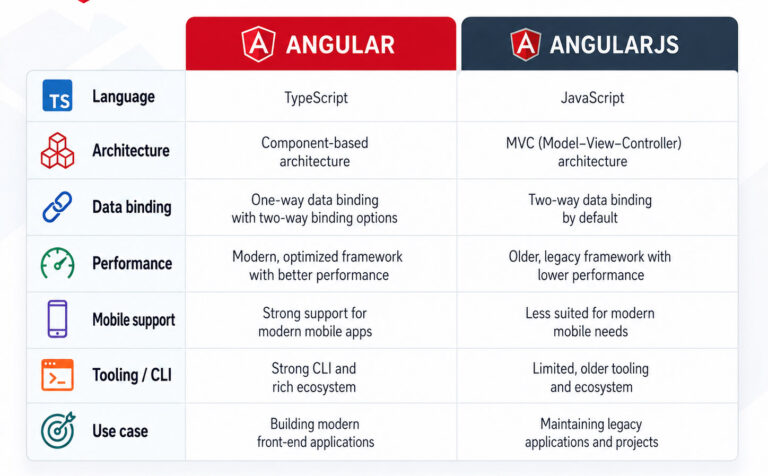
Why Angular Is Different from AngularJS
Angular is not just a small update of AngularJS. Instead, it is a complete redesign with a different architecture and better development approach.
| Point | AngularJS | Angular |
|---|---|---|
| Language | JavaScript | TypeScript |
| Architecture | Controller-based | Component-based |
| Mobile support | Limited | Better mobile-friendly approach |
| Performance | Suitable for older application patterns | Designed for modern web applications |
| Structure | Less strict project structure | More organized and scalable structure |
| Support status | Official support ended | Actively supported |
This difference makes Angular a better choice for modern applications that need better performance, maintainability, and long-term support.
Why Angular Uses TypeScript
TypeScript is one of the main reasons Angular feels more structured than AngularJS.
TypeScript helps developers define clear data types, classes, interfaces, and reusable code patterns. As a result, developers can catch many mistakes early during development.
For example, a simple Angular component usually includes a TypeScript class and an HTML template.
import { Component } from '@angular/core';
@Component({
      selector: 'app-message',
      template: 'Welcome to Angular'
})
export class MessageComponent {
}
This component-based structure keeps the user interface and related logic organized.
Important Building Blocks of Angular
Angular applications are built using different building blocks. Each block has a specific responsibility.
| Building Block | Purpose |
|---|---|
| Component | Controls a part of the user interface |
| Template | Defines the HTML view shown to users |
| Service | Handles reusable logic, API calls, or shared data |
| Routing | Manages navigation between pages or views |
| Dependency Injection | Provides required services to components |
| Modules or Standalone APIs | Help organize application features |
These building blocks make Angular useful for both small and large web applications.
Advantages of Angular
Angular provides many advantages for front-end development.
- It follows a component-based architecture.
- It uses TypeScript for better code quality.
- It provides routing for single-page applications.
- It supports reusable services and dependency injection.
- It helps organize large applications in a cleaner way.
- It provides strong tooling for building, testing, and maintaining applications.
Therefore, Angular is often used when an application needs structure, scalability, and long-term maintainability.
Common Use Cases of Angular
Angular can be used for many types of web applications.
- Single-page applications
- Admin dashboards
- Business portals
- Customer management systems
- Reporting applications
- Progressive web applications
However, Angular may feel heavy for very small websites or simple static pages. In those cases, a lighter approach may be enough.
Angular and Security
Angular includes several built-in features that help developers write safer front-end code. For example, it helps reduce risks related to unsafe HTML binding and common template mistakes.
Still, Angular alone cannot handle complete application security. Authentication, authorization, data validation, and sensitive business rules should also be handled properly on the server side.
So, Angular improves front-end safety, but a secure application still needs a strong back-end security approach.
Conclusion
Angular is a modern front-end framework for building structured and scalable web applications. It uses TypeScript, components, services, routing, and dependency injection to make application development more organized.
AngularJS was important in the early stage of modern web development. However, Angular introduced a better architecture for current application needs.
For beginners, the best starting point is to understand Angular components, templates, services, and routing. After that, advanced topics like forms, API integration, lazy loading, and state management become easier to learn.

AboutTPJ Technical Team
The Project Jugaad Technical Team creates practical, easy-to-follow content on software development, web technologies, artificial intelligence, cybersecurity, cloud platforms, and digital tools. Our articles are informed by more than 13 years of hands-on experience with .NET, Angular, SQL Server, AWS, WordPress, Linux hosting, application deployment, and real-world troubleshooting. Each guide is researched, reviewed, and updated to provide accurate, useful, and actionable information for developers, businesses, and everyday technology users.