
Artificial Intelligence
Artificial intelligence applications do not always need the largest available model. While large language models can handle broad and complex tasks, smaller models may respond faster, cost less, and run on devices with limited computing power.
The Small Language Models vs Large Language Models decision depends on the task, expected accuracy, available hardware, privacy requirements, response speed, and operating budget. Therefore, choosing the model with the highest parameter count does not always produce the best application.
A focused small language model may perform well on a narrow business workflow. In contrast, a large language model may be more suitable when users ask unpredictable questions or require broad knowledge, complex reasoning, and flexible content generation.
Small Language Models vs Large Language Models: Quick Answer
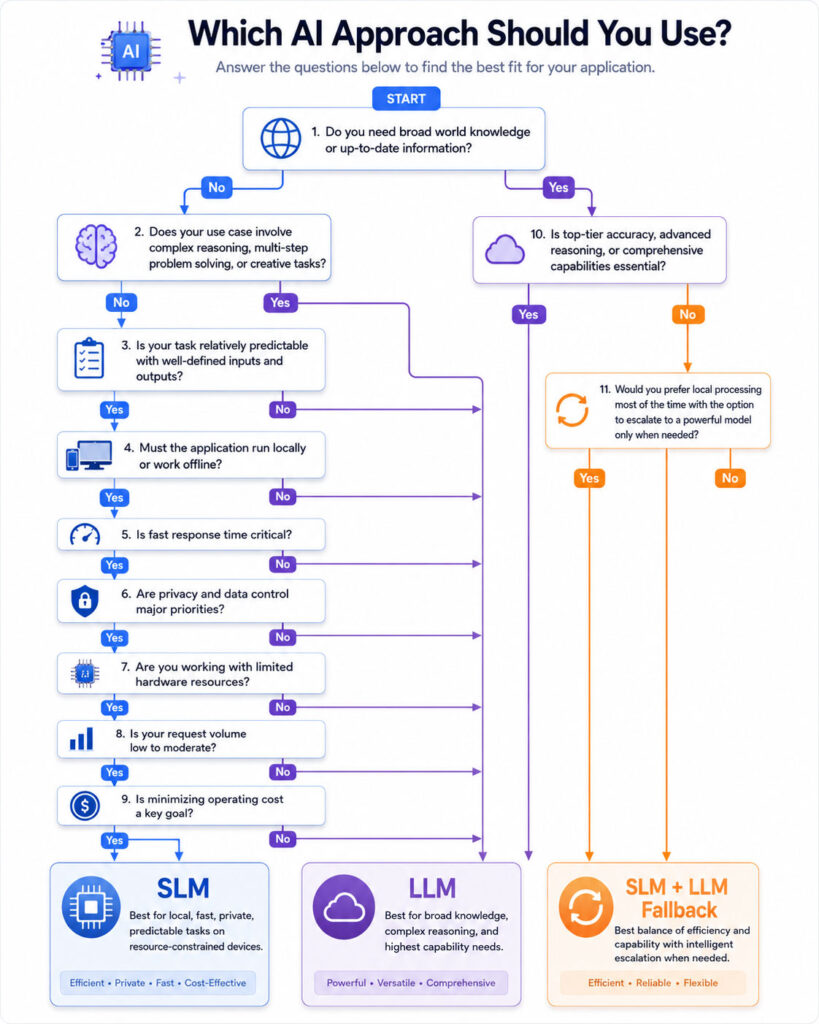
- Choose a small language model for focused tasks, local processing, lower latency, limited hardware, offline features, and high-volume automation.
- Choose a large language model for broad conversations, complex instructions, advanced reasoning, creative work, and tasks covering many subjects.
- Use a hybrid approach when a small model can process routine requests and a larger model can handle difficult or uncertain cases.
Neither category is automatically better. The best option is the smallest model that can meet the application’s quality, safety, and reliability requirements.
What Is a Language Model?
A language model is an artificial intelligence system trained to recognise patterns in text and predict suitable outputs. Modern language models can answer questions, summarise documents, generate content, translate languages, classify text, write code, and extract structured information.
Most current generative language models use transformer-based architectures. During training, the model learns relationships between words, phrases, concepts, and other data patterns.
After training, developers can use the model directly, provide instructions through prompts, connect it to external information, or customise it for a specific task. However, every model has limitations and can produce incomplete, inaccurate, or unsupported answers.
What Is a Small Language Model?
A small language model, commonly called an SLM, is a relatively compact AI model designed to perform language-related tasks with fewer computing resources than a larger model.
There is no universal parameter limit that turns an SLM into an LLM. Some organisations use the term for models with a few hundred million parameters, while others include models containing several billion parameters.
Therefore, the term “small” is relative. It may describe a model that can run on a laptop, smartphone, edge device, private server, or modest cloud instance.
Small language models often focus on efficiency. Developers may train, fine-tune, distil, quantise, or optimise them for tasks such as classification, document extraction, command execution, customer-service routing, code completion, and local assistance.
What Is a Large Language Model?
A large language model, commonly called an LLM, is trained with a larger number of parameters and extensive data. It generally requires more computing power for training and operation.
Large models usually provide broader language capabilities. They can follow varied instructions, discuss many subjects, generate long-form content, analyse complex inputs, and adapt to tasks that were not specifically included in one narrow workflow.
However, a larger model does not guarantee a correct response. It may still misunderstand the request, use outdated knowledge, invent unsupported details, or fail to follow a required format.
LLMs also vary widely. Two models with similar parameter counts may produce different results because of their training data, architecture, optimisation, alignment, context handling, and post-training methods.
Does Parameter Count Determine Model Quality?
Parameter count describes the number of learned values inside a model. A larger parameter count can increase capacity, but it does not measure every aspect of intelligence, accuracy, or usefulness.
Training-data quality, model architecture, instruction tuning, reasoning methods, quantisation, retrieval, tools, and task-specific optimisation can significantly affect performance.
As a result, a well-trained SLM may outperform a larger model on a narrow task. For example, a specialised model may classify support tickets more reliably than a general-purpose LLM that has not been configured for the company’s categories.
Conversely, the larger model may perform better when the user asks an unusual question that falls outside the smaller model’s specialisation.
How Small and Large Models Process a Request
Both SLMs and LLMs receive input, break it into tokens, process those tokens through model layers, and generate an output. Nevertheless, their infrastructure requirements can differ considerably.
A small model may run directly on a user’s device or within a lightweight application server. Therefore, the request may remain local and return a result quickly.
A large model often runs on powerful cloud infrastructure containing specialised processors and substantial memory. The application sends a request to the model service and receives the generated result.
However, these are common patterns rather than strict rules. Organisations can host smaller models in the cloud, while companies with suitable infrastructure can privately host larger models.
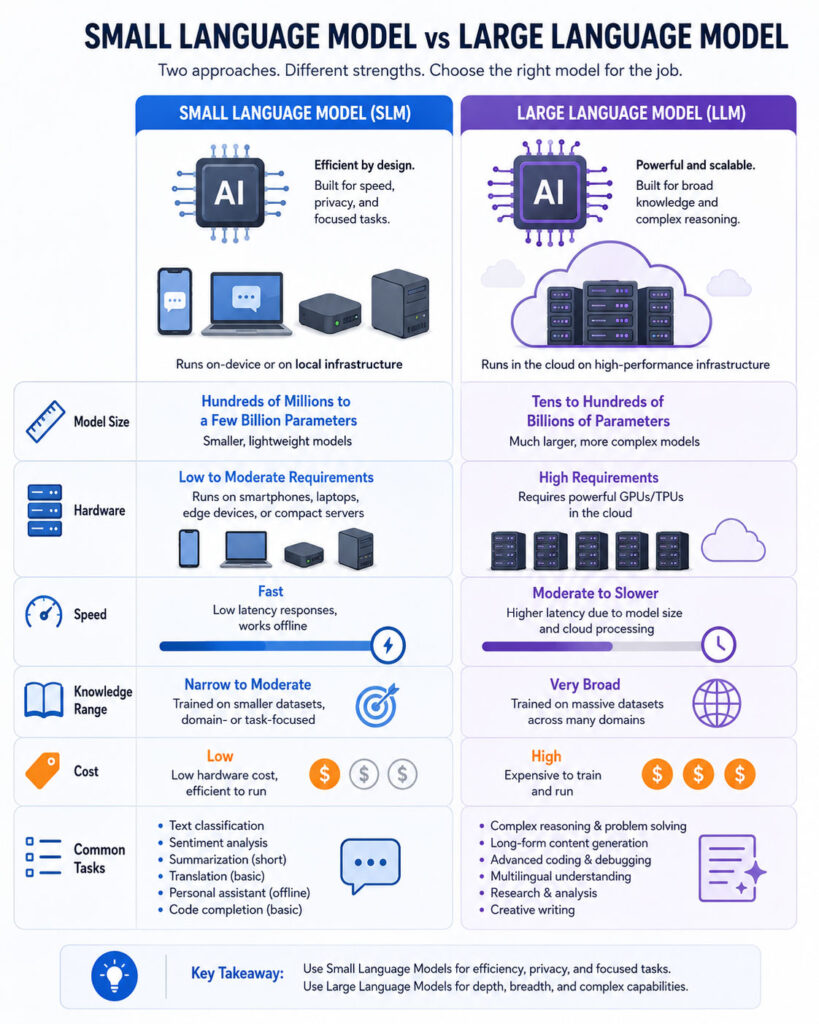
Small Language Models vs Large Language Models Comparison
| Area | Small Language Models | Large Language Models |
|---|---|---|
| Model size | Relatively compact | Relatively large |
| Computing needs | Lower in many deployments | Usually higher |
| Response speed | Often faster for focused tasks | May require more processing |
| General knowledge | Usually more limited | Usually broader |
| Complex reasoning | Varies and may be limited | Generally stronger on difficult tasks |
| Specialised workflows | Can perform very well after customisation | Capable but may be unnecessarily expensive |
| On-device use | More practical | Often difficult without substantial resources |
| Offline operation | Possible with local deployment | Less practical for very large models |
| Privacy control | Can keep data local | Depends on hosting and provider controls |
| Operating cost | Often lower at scale | Often higher per request |
| Customisation | May be easier and cheaper to fine-tune | May require more resources |
| Best suited for | Focused, repeatable applications | Broad and unpredictable applications |
This comparison describes common characteristics. Actual performance depends on the selected model, hardware, optimisation method, prompt, input length, output length, and application design.
Accuracy and Task Performance
A large language model often performs better when a task requires broad knowledge, flexible instruction following, advanced writing, or several stages of reasoning. Its greater capacity can help it handle requests that vary significantly from one user to another.
However, a smaller model may provide comparable or better results on a focused task. A company can customise an SLM using carefully prepared examples, domain terminology, structured outputs, and clear validation rules.
For example, a compact model designed to extract invoice fields may perform more consistently than a general model that also supports thousands of unrelated tasks.
Therefore, teams should evaluate models on their real business data. General benchmark scores do not always predict performance in a specific application.
Reasoning and Complex Instructions
Large language models generally handle complicated prompts, ambiguous questions, multi-step analysis, and unfamiliar scenarios more effectively. They may also recover better when users provide incomplete or poorly structured instructions.
Small models can follow clear and constrained instructions, especially when the expected output uses a fixed format. However, performance may fall when the task requires several reasoning steps or knowledge beyond the model’s training and specialisation.
Application design can reduce this difference. Developers can divide a complex workflow into smaller steps, provide relevant context, use external tools, and validate each result before continuing.
Speed and Response Time
Small language models usually require fewer calculations for each generated token. As a result, they can provide faster responses on suitable hardware.
Low latency matters for autocomplete, voice interfaces, in-game assistance, industrial devices, live translation, and interactive mobile features. Even a small delay can make these applications feel unresponsive.
Large models may take longer because they process requests through more parameters and more demanding infrastructure. Nevertheless, cloud providers can use specialised hardware, batching, caching, and model optimisation to improve performance.
Teams should measure the complete response time, including network delay, input processing, model generation, tool calls, and post-processing.
Hardware and Memory Requirements
A small model can run on less powerful processors and use less memory. Quantisation can reduce its memory requirements further by representing model values with lower numerical precision.
This efficiency makes SLMs practical for laptops, smartphones, embedded systems, edge servers, and smaller cloud instances. However, model size is not the only factor. Context length, batch size, numerical precision, and generated output also affect memory usage.
Large language models usually require powerful graphics processors or other AI accelerators. Privately hosting them may involve substantial hardware, cooling, maintenance, and infrastructure costs.
For many organisations, accessing an LLM through an API is easier than maintaining the required hardware internally.
Cost per Request
Small models often cost less to operate because they use fewer computing resources. This benefit becomes important when an application processes thousands or millions of repetitive requests.
For example, using a premium LLM to classify every short customer message may create unnecessary expense. A specialised SLM could process most messages at a lower cost while sending uncertain cases to a larger model.
However, cost depends on the deployment. A cloud API may be economical for low usage because the organisation does not need to purchase or maintain infrastructure.
Therefore, teams should calculate the total cost, including hosting, API usage, engineering, monitoring, updates, storage, networking, and human review.
Privacy and Data Control
A locally deployed SLM can process information without sending it to an external AI service. This design can improve data control for confidential documents, internal operations, personal devices, and environments with strict network restrictions.
However, a small model does not automatically guarantee privacy. The application may still record prompts, store generated content, send analytics, or connect to external services.
Similarly, using an LLM does not automatically expose private information. Organisations may use private cloud deployments, enterprise agreements, regional processing, access controls, encryption, and data-retention settings.
Teams should review the complete data flow rather than assuming privacy from the model size alone.
Offline and Edge AI
Small language models can support offline AI features when they run directly on a device. This capability is useful in locations with weak internet access, high network costs, or strict operational requirements.
Possible applications include offline document search, device commands, field-service assistance, manufacturing support, local translation, and private note summarisation.
On-device processing can also reduce network latency and keep the application available during an internet outage. Nevertheless, the device must have enough storage, memory, processing power, and battery capacity.
Customisation and Fine-Tuning
Small models are often easier and less expensive to customise. Developers can fine-tune them for a domain, writing style, classification system, output format, or tool-calling workflow.
A focused dataset may help an SLM learn company-specific terminology and predictable task patterns. However, poor or unbalanced training data can reduce quality and introduce unwanted behaviour.
Large models can also be customised through prompting, retrieval, fine-tuning, adapters, and external tools. Still, the required computing resources and operating costs may be higher.
Before fine-tuning any model, teams should first test whether better prompts, retrieval, examples, or deterministic application logic can solve the problem.
Retrieval-Augmented Generation
Retrieval-augmented generation, or RAG, gives a model relevant information from documents, databases, or search systems before it generates an answer.
RAG can make a smaller model more useful because the model does not need to store every business fact inside its parameters. Instead, the application retrieves the required information at request time.
Large models also benefit from retrieval. Their broader capabilities may help them understand complex documents and combine information from several sources.
However, retrieval quality remains critical. Neither an SLM nor an LLM can reliably answer from relevant evidence when the search system returns incomplete or incorrect content.
Tool Use and Structured Outputs
Many AI applications need a model to select tools, call APIs, generate JSON, or extract values rather than write long paragraphs.
A specialised SLM may handle these constrained tasks efficiently when the available tools and output schema remain clear. Developers can also reject invalid output and retry the request through controlled application logic.
A large model may perform better when the user’s request is ambiguous or when selecting the correct tool requires broader understanding.
Consequently, teams should evaluate successful task completion rather than judging the model only by conversational quality.
Reliability and Hallucinations
Both small and large language models can produce confident but incorrect content. Increasing model size may improve performance on many tasks, but it does not eliminate hallucinations.
A small model may fail because it lacks sufficient knowledge or reasoning capacity. Meanwhile, a large model may generate a detailed answer that sounds convincing despite lacking reliable evidence.
Applications should ground important answers in trusted information, validate structured results, restrict available actions, and involve human review when mistakes could cause harm.
Financial, medical, legal, security, and operational decisions require additional safeguards regardless of the chosen model size.
Small Language Model Use Cases
- Classifying support requests into known categories.
- Extracting fields from invoices, forms, or internal documents.
- Providing offline assistance on mobile and edge devices.
- Generating short replies from approved business information.
- Converting natural-language commands into structured actions.
- Detecting intent, sentiment, or document type.
- Supporting code completion for a focused language or framework.
- Summarising private notes or locally stored documents.
- Routing requests to the correct system or larger model.
- Powering high-volume workflows with predictable inputs.
Large Language Model Use Cases
- Answering broad and unpredictable user questions.
- Creating detailed articles, reports, and marketing content.
- Analysing complex documents across several subjects.
- Supporting advanced coding, debugging, and architecture tasks.
- Following multi-step instructions with changing requirements.
- Handling open-ended research and brainstorming.
- Supporting multilingual conversations across many domains.
- Coordinating several tools in a complex workflow.
- Generating personalised explanations for different audiences.
- Acting as a general-purpose enterprise assistant.
SLM vs LLM for Common Applications
| Application | Commonly Suitable Choice | Reason |
|---|---|---|
| Offline mobile assistant | SLM | Lower hardware requirements and local processing |
| General-purpose chatbot | LLM | Broader knowledge and instruction handling |
| Support ticket classification | SLM | Focused, repetitive, and high-volume task |
| Complex research assistant | LLM with retrieval | Requires broad analysis and external evidence |
| Document field extraction | SLM or specialised model | Constrained output and predictable structure |
| Enterprise knowledge assistant | SLM or LLM with RAG | Choice depends on question complexity and scale |
| Creative content generation | LLM | Greater flexibility and language range |
| Device command execution | SLM | Low latency and limited command set |
| Advanced coding assistant | LLM | Broader code knowledge and problem solving |
| High-volume API automation | SLM with LLM fallback | Balances cost, speed, and difficult cases |
Choose a Small Language Model When Efficiency Matters
An SLM is a strong choice when the task remains focused and the expected inputs follow recognisable patterns. It can reduce latency, hardware usage, and operating cost without adding capabilities that the application does not need.
Small models also suit applications that must run on a device, continue working offline, or keep information inside a controlled environment.
However, developers should test the model against difficult examples. A compact model that performs well during a simple demonstration may struggle with unusual wording, incomplete instructions, or requests outside its training scope.
Choose a Large Language Model for Broad Capabilities
An LLM is often more suitable when users can ask almost anything within a wide domain. Its broader training and greater capacity can support complex instructions, long-form writing, advanced coding, and varied conversations.
Large models can also reduce early development effort because one model may support several features without separate specialised models.
Nevertheless, teams should avoid using an expensive model for every task by default. Classification, routing, validation, calculations, and database operations may work better through smaller models or ordinary application code.
Use a Hybrid SLM and LLM Approach
A hybrid system uses different models according to task difficulty. The application may send common and predictable requests to an SLM while routing uncertain or complicated cases to an LLM.
For example, a small model could classify a support request, extract the account type, and select an approved response. If confidence remains low, the application could forward the request and relevant context to a larger model.
This approach can reduce average cost and response time while preserving access to advanced capabilities. However, the routing system must recognise when the smaller model needs help.
Teams can use confidence scores, validation rules, user feedback, task type, input complexity, and previous failures to make routing decisions.
Model Cascades and Fallback Systems
A model cascade begins with the least expensive suitable option. The system accepts the answer when it meets defined quality checks and moves to a more capable model when validation fails.
For structured extraction, the application might first use an SLM and verify the returned JSON against a schema. If required fields are missing or invalid, it can retry with a larger model.
This design measures success through completed tasks instead of assuming that the largest model must handle every request.
Nevertheless, retries and routing add complexity. Developers must monitor total latency, duplicate actions, error handling, and the cost of repeated requests.
Cloud, Private Server, or On-Device Deployment
The deployment location can matter as much as model size. A cloud API provides quick access to capable models without requiring the organisation to maintain AI hardware.
A privately hosted model gives the organisation greater control over infrastructure, access, configuration, and data flow. However, it also creates responsibility for updates, monitoring, scaling, and security.
On-device deployment reduces network dependence and can keep processing local. Still, the application must manage model downloads, storage, compatibility, battery usage, and performance across different devices.
Therefore, teams should select the deployment model after reviewing privacy, scale, latency, maintenance, and reliability requirements.
How to Evaluate an SLM or LLM
Begin with a representative collection of real tasks. Include common requests, unusual wording, incomplete inputs, long documents, unsupported questions, and adversarial examples.
Then measure the criteria that matter to the application:
- Task success rate: How often does the model complete the intended task correctly?
- Factual accuracy: Does the response match trusted information?
- Format reliability: Does the model consistently follow the required schema or structure?
- Latency: How quickly does the complete application return a result?
- Cost: What is the total cost for each successful task?
- Resource usage: How much memory, processing power, storage, and energy does the deployment require?
- Safety: Does the model avoid harmful, restricted, or unauthorised actions?
- Privacy: Where does the input travel, and what information is stored?
- Fallback rate: How often does a smaller model need assistance from a larger model?
- User satisfaction: Do users find the result useful, clear, and reliable?
Questions to Ask Before Choosing a Model
- Is the task narrow and repeatable or broad and unpredictable?
- Does the application need advanced reasoning?
- Must the model work without an internet connection?
- Can user data leave the device or private network?
- What response time will users accept?
- How many requests will the application process?
- What hardware is available?
- Does the model need to call tools or generate structured output?
- How will the application verify important answers?
- Can difficult cases move to a larger model or human reviewer?
- How frequently will the model or supporting data need updates?
- What operating cost can the application support?
Common Mistakes When Selecting an AI Model
- Choosing the largest model without testing smaller alternatives.
- Selecting a small model only because it costs less.
- Comparing models using parameter count alone.
- Relying only on public benchmark scores.
- Testing with simple demonstrations instead of real business data.
- Ignoring network delay and application processing time.
- Assuming local deployment automatically guarantees privacy.
- Using a language model for calculations or rules that normal code can handle reliably.
- Fine-tuning before testing better prompts, retrieval, and examples.
- Allowing a model to perform sensitive actions without validation.
- Failing to monitor accuracy after deployment.
- Using one model for every task when routing could improve efficiency.
Are Small Language Models Less Accurate?
Small language models may be less capable on broad, complex, or unfamiliar tasks. However, they can provide strong accuracy when developers specialise them for a focused workflow and supply clear instructions or relevant context.
Therefore, accuracy should be measured for the intended application rather than inferred from size alone.
Can a Small Language Model Run on a Smartphone?
Some compact and optimised language models can run on modern smartphones, tablets, and laptops. Actual performance depends on model size, quantisation, available memory, device processors, context length, and application requirements.
A model that runs on one premium device may not work efficiently across every supported device. Developers should test the complete device range before deployment.
Are Large Language Models Always Cloud-Based?
No. Organisations can host large language models on private infrastructure when they have suitable processors, memory, storage, engineering skills, and operational capacity.
However, cloud services are common because training and operating large models can require substantial resources.
Can an SLM Use RAG?
Yes. A small language model can use retrieval-augmented generation to answer questions from external documents or databases.
RAG may improve the model’s usefulness by providing current and domain-specific information. Nevertheless, the application must retrieve relevant content and instruct the model to rely on that content.
Can an SLM Replace an LLM?
An SLM can replace an LLM when the application handles focused tasks that the smaller model completes reliably. This change may improve speed, privacy, and cost.
However, an SLM may not replace a larger model for broad conversations, difficult reasoning, advanced coding, or highly varied requests.
Does an LLM Know More Than an SLM?
A large model generally has greater capacity and may support a wider range of topics. However, knowledge depends on training data and post-training, not only model size.
A specialised small model may know more about one controlled domain than a general model that lacks the relevant data or terminology.
Which Model Is Better for Business Applications?
The answer depends on the workflow. SLMs can suit document processing, classification, routing, local assistance, and repetitive automation. LLMs can suit broad knowledge assistants, complex analysis, content creation, and advanced customer interactions.
Many businesses can benefit from combining both approaches instead of selecting one model for every feature.
Which Model Is More Secure?
Model size does not determine security. Security depends on hosting, access controls, data handling, permissions, prompt protection, tool restrictions, monitoring, and application design.
A local SLM may reduce external data transfer, but it can still expose information through logs or insecure storage. Similarly, a securely configured enterprise LLM service may provide strong organisational controls.
Will Small Language Models Replace Large Language Models?
Small models are unlikely to replace every large model. Instead, they can handle a growing number of focused and resource-sensitive tasks.
Large models will remain useful for broad and complex work, while hybrid systems can use each model where it provides the greatest value.
Final Verdict
The Small Language Models vs Large Language Models comparison does not produce one universal winner. Small models provide efficiency, lower hardware requirements, fast responses, local deployment, and strong performance on focused tasks.
Large models provide broader knowledge, flexible instruction handling, and stronger performance on many complex or unpredictable requests. However, those capabilities may require more computing resources and a higher operating budget.
Choose an SLM when the workflow is narrow, repeatable, private, cost-sensitive, or device-based. Choose an LLM when the application needs broad knowledge, complex reasoning, creative flexibility, or varied conversations.
Finally, consider a hybrid approach for larger applications. A small model can process routine work, while a larger model handles difficult cases. This design can balance capability, cost, speed, privacy, and reliability more effectively than using one model for everything.
AboutTPJ Technical Team
The Project Jugaad Technical Team creates practical, easy-to-follow content on software development, web technologies, artificial intelligence, cybersecurity, cloud platforms, and digital tools. Our articles are informed by more than 13 years of hands-on experience with .NET, Angular, SQL Server, AWS, WordPress, Linux hosting, application deployment, and real-world troubleshooting. Each guide is researched, reviewed, and updated to provide accurate, useful, and actionable information for developers, businesses, and everyday technology users.