
Software Development
Most web applications need a secure way to recognise users after they sign in. Two common approaches are JWT authentication and session-based authentication. Both can protect private pages and APIs, but they manage login state differently.
In session authentication, the server stores the user’s login state and sends the browser a session identifier. In contrast, JWT authentication usually places user-related claims inside a signed token that the client sends with later requests.
The JWT vs Session Authentication decision affects security, scalability, logout behaviour, infrastructure, and application complexity. Therefore, developers should understand the complete request flow before choosing one approach.
JWT vs Session Authentication: Quick Answer
- Choose session authentication for traditional websites, server-rendered applications, administrative portals, and systems that need immediate logout or simple access revocation.
- Choose JWT authentication for distributed APIs, mobile applications, service-to-service communication, and systems that need independently verifiable access tokens.
- Use a hybrid approach when a central authentication service issues short-lived access tokens while securely managing refresh sessions.
Neither option is automatically more secure. The implementation, storage location, token lifetime, cookie settings, key management, and revocation strategy determine the actual security level.
What Is Authentication?
Authentication confirms who a user is. For example, a person may enter an email address and password, complete a passkey challenge, or sign in through an identity provider.
After successful authentication, the application needs a way to recognise that user during later requests. Otherwise, the user would need to sign in again whenever the browser loads another page or calls an API.
Sessions and JWTs solve this continuity problem. However, they store and validate the authentication state in different places.
What Is Session-Based Authentication?
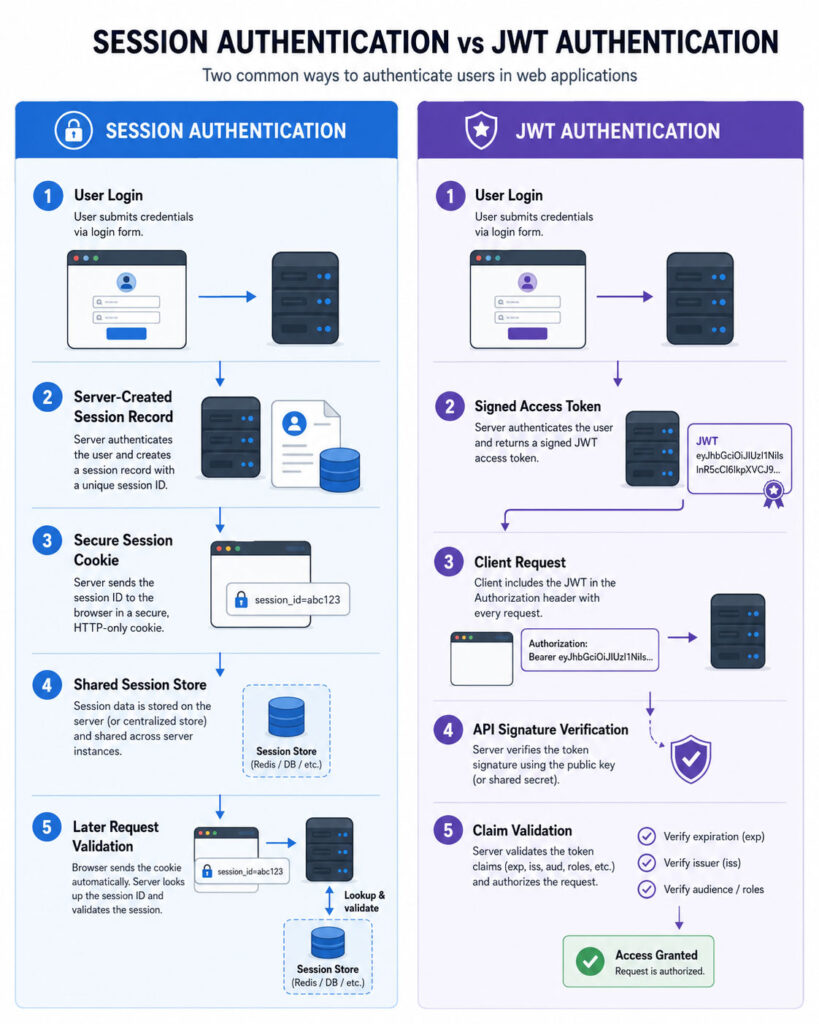
Session-based authentication stores login state on the server. After the user signs in, the server creates a session record containing information such as the user identifier, permissions, creation time, expiry time, and security-related metadata.
The server then sends a random session identifier to the browser. Applications commonly store this identifier inside a secure cookie. The browser automatically includes the cookie with later requests to the same site.
When the server receives the request, it reads the session identifier and looks up the matching session record. If the session exists and remains valid, the server treats the request as authenticated.
How Session Authentication Works
- The user submits login credentials.
- The server verifies the credentials.
- The server creates a session record.
- The server sends a session cookie to the browser.
- The browser includes the cookie with later requests.
- The server loads and validates the session.
- The application allows or denies access.
This approach keeps most authentication data under server control. As a result, the server can invalidate a session immediately when the user logs out, changes a password, loses access, or reports suspicious activity.
What Is JWT Authentication?
JWT stands for JSON Web Token. A JWT is a compact token that can carry claims about a user, client, or authentication event. The issuing system signs the token so another trusted component can verify that nobody changed its contents.
A typical JWT contains three encoded sections: a header, a payload, and a signature. The header describes the token type and signing algorithm. The payload contains claims, while the signature protects the token from unauthorised modification.
JWT contents are encoded rather than automatically encrypted. Therefore, applications must not place passwords, private personal information, secret keys, or other sensitive data inside a normal signed JWT.
How JWT Authentication Works
- The user submits login credentials.
- The authentication server verifies the credentials.
- The server generates and signs a JWT.
- The client stores or receives the token.
- The client sends the token with later requests.
- The API verifies the signature and token claims.
- The application allows or denies access.
Because the token carries claims and can be verified through a signing key, an API may not need to load a central session record for every request. However, the system still needs a secure strategy for expiration, revocation, refresh, signing-key rotation, and compromised tokens.
JWT Structure
A JWT commonly looks like three Base64URL-encoded values separated by dots:
header.payload.signatureThe payload may contain registered or custom claims such as:
subfor the subject or user identifier.issfor the token issuer.audfor the intended audience.expfor the expiration time.iatfor the issue time.nbffor the time before which the token must not be accepted.
Applications should validate relevant claims instead of checking only the signature. A correctly signed token may still be invalid for the current API, environment, audience, or time window.
JWT vs Session Authentication Comparison
| Area | Session Authentication | JWT Authentication |
|---|---|---|
| Login state | Stored on the server | Claims commonly carried in the token |
| Client receives | Random session identifier | Signed access token |
| Request validation | Server loads the session record | Server verifies the token and claims |
| Immediate revocation | Usually straightforward | Requires an additional strategy |
| Distributed APIs | May need shared session storage | Can support independent token verification |
| Token size | Usually small session identifier | Usually larger because it contains claims |
| Browser automation | Cookies can be sent automatically | Depends on whether the JWT uses a cookie or header |
| Common use | Traditional web applications | APIs, mobile apps, and distributed systems |
These are general differences rather than strict rules. A JWT can be stored in a cookie, while a server may also keep token-related state for revocation or refresh management.
Where Is Authentication State Stored?
The main difference between JWT and session authentication is where the application keeps the information needed to recognise a signed-in user.
Session authentication stores that state on the server. The browser normally holds only a random identifier that points to the server-side record.
JWT authentication can place selected claims inside the token itself. Therefore, an API may validate the token without loading a central session for every request.
However, JWT systems are not always completely stateless. Applications often maintain refresh sessions, revoked-token lists, device records, consent data, signing keys, and security-event records.
Security Comparison
Both approaches can be secure when developers configure them correctly. Likewise, both can become vulnerable through weak storage, long expiry periods, missing validation, insecure cookies, cross-site scripting, or poor logout design.
Session authentication offers strong central control because the server owns the session record. Administrators can remove a session immediately, limit active devices, or require a new login after a security event.
JWT authentication reduces the need for repeated session lookups, but a stolen token may remain usable until it expires. Therefore, access tokens should remain short-lived, narrowly scoped, and protected during storage and transport.
JWT Is Signed, Not Necessarily Encrypted
A common mistake is assuming that nobody can read a JWT because it contains encoded text. Standard JWT payloads are often easy to decode.
The signature proves that the token came from a trusted issuer and that its content has not changed. It does not automatically hide the payload.
Consequently, developers should include only the minimum claims needed by the receiving service. Sensitive information should remain in a protected database or another suitable secure system.
Cookie Storage vs Browser Storage
JWT and cookie are not competing authentication technologies. A cookie is a browser storage and transport mechanism, while a JWT is a token format. An application can place a JWT inside a secure cookie.
For browser-based applications, an HttpOnly cookie can prevent JavaScript from directly reading the authentication value. The Secure attribute restricts transmission to HTTPS, while an appropriate SameSite setting can reduce some cross-site request risks.
Storing long-lived access tokens in localStorage or similar JavaScript-accessible storage can increase the impact of a cross-site scripting attack. Malicious script running on the page may read and send those tokens elsewhere.
However, cookies require careful protection against cross-site request forgery because browsers may attach them automatically. Therefore, developers may need SameSite controls, anti-forgery tokens, origin checks, and secure application design.
Logout and Token Revocation
Session authentication usually provides simpler logout behaviour. The server deletes or invalidates the session record, and the session identifier no longer grants access.
JWT logout can be more complex when the access token remains independently valid until its expiration time. Removing the token from one browser does not invalidate a copy that an attacker has already stolen.
Applications can reduce this risk by using short-lived access tokens and server-managed refresh sessions. Other options include token versioning, deny lists, key rotation, or checking important security state against a database.
Each additional check reduces some of the stateless advantage. Therefore, teams should not choose JWT only because they expect to eliminate all authentication storage.
Scalability
Traditional sessions may require a shared session store when an application runs on multiple servers. For example, the servers may use a database or distributed cache so that every instance can access the same session records.
Alternatively, infrastructure can route a user to the same server through sticky sessions. However, this design may complicate failover, deployments, and load distribution.
JWTs can help distributed APIs because each trusted service can verify a signed token without calling the authentication server for every request. This approach can reduce central lookups and simplify some service boundaries.
Nevertheless, JWT verification still uses CPU, key management, configuration, and claim validation. Larger tokens also increase the size of every request.
Performance
A session identifier is usually short, so it adds little network overhead. However, the application may need to load a session from memory, a cache, or a database during each request.
A JWT may avoid that lookup when the API can validate it locally. On the other hand, the token is larger, and the API must verify its cryptographic signature and claims.
For many business applications, both approaches perform well when implemented properly. Therefore, teams should measure real workloads instead of selecting JWT only for theoretical performance gains.
Updating Roles and Permissions
Session-based applications can update a user’s permissions centrally. The next request may read the latest session or permission data, depending on the implementation.
A JWT may continue carrying older roles or permissions until it expires. For example, removing an administrative role in the database does not automatically change an access token that has already been issued.
Short token lifetimes reduce this delay. High-risk APIs may also check critical permissions or account status against a trusted server-side source.
Token Size and Network Overhead
Session cookies usually contain only an opaque random identifier. As a result, they remain relatively small.
JWTs contain headers, claims, and signatures. Adding many roles, permissions, tenant identifiers, profile fields, or custom values can make them unnecessarily large.
Browsers and clients send authentication data repeatedly. Therefore, developers should keep JWT payloads small and avoid treating access tokens as general-purpose user profiles.
Cross-Site Scripting and Cross-Site Request Forgery
Cross-site scripting and cross-site request forgery are different threats. Storage and transport choices affect how each threat applies.
- JavaScript-accessible tokens: A successful script injection may read and steal them.
- HttpOnly cookies: JavaScript cannot directly read them, but the browser may send them automatically.
- Cookie-based authentication: The application should implement appropriate anti-forgery protections.
- All approaches: The application still needs output encoding, content security controls, safe dependencies, and secure input handling.
No token storage method removes the need to prevent cross-site scripting. Attackers may perform actions through the victim’s browser even when they cannot directly read an HttpOnly cookie.
JWT vs Session Authentication for Common Applications
| Application Type | Commonly Suitable Approach | Reason |
|---|---|---|
| Traditional server-rendered website | Session authentication | Simple cookie flow and central logout control |
| Administrative portal | Session authentication or hybrid | Immediate revocation and strict session management |
| Mobile application with APIs | JWT or another access-token format | Works well with API authorization headers |
| Single-page application | Secure cookie session or token-based flow | Choice depends on architecture and identity provider |
| Microservices | Short-lived signed access tokens | Services can verify trusted tokens independently |
| Banking or high-risk application | Stateful or hybrid design | Supports strong revocation and device controls |
| Public API for third-party clients | Standards-based access tokens | Supports scoped and delegated API access |
When Session Authentication Is Better
- The application is primarily a traditional website.
- The server and browser belong to the same web application.
- The team needs simple and immediate logout.
- Administrators must revoke access quickly.
- The application needs detailed device and session management.
- The infrastructure already supports a reliable shared session store.
- The development team wants to minimise token-handling complexity.
When JWT Authentication Is Better
- Multiple APIs need to verify the same trusted access token.
- The application supports mobile, desktop, or non-browser clients.
- Services run across separate systems or infrastructure boundaries.
- The design uses short-lived access tokens and secure refresh sessions.
- The application needs signed claims with clear issuers and audiences.
- The system integrates with an external identity or authorization provider.
JWT authentication becomes most useful when the architecture genuinely benefits from portable, independently verifiable tokens. It should not become the default choice for every login form.
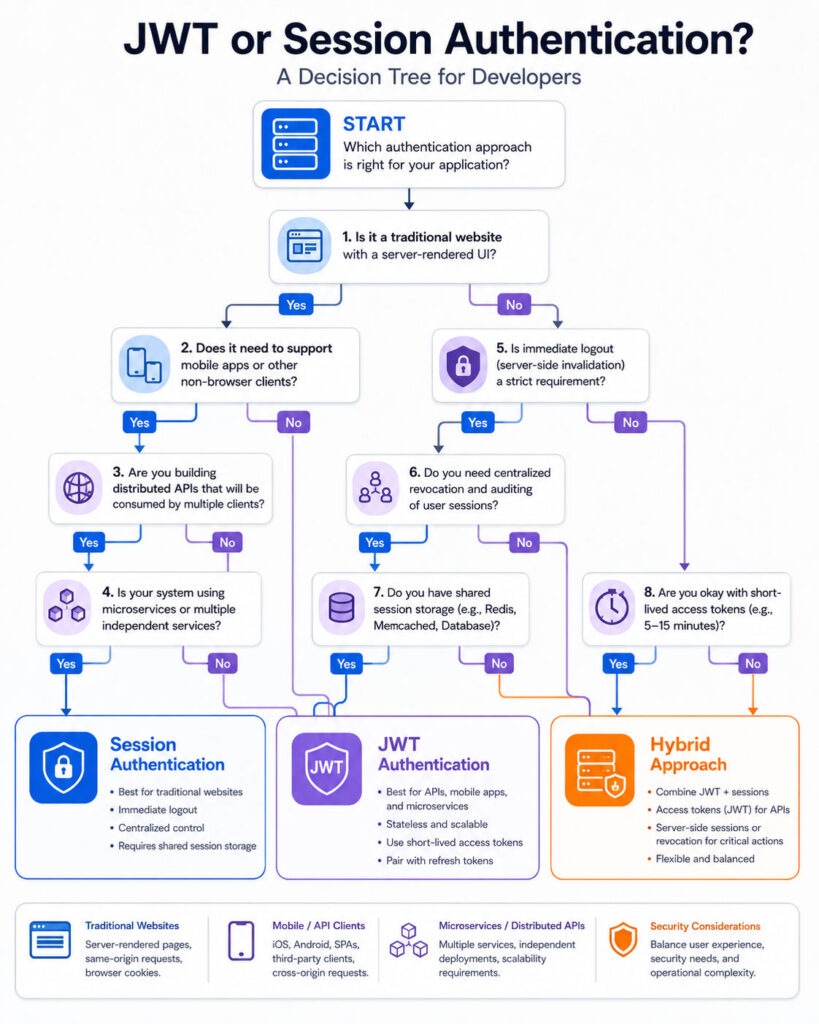
What Is a Hybrid Authentication Approach?
Many modern systems combine stateful sessions with short-lived access tokens. For example, an authentication service may maintain a refresh session while issuing a brief JWT access token for API requests.
The access token allows APIs to verify requests efficiently. Meanwhile, the server-controlled refresh session supports logout, device management, suspicious-login detection, and access revocation.
This design can provide a useful balance. However, it also introduces more moving parts, so teams need clear rules for access-token expiry, refresh-token rotation, reuse detection, storage, and error handling.
Access Tokens and Refresh Tokens
An access token authorizes API requests for a limited time. It should normally remain short-lived so that a stolen token loses value quickly.
A refresh token or refresh session allows the client to obtain a new access token without asking the user to enter credentials again. Because it can extend a login, the system should protect it more carefully than an ordinary short-lived access token.
Secure implementations may rotate refresh tokens after use, track token families, detect replay, associate sessions with devices, and revoke the full chain when suspicious behaviour appears.
Should You Use JWT for User Sessions?
JWT can represent an authenticated user, but that does not mean it should replace every server-side session. A normal website may gain little from placing all session data into a signed token.
Before choosing JWT, ask whether multiple independent services truly need to verify the token. Also consider how the application will handle logout, permission changes, stolen tokens, key rotation, account suspension, and device management.
If those requirements force the application to check server-side state on nearly every request, a conventional session may be simpler and clearer.
JWT Validation Checklist
- Accept only the expected signing algorithms.
- Verify the signature with a trusted key.
- Validate the issuer.
- Validate the intended audience.
- Reject expired tokens.
- Respect the not-before time when present.
- Apply a small and controlled allowance for clock differences.
- Check required claims and expected data types.
- Keep access-token lifetimes short.
- Rotate signing keys safely.
- Do not trust authorization claims beyond their intended scope.
- Never include secrets or unnecessary personal data in the payload.
Session Security Checklist
- Generate long and unpredictable session identifiers.
- Use HTTPS throughout the application.
- Store the identifier in a secure HttpOnly cookie.
- Configure an appropriate SameSite policy.
- Regenerate the session identifier after login or privilege changes.
- Set both idle and absolute expiry limits.
- Invalidate sessions during logout and password-reset events.
- Protect cookie-authenticated requests against cross-site request forgery.
- Do not place sensitive information directly inside the session cookie.
- Provide users with active-session and device controls when appropriate.
Common JWT Mistakes
- Using JWT because it is popular rather than because the architecture needs it.
- Creating access tokens that remain valid for days or months.
- Storing sensitive information in an easily decoded payload.
- Skipping issuer, audience, or expiration validation.
- Accepting unexpected algorithms or weak signing configurations.
- Placing too many roles and profile fields inside the token.
- Assuming logout automatically invalidates every issued token.
- Using one signing key indefinitely without a rotation plan.
- Storing long-lived tokens in browser storage without considering script attacks.
- Building a custom authentication protocol instead of using established standards and libraries.
Common Session Authentication Mistakes
- Using predictable or insufficiently random session identifiers.
- Sending session cookies without HTTPS.
- Forgetting the HttpOnly or Secure cookie attributes.
- Failing to regenerate the session identifier after login.
- Keeping sessions active indefinitely.
- Not invalidating sessions after password or account-security changes.
- Ignoring cross-site request forgery protection.
- Storing sensitive data directly inside an unprotected client cookie.
- Using local in-memory sessions across multiple servers without a distribution strategy.
- Failing to provide administrators with session-revocation controls.
Does JWT Replace OAuth 2.0?
No. JWT is a token format, while OAuth 2.0 is an authorization framework. An OAuth system may issue JWT access tokens, opaque access tokens, or another supported format.
Similarly, OpenID Connect adds an identity layer for user authentication. A complete login architecture involves more than selecting a token format.
Is JWT More Secure Than Session Authentication?
JWT is not automatically more secure than a server-side session. Both approaches can provide strong protection when teams use secure transport, safe storage, short lifetimes, robust validation, and proper revocation controls.
Session authentication often provides simpler central control. JWT can provide architectural flexibility, but that flexibility requires careful token management.
Is Session Authentication Outdated?
No. Server-side sessions remain effective for many modern web applications. They can provide clear security controls, simple logout, and minimal client-side token handling.
A distributed deployment may require a shared session store, but modern databases and caches can support that requirement efficiently.
Can JWT Be Stored in a Cookie?
Yes. A JWT can be placed inside a secure HttpOnly cookie. In that design, the browser sends the token like other cookies, while client-side JavaScript cannot directly read it.
However, the application must still consider cross-site request forgery because the browser may attach the cookie automatically.
Can Session Authentication Be Used for APIs?
Yes. A browser-based application can call an API using a session cookie, especially when the website and API share the same trusted environment.
However, public APIs, mobile clients, and third-party integrations often benefit from standards-based access tokens because cookies may not fit those client types or deployment boundaries.
What Happens When a JWT Is Stolen?
An attacker may use a stolen bearer token until it expires or the system blocks it through a revocation mechanism. The attacker usually does not need the user’s password because possession of the token may be enough.
Therefore, applications should use HTTPS, short token lifetimes, secure storage, restricted scopes, refresh-session controls, and monitoring for suspicious activity.
Which Approach Is Easier to Implement?
For a conventional website, session authentication is often easier because web frameworks already support secure session cookies, expiration, and logout.
JWT authentication may appear simple at first, but a production-ready system also needs token validation, refresh handling, key rotation, revocation, storage decisions, and protection against replay.
How to Choose the Right Authentication Method
Start with the application architecture rather than a preferred technology. Identify the client types, number of APIs, trust boundaries, logout requirements, security risks, and infrastructure capabilities.
- Use sessions when central control and simplicity matter most.
- Use short-lived signed tokens when independent services need portable authorization data.
- Use a hybrid design when APIs need tokens but the system also needs controlled refresh sessions and immediate account-level revocation.
- Avoid custom cryptography and custom token formats.
- Review the complete threat model before implementing storage and transport.
Final Verdict
The JWT vs Session Authentication comparison does not have one winner for every web application. Session authentication provides server-controlled state, straightforward logout, and simple revocation. Therefore, it remains an excellent choice for traditional websites, administrative systems, and applications with strict session controls.
JWT authentication works well when mobile clients, distributed APIs, or separate services need signed and portable access tokens. However, teams must manage token expiry, claims, refresh flows, signing keys, and revocation carefully.
Choose the simplest approach that meets the application’s real architectural and security requirements. In many cases, a secure server-side session is enough. In larger distributed systems, short-lived JWT access tokens combined with controlled refresh sessions may provide a stronger balance.

AboutTPJ Technical Team
The Project Jugaad Technical Team creates practical, easy-to-follow content on software development, web technologies, artificial intelligence, cybersecurity, cloud platforms, and digital tools. Our articles are informed by more than 13 years of hands-on experience with .NET, Angular, SQL Server, AWS, WordPress, Linux hosting, application deployment, and real-world troubleshooting. Each guide is researched, reviewed, and updated to provide accurate, useful, and actionable information for developers, businesses, and everyday technology users.