
Technology
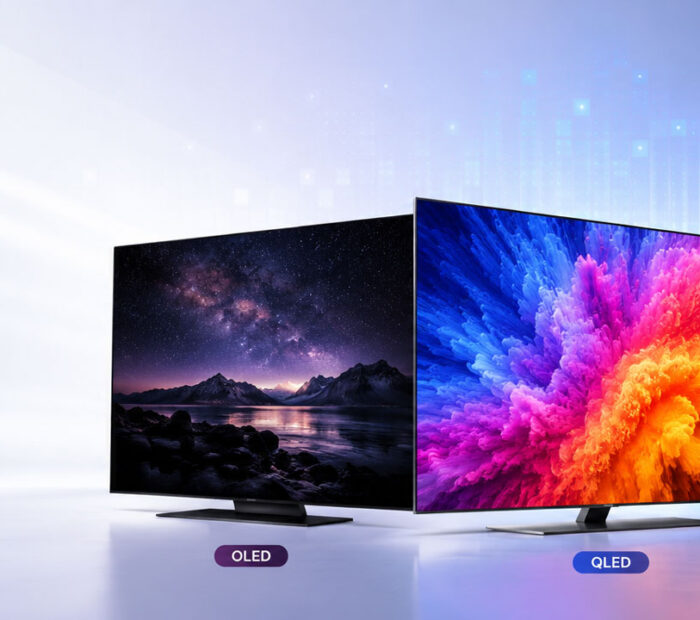
Buying a new television can become confusing when product pages use terms such as OLED, QLED, Mini-LED, Neo QLED, and Quantum Dot. Although these names may sound similar, the technologies do not create or control light in the same way.
The OLED vs QLED vs Mini-LED decision mainly depends on your room lighting, viewing habits, preferred content, and budget. OLED usually provides the deepest blacks and most precise contrast. Meanwhile, QLED televisions offer strong brightness and a wide selection of prices and screen sizes. Mini-LED improves traditional LCD backlighting to provide greater brightness and better control over dark areas.
However, the display label alone does not determine the final picture quality. Image processing, local dimming, panel quality, screen coating, refresh rate, and software also make a major difference. Therefore, buyers should compare complete television models instead of selecting one only by its display name.
OLED vs QLED vs Mini-LED: Quick Comparison
- Choose OLED for deep blacks, precise contrast, wide viewing angles, movies, and responsive gaming.
- Choose QLED for vibrant colours, good brightness, broader price choices, and everyday family viewing.
- Choose Mini-LED for very high brightness, improved local dimming, HDR content, sports, and bright rooms.
Each technology has clear strengths. As a result, there is no single display type that suits every home or every viewer.
What Is an OLED TV?
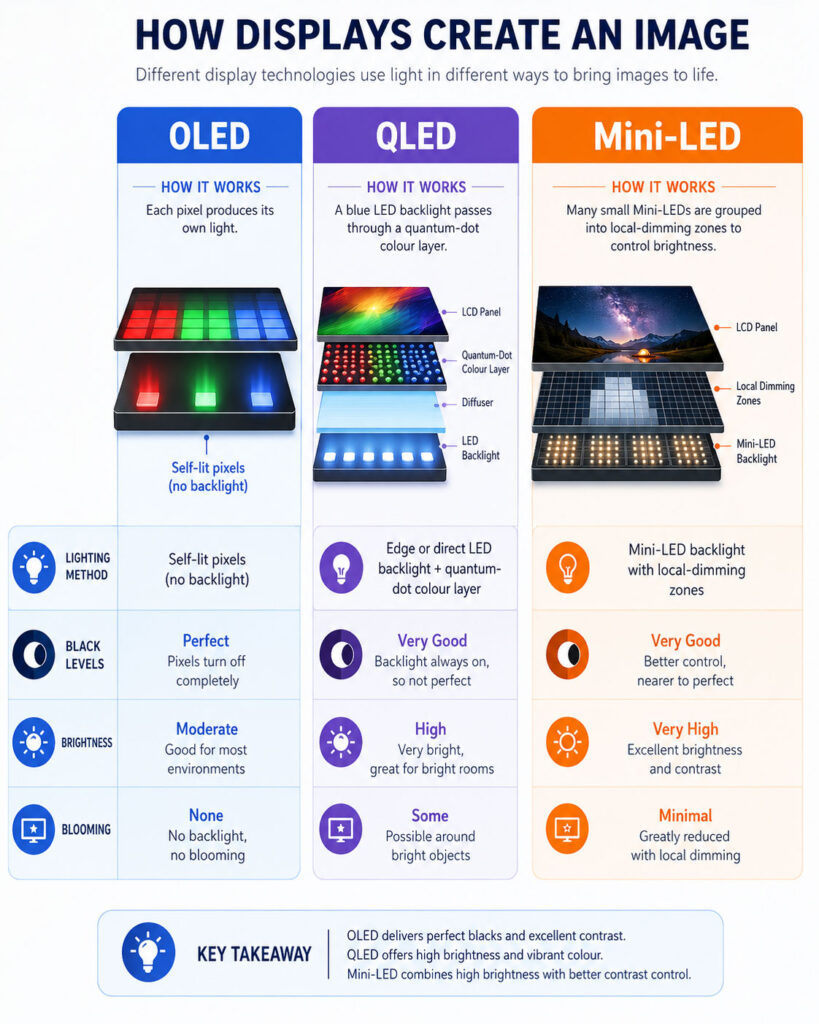
OLED stands for Organic Light-Emitting Diode. Every pixel in an OLED display produces its own light, so the television does not need a separate backlight behind the screen.
When an OLED pixel needs to show black, it can switch off completely. Consequently, OLED televisions can produce deep black areas next to bright objects without creating a visible halo. This pixel-level lighting control also helps preserve detail in dark movie scenes.
OLED televisions generally maintain consistent colours and contrast when viewed from the side. In addition, their pixels respond very quickly, which can make motion appear sharp during games, sports, and action movies.
However, OLED televisions often cost more than basic LED or QLED models. They can also face permanent image-retention risk when static elements remain on the screen for prolonged periods. Modern protection features reduce that risk, although they cannot remove it completely.
What Is a QLED TV?
QLED stands for Quantum Dot Light-Emitting Diode. Despite its name, a consumer QLED television usually uses an LCD panel with a separate LED backlight. A quantum-dot layer helps the television produce bright and vivid colours.
QLED televisions commonly work well in living rooms that receive plenty of daylight. Manufacturers also offer them across a wide range of sizes and prices. Therefore, buyers can find both affordable QLED televisions and advanced premium models.
Nevertheless, QLED picture quality varies considerably between models. Entry-level televisions may use basic edge lighting and provide limited control over dark scenes. Premium models may use full-array local dimming or Mini-LED backlighting to improve contrast.
For this reason, the QLED label alone does not guarantee excellent black levels or premium picture quality. Buyers should also check the backlight design, dimming performance, refresh rate, and independent model reviews.
What Is a Mini-LED TV?
Mini-LED is a backlight technology rather than a completely separate type of display panel. It uses much smaller LEDs behind an LCD screen. Manufacturers can place more LEDs and local-dimming zones behind the panel, which allows the television to control bright and dark sections more accurately.
A good Mini-LED television can deliver strong HDR highlights, high full-screen brightness, and deeper blacks than a basic LED-backlit television. Furthermore, better local dimming can reduce the glow around subtitles, stars, lamps, and other bright objects.
However, Mini-LED still uses a backlight. It cannot switch off each individual pixel in the same way as OLED. Therefore, some blooming may remain when a small bright object appears against a completely dark background.
Mini-LED performance also depends on the quality of the dimming algorithm. A television with many lighting zones may still perform poorly if its software reacts too slowly or dims important picture details.
Can a TV Be Both QLED and Mini-LED?
Yes. QLED and Mini-LED describe different parts of a television.
QLED refers to the quantum-dot technology used to improve colour. In contrast, Mini-LED refers to the backlight that shines through the LCD panel. Therefore, one television can combine both technologies.
Manufacturers may market these combinations using names such as Neo QLED, QD-Mini LED, or Mini-LED QLED. Buyers should examine the specifications carefully instead of assuming that QLED and Mini-LED always compete with each other.
OLED vs QLED vs Mini-LED Comparison
| Feature | OLED | QLED | Mini-LED |
|---|---|---|---|
| Lighting method | Each pixel produces its own light | LED backlight with quantum dots | Smaller LEDs with local-dimming zones |
| Black levels | Excellent | Varies by backlight quality | Very good on premium models |
| Brightness | Good to very high | Usually high | Usually very high |
| Blooming | No backlight blooming | Possible | Reduced but still possible |
| Viewing angles | Generally wide | Varies by LCD panel | Varies by LCD panel |
| Static image concern | Some burn-in risk | No OLED-style burn-in risk | No OLED-style burn-in risk |
| Common price range | Mid-range to premium | Budget to premium | Mid-range to premium |
| Best suited for | Movies and dark rooms | General viewing and varied budgets | Bright rooms, sports, and HDR |
This table describes the general characteristics of each technology. Still, a premium QLED or Mini-LED television may outperform an entry-level OLED in specific areas. The quality of the individual model remains important.
Black Levels and Contrast
OLED has the clearest advantage in black-level performance. Since every pixel controls its own light, black areas can remain completely dark even when a bright object appears beside them.
This precise control gives dark movie scenes greater depth. For example, stars, streetlights, and subtitles can appear bright without producing a backlight glow around them. Therefore, OLED remains a strong choice for home theatres and evening viewing.
Mini-LED televisions attempt to achieve a similar effect by dividing the backlight into many local-dimming zones. Smaller zones allow the television to control light more accurately than a standard LED television. Even so, one zone may illuminate several pixels at once, so some blooming can still appear.
QLED contrast depends heavily on the backlight. A premium full-array or Mini-LED QLED television may produce impressive dark scenes. In contrast, a basic edge-lit model may display grey-looking blacks or uneven light.
Brightness and HDR Performance
Mini-LED televisions usually offer the strongest brightness for sunlit rooms and high-impact HDR content. Their powerful backlights can keep the picture visible when daylight or room lighting reaches the screen.
QLED televisions also tend to perform well in bright environments. Quantum dots help them maintain rich colours at higher brightness levels. As a result, QLED can suit everyday television, sports, and daytime family viewing.
Modern OLED televisions have become significantly brighter. However, many still reduce brightness when a large part of the screen displays a bright image. A premium Mini-LED television may therefore look brighter during sports, animated programmes, or scenes containing large white areas.
Brightness alone does not determine HDR quality. OLED can create dramatic highlights because each bright object appears next to pixels that can switch off completely. Consequently, an OLED television may still deliver a more striking dark-room HDR experience.
Colour Quality
OLED, QLED, and Mini-LED televisions can all produce excellent colours when manufacturers tune them properly. OLED combines accurate pixel control with strong contrast, while QLED commonly maintains vivid colours at high brightness.
Many Mini-LED televisions also include quantum-dot technology. Therefore, premium models can combine high colour volume, strong brightness, and improved black levels.
However, showroom settings often increase saturation, brightness, and sharpness to attract attention. Buyers should compare televisions using accurate cinema, filmmaker, or movie modes whenever possible.
Viewing Angles
OLED generally provides the most consistent off-centre viewing experience. Colours and contrast usually remain stable when viewers sit away from the middle of the television.
QLED and Mini-LED viewing angles depend on the LCD panel and any additional viewing-angle layer. Some models look excellent from the centre but lose contrast or colour intensity when viewed from the side.
Therefore, viewing angles matter when a room has a wide sofa, several chairs, or an open seating arrangement. A television that looks excellent from one position may not provide the same experience to everyone in the room.
Reflections and Bright-Room Viewing
A television needs enough brightness and an effective screen coating to overcome reflections. Premium QLED and Mini-LED models often perform well in rooms with windows because they combine strong brightness with anti-reflection technology.
OLED televisions can also work in bright rooms, particularly when newer panels include improved brightness and better coatings. Nevertheless, direct sunlight may reduce visibility and can place unnecessary heat on the panel.
Room layout matters as much as display technology. Before buying, check whether lamps, windows, or balcony doors will reflect directly on the screen.
Motion and Sports
OLED pixels change rapidly, which reduces visible smearing during fast movement. This characteristic can make action scenes, football, cricket, and racing content appear clear.
However, fast pixel response can also make low-frame-rate movies appear slightly uneven during slow camera movement. Motion-processing settings may reduce this effect, although excessive processing can create an unnatural appearance.
QLED and Mini-LED televisions can also handle motion well when they use a native high-refresh-rate panel and capable image processing. Therefore, sports viewers should compare motion handling, panel refresh rate, and upscaling instead of relying only on the display label.
Gaming Performance
OLED is popular among gamers because it combines fast pixel response, deep blacks, and precise contrast. A suitable model can make dark games look detailed while keeping controls responsive.
Premium QLED and Mini-LED televisions can also provide an excellent gaming experience. Many include high refresh rates, low-latency modes, variable refresh rate support, and HDMI 2.1 connections.
As a result, display technology should not be the only gaming consideration. Buyers should also check input lag, supported resolutions, refresh rates, HDMI bandwidth, variable-refresh-rate formats, and game-mode picture quality.
People who play the same game for many hours every day may prefer QLED or Mini-LED. Fixed health bars, maps, scoreboards, and menus do not create the same burn-in concern found with OLED panels.
OLED Burn-In and Static Content
Burn-in is permanent image retention caused by uneven pixel ageing. It may occur when an OLED television repeatedly displays the same static logo, banner, menu, scoreboard, or game interface for prolonged periods.
Modern OLED televisions use pixel shifting, screen savers, logo brightness adjustment, compensation cycles, and other protective features. These tools make burn-in less concerning for normal mixed viewing.
Nevertheless, users who show security-camera feeds, business dashboards, news channels, or fixed computer interfaces throughout the day may feel more comfortable with QLED or Mini-LED.
QLED and Mini-LED televisions use LCD panels with separate backlights. Therefore, they do not face the same organic-pixel ageing associated with OLED burn-in.
Which Display Works Best in Your Room?
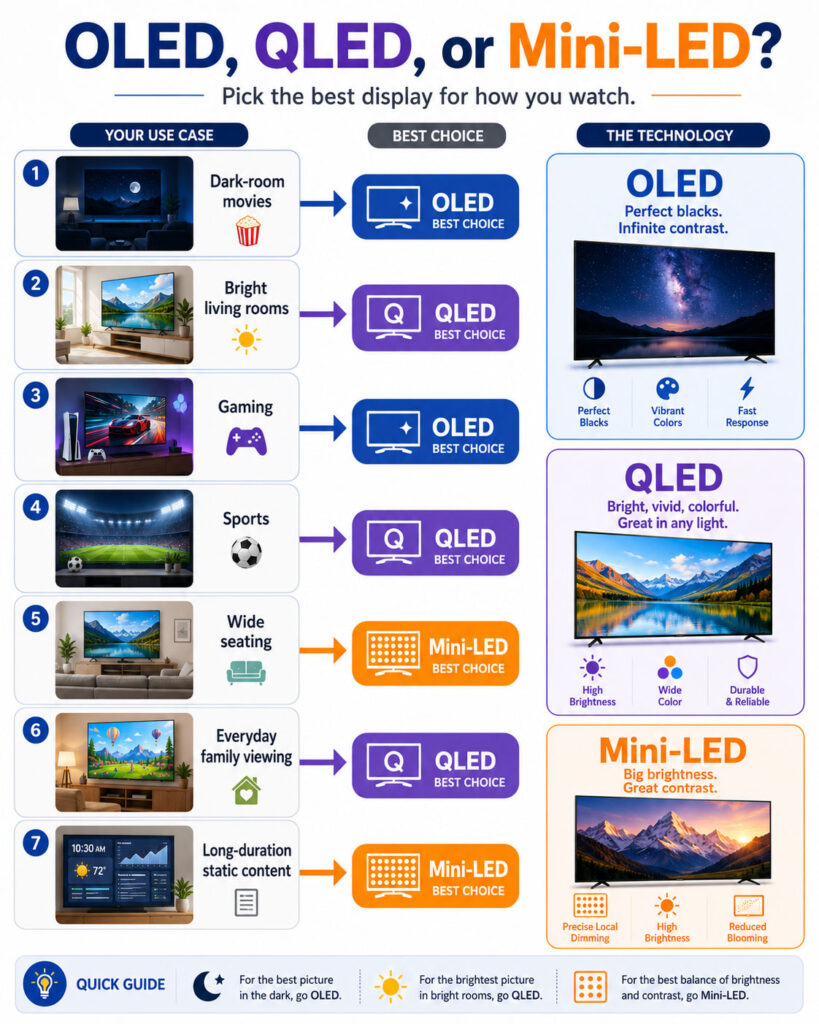
- Dark home-theatre room: OLED usually provides the strongest blacks and most precise contrast.
- Very bright living room: Mini-LED usually provides greater full-screen brightness.
- Moderately lit room: Any of the three can perform well when the individual model is suitable.
- Wide seating arrangement: OLED generally provides more consistent off-centre viewing.
- Television used throughout the day: QLED or Mini-LED may provide greater confidence with static content.
- Room with strong reflections: Compare screen coatings and measured brightness rather than the panel name alone.
Best Display for Different Types of Content
- Movies: OLED provides deep blacks and precise control during dark scenes.
- Sports: Mini-LED offers strong brightness, while OLED provides fast pixel response.
- Gaming: OLED offers excellent response, although premium Mini-LED and QLED televisions can also provide advanced gaming features.
- News channels: QLED or Mini-LED avoids OLED-style burn-in concerns from fixed logos and banners.
- Everyday family viewing: QLED provides many practical choices across different budgets.
- HDR movies and series: OLED provides precise contrast, while Mini-LED produces powerful bright highlights.
Therefore, the best TV for movies and gaming may not be the best option for a sunny living room that shows news or sports throughout the day.
Choose OLED If You Want a Cinematic Experience
OLED is a strong choice for movie enthusiasts who usually watch television in a dim or dark room. Its self-lit pixels provide deep blacks, precise contrast, and detailed night scenes.
It also suits rooms with wide seating arrangements because viewers can generally see consistent colours and contrast from different positions. Furthermore, fast pixel response makes OLED attractive for modern console and computer gaming.
However, buyers should consider their viewing habits. OLED may not be the most practical option when a television displays the same channel logo, dashboard, menu, or security-camera layout for most of the day.
Choose QLED If You Want More Options
QLED is suitable for buyers who want vibrant colours, good brightness, and a broad selection of prices, sizes, and features.
A QLED television can work well for streaming, television channels, family entertainment, sports, and casual gaming. However, buyers should examine the backlight system carefully because two televisions carrying the QLED label may provide very different contrast performance.
Therefore, compare the individual model’s local dimming, brightness, panel refresh rate, screen coating, and software rather than relying only on the QLED name.
Choose Mini-LED If You Want High Brightness
Mini-LED is ideal for bright rooms, daytime viewing, sports, and high-impact HDR content. It offers more precise backlight control than a conventional LED television and avoids OLED-style burn-in concerns.
Premium Mini-LED models can provide an effective balance of brightness, colour, contrast, and large screen sizes. Nevertheless, they may still show blooming in difficult dark scenes. Their viewing angles can also vary according to the LCD panel.
For many households, Mini-LED provides a practical middle ground between OLED’s pixel-level contrast and the brightness associated with premium LCD televisions.
Important Specifications Beyond the Display Name
Display technology is important, but it should not be the only buying factor. Before selecting a television, review the following specifications:
- Local-dimming performance: Better control can improve black levels and reduce blooming.
- Native refresh rate: A 120Hz or higher panel can improve gaming and fast-moving content.
- HDMI 2.1 connections: Suitable ports may support higher gaming resolutions and refresh rates.
- Variable refresh rate: VRR can reduce screen tearing when a game’s frame rate changes.
- Input lag: Lower input lag provides faster response between a controller and the screen.
- HDR format support: Check compatibility with your streaming services, discs, and connected devices.
- Image processing: Good processing improves motion, upscaling, gradients, and lower-quality content.
- Anti-reflection coating: An effective coating matters in rooms with windows and strong lighting.
- Operating system: Review app availability, update support, speed, advertisements, and ease of use.
- Screen size: A larger balanced television may provide more value than a smaller premium panel.
- Sound quality: Thin televisions often benefit from a soundbar or external speaker system.
Common TV-Buying Mistakes
- Assuming that every QLED television offers the same picture quality.
- Believing that Mini-LED and QLED cannot appear in the same television.
- Selecting the brightest showroom display without checking accurate picture modes.
- Ignoring windows, lamps, reflections, and viewing angles.
- Buying a television without checking its HDMI ports and gaming capabilities.
- Choosing a small premium screen when a larger balanced model better suits the viewing distance.
- Assuming that OLED burn-in is guaranteed during normal use.
- Believing that OLED burn-in is impossible under demanding static use.
- Comparing only panel technology while ignoring processing and local dimming.
- Paying for advanced gaming features that the connected console or computer cannot use.
Is Mini-LED Better Than OLED?
Mini-LED is usually more suitable for very bright rooms, daytime sports, large bright scenes, and users who display static content for long periods. In contrast, OLED generally provides deeper blacks, more precise pixel-level contrast, and wider viewing angles.
Therefore, Mini-LED is not automatically better than OLED. The right choice depends on the room, content, and daily usage.
Is QLED Better Than OLED?
QLED may offer higher full-screen brightness, more size choices, and a broader range of prices. OLED usually provides deeper blacks, more precise contrast, and more consistent viewing angles.
Consequently, QLED may be more practical for a bright family room, while OLED may deliver a stronger cinematic experience in a controlled environment.
Does QLED Have Burn-In?
QLED televisions use LCD panels with separate LED backlights. As a result, they do not face the same permanent image-retention risk caused by uneven ageing of organic OLED pixels.
However, televisions can still experience temporary image retention, panel defects, or other display problems. Users should follow the manufacturer’s operating and maintenance guidance.
Is OLED Suitable for a Bright Room?
Modern OLED televisions can work well in many bright rooms, especially when they include improved panels and effective anti-reflection coatings. However, direct sunlight and strong reflections can still reduce picture visibility.
A high-quality Mini-LED television may provide a more practical choice when the room remains extremely bright throughout the day.
Is Mini-LED the Same as QLED?
No. Mini-LED describes the backlight, while QLED describes the use of quantum dots to improve colour. A television can use either technology or combine both.
Which TV Display Is Best for Gaming?
OLED is popular for gaming because it offers fast pixel response, deep blacks, and precise light control. However, premium QLED and Mini-LED televisions can also provide high refresh rates, low input lag, VRR, and strong HDR brightness.
Therefore, compare the complete gaming feature set. Check the number of HDMI 2.1 ports, supported refresh rates, variable-refresh-rate formats, input lag, and game-mode image quality.
Which Technology Lasts Longer?
A television’s usable life depends on panel quality, heat, brightness settings, daily usage, components, and manufacturing quality. Therefore, it is difficult to declare one technology the longest-lasting option in every situation.
OLED pixels gradually lose brightness as they age, while LCD televisions can experience backlight, panel, or local-dimming problems. Buyers should review warranty coverage, service availability, and long-term model reliability rather than relying on a general lifespan claim.
Should You Buy a TV Only by Its Display Type?
No. A well-designed television with strong processing and accurate local dimming may outperform another model that uses a more advanced display label but has weaker implementation.
Before purchasing, compare professional measurements, customer support, software performance, port selection, warranty terms, and the television’s behaviour with your preferred content.
Final Verdict
The OLED vs QLED vs Mini-LED comparison does not produce one winner for every buyer. OLED delivers exceptional black levels, precise contrast, wide viewing angles, and responsive gaming. QLED provides vibrant colours and many choices across different prices and sizes. Meanwhile, Mini-LED combines powerful brightness with more accurate backlight control.
Choose OLED for cinematic viewing, dark rooms, wide seating, and fast gaming. Select QLED when you want flexibility, brightness, and more budget choices. Consider Mini-LED when you need very high brightness, strong HDR performance, and reduced concern about static content.
Finally, compare complete television models before making a purchase. The processor, backlight system, screen coating, refresh rate, connections, software, and warranty can matter just as much as the display name printed on the box.

AboutTPJ Technical Team
The Project Jugaad Technical Team creates practical, easy-to-follow content on software development, web technologies, artificial intelligence, cybersecurity, cloud platforms, and digital tools. Our articles are informed by more than 13 years of hands-on experience with .NET, Angular, SQL Server, AWS, WordPress, Linux hosting, application deployment, and real-world troubleshooting. Each guide is researched, reviewed, and updated to provide accurate, useful, and actionable information for developers, businesses, and everyday technology users.