
Web Development
SEO vs AEO vs GEO has become an important comparison for website owners, marketers, developers, bloggers, and businesses adapting to AI-powered search.
Traditional search results still matter. However, users can now receive direct answers, summaries, comparisons, recommendations, and supporting links through AI-driven search experiences.
As a result, websites need content that search engines can crawl and index, people can understand, and AI systems can retrieve when building a useful response.
SEO remains the foundation. Meanwhile, AEO focuses on making answers easier to find and present, while GEO focuses on visibility within generative AI responses.
What Is SEO?
SEO stands for Search Engine Optimization.
It includes the technical, content, and authority-related work that helps search engines discover, understand, index, and present a website.
For example, SEO may include:
- Creating useful and original content.
- Matching pages with relevant search intent.
- Improving page titles and descriptions.
- Using clear headings and internal links.
- Making pages crawlable and indexable.
- Improving mobile usability and page performance.
- Managing duplicate URLs and canonical tags.
- Earning genuine links and mentions.
- Adding supported structured data where appropriate.
Therefore, SEO covers much more than placing keywords inside a page.
What Is AEO?
AEO stands for Answer Engine Optimization.
The term describes practices that help search systems identify a clear and useful answer to a user’s question.
Answer engines can include featured snippets, voice assistants, question-and-answer interfaces, and AI-supported search experiences.
For example, a page about website speed may answer a specific question directly:
What is Largest Contentful Paint?

Largest Contentful Paint measures how long the largest
visible content element takes to appear in the viewport.
The answer appears immediately after the question. Consequently, users and search systems can understand the main point without reading several unrelated paragraphs first.
However, AEO does not mean that every paragraph should become a short definition. A complete page should still provide examples, context, limitations, and practical guidance.
What Is GEO?
GEO stands for Generative Engine Optimization.
The term generally describes efforts to improve whether generative AI search systems retrieve, reference, summarise, or link to website content.
For instance, a generative response may combine information from several sources before showing a comparison and supporting links.
GEO commonly focuses on:
- Clear and verifiable information.
- Original experience or expert insight.
- Strong topical coverage.
- Accurate facts and source attribution.
- Content that answers complex follow-up questions.
- Consistent information about a business or entity.
- Pages that search systems can crawl and index.
Nevertheless, GEO is an industry term rather than a separate technical standard followed identically by every AI platform.
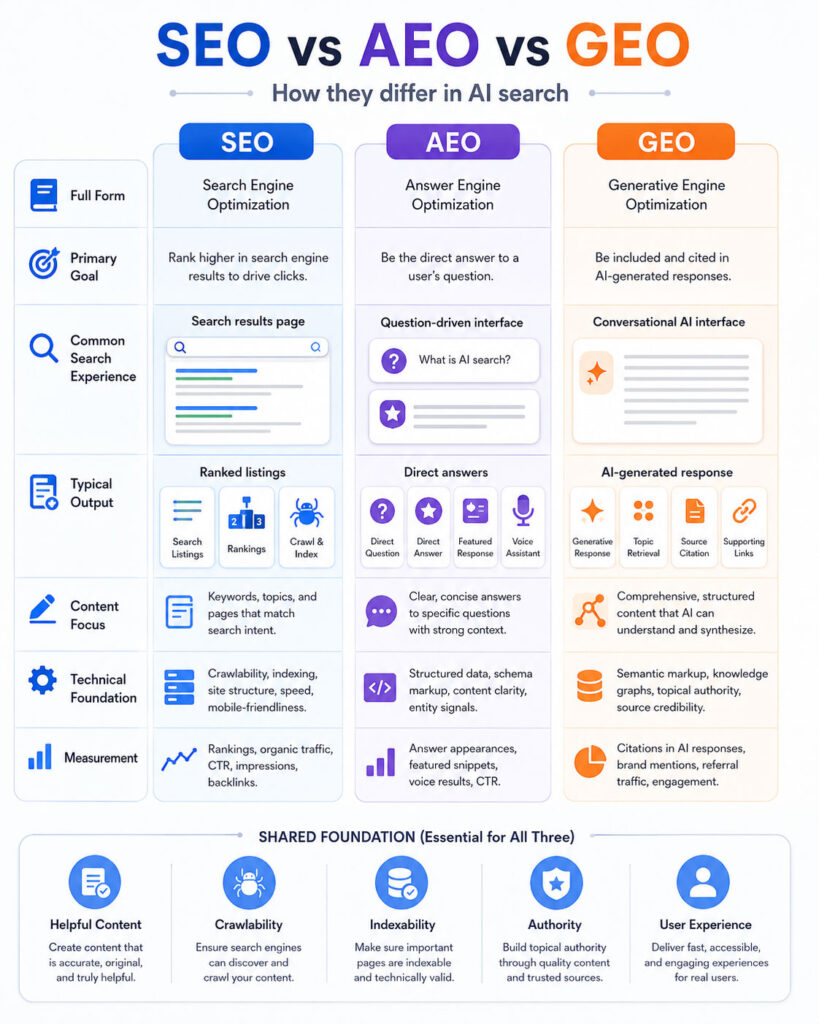
SEO vs AEO vs GEO: Quick Comparison
| Point | SEO | AEO | GEO |
|---|---|---|---|
| Full Form | Search Engine Optimization | Answer Engine Optimization | Generative Engine Optimization |
| Main Goal | Improve website visibility in search | Make useful answers easy to identify and present | Improve visibility within generative AI responses |
| Typical Result | Search listing, rich result, image, video, or local result | Direct answer, featured response, or voice answer | AI-generated response with references or supporting links |
| Primary Foundation | Crawlability, indexing, relevance, quality, and authority | Clear questions, concise answers, and useful structure | Retrievable, reliable, distinctive, and well-supported content |
| Content Style | Useful content aligned with search intent | Direct answers supported by deeper information | Complete topic coverage with evidence and unique value |
| Measurement | Impressions, clicks, rankings, traffic, and conversions | Answer visibility, question impressions, clicks, and engagement | AI-feature visibility, citations, referrals, and conversions |
The three areas overlap significantly. Therefore, businesses should not treat them as isolated marketing channels.
Is AEO or GEO Replacing SEO?
No. AEO and GEO extend familiar search practices rather than replacing the need for SEO.
A page cannot gain reliable search visibility when crawlers cannot access it, the URL is not indexed, or search engines cannot understand its main purpose.
Likewise, an AI search feature often relies on indexed web content and established ranking or retrieval systems when finding supporting information.
Consequently, technical SEO, helpful content, internal linking, mobile usability, and page quality remain important.
How AI Search Differs from Traditional Search
Traditional search commonly displays a list of results that users explore individually.
By contrast, AI search can combine information from several sources and create a direct response. It may also help users continue with more detailed follow-up questions.
For example, a user may ask:
Which website platform is suitable for a small service business
that needs good SEO, easy content editing, and a low budget?
This request contains several requirements. Therefore, the search system may investigate platform cost, SEO capability, editing experience, hosting, maintenance, and scalability before creating a response.
Some AI search systems use several related searches to explore subtopics. As a result, one detailed page may become relevant to several parts of a broader question.
What Is Query Fan-Out?
Query fan-out is a process in which an AI search system creates several related searches from one complex request.
For example, a question about choosing a laptop may lead to related searches about processor performance, battery life, display quality, price, software compatibility, and repair support.
Original complex question
↓
Multiple related searches
↓
Relevant pages and data sources
↓
Generated response with supporting links
Therefore, websites should cover meaningful subtopics naturally instead of repeating one keyword many times.
How Websites Become Eligible for AI Search Visibility
Eligibility begins with the same technical foundation used for ordinary search.
A page should be:
- Accessible to the relevant search crawler.
- Indexable.
- Eligible to appear with a search snippet.
- Available through a stable and working URL.
- Useful on mobile and desktop devices.
- Clear about its primary topic.
- Compliant with search quality and spam policies.
Meeting these requirements does not guarantee inclusion. However, blocking indexing or snippets can prevent the page from appearing as a supporting source.
SEO vs AEO vs GEO Content Example
Consider a blog about password security.
A basic SEO approach may target a relevant title, searchable topic, internal links, descriptive headings, and useful information.
An AEO improvement may add a clear answer near the beginning:
A strong password should be long, unique, and difficult
to predict. A password manager can generate and store
different passwords for separate accounts.
A GEO improvement may add original testing, practical examples, current recommendations, limitations, and links to reliable sources.
Together, these improvements create a page that can rank, answer, support, and inform.
What Has Not Changed?
AI search changes how users interact with results. Nevertheless, the core purpose of useful website content remains the same.
Pages should help real visitors solve a problem, understand a topic, compare options, or complete a task.
Therefore, the most durable strategy still includes:
- Accurate information.
- Clear writing.
- Original value.
- Logical navigation.
- Good technical implementation.
- Reliable user experience.
- Transparent authorship and updates.
Content created only to manipulate an AI response is unlikely to provide stable long-term value.
How to Improve SEO for AI Search
Start with the same foundation required for traditional search.
First, identify what visitors genuinely want to understand or accomplish. Next, create a page that answers the main question and supports related decisions.
Finally, ensure that search engines can crawl, render, index, and interpret the page.
1. Match the Real Search Intent
A page should solve the problem behind the query rather than target only the words inside it.
For example, someone searching for best cloud backup may need more than a product list. The visitor may also want pricing, storage limits, restore options, device support, security, and cancellation details.
Therefore, review the decisions a reader must make after arriving on the page.
2. Answer the Main Question Early
Do not force readers to move through a long introduction before receiving the basic answer.
Instead, provide a concise and accurate summary near the beginning. Afterwards, expand the topic through examples, comparisons, evidence, and practical steps.
For example:
<h6>What Is Answer Engine Optimization?</h6>
<p>Answer Engine Optimization helps search systems
identify and present a clear response to a user's question.
It builds on SEO through direct answers, useful structure,
and reliable supporting information.</p>
This format benefits readers first. In addition, it gives retrieval systems a clearly defined passage.
3. Use Descriptive Headings
Headings should communicate what the following section contains.
Generic headings such as More Information or Important Details provide limited context.
Instead, use headings such as:
- How Does AI Search Find Supporting Sources?
- Does Structured Data Improve AI Search Visibility?
- Should You Create an llms.txt File?
- How Can Small Websites Compete?
Consequently, both readers and search systems can navigate the content more easily.
4. Create Complete but Focused Topic Coverage
A useful page should answer the main question and the closely related questions a visitor is likely to ask next.
However, do not add unrelated sections only to increase word count.
For a comparison article, useful coverage may include:
- Definitions.
- Main differences.
- Benefits and limitations.
- Pricing or resource requirements.
- Security and privacy concerns.
- Practical use cases.
- A decision checklist.
Therefore, completeness should come from reader needs rather than keyword volume.
5. Add Original and Non-Commodity Value
AI systems can already summarise widely repeated information.
As a result, pages that simply rewrite common facts may struggle to stand out.
Original value can include:
- First-hand experience.
- Real screenshots or test results.
- Case studies.
- Detailed implementation steps.
- Original comparisons.
- Local or industry-specific insight.
- Mistakes discovered during practical work.
- Clear opinions supported by evidence.
For example, a generic hosting article may repeat standard features. In contrast, an original article can document actual migration time, support experience, performance results, and unexpected limitations.
6. Demonstrate Experience and Trust
Visitors should understand who created the content and why they can trust it.
Therefore, consider adding:
- A clear author name.
- An author profile.
- A publication or review date.
- Relevant experience.
- Sources for important claims.
- Contact and business information.
- A correction or update process.
These details do not replace content quality. However, they help readers evaluate the information.
7. Support Important Claims with Reliable Sources
Technical, financial, medical, legal, and time-sensitive claims require careful verification.
Whenever possible, use primary sources such as official documentation, standards, government resources, original research, or direct product information.
Furthermore, make sure the cited source actually supports the statement.
Adding unrelated links does not increase trust. Instead, it can distract readers and weaken the page.
8. Use Clear Entities and Consistent Names
An entity can be a business, person, product, service, location, organisation, or concept.
Use consistent names when referring to important entities. In addition, explain uncommon abbreviations when they first appear.
For example:
Generative Engine Optimization (GEO)Afterwards, the shorter term GEO can be used without creating confusion.
9. Strengthen Internal Linking
Internal links help visitors and search systems discover related pages.
For example, an article about AI search can link naturally to content about structured data, Core Web Vitals, AI-generated content, and website indexing.
Use descriptive link text instead of repeated phrases such as click here.
However, do not add every possible internal link to every paragraph. Select links that genuinely help the reader continue the topic.
10. Keep Important Information in Visible Page Content
Search systems should be able to access the same meaningful content that users can read.
Therefore, avoid placing critical information only inside images, inaccessible scripts, or interactions that crawlers cannot reach.
Images can support the page, but the surrounding HTML should still explain the essential information.
11. Make JavaScript Content Search-Friendly
Modern websites often use JavaScript frameworks and client-side rendering.
Search engines can process many JavaScript pages. Nevertheless, rendering adds complexity and can delay discovery of important content or links.
Therefore:
- Return useful HTML whenever practical.
- Do not block essential scripts or styles.
- Use real links with valid URLs.
- Ensure primary content appears without user interaction.
- Test rendered pages through search-engine tools.
- Use server rendering or pre-rendering when it provides a clear benefit.
12. Improve Page Experience
A visitor may leave even when the content is excellent if the page loads slowly or becomes difficult to use.
Consequently, review:
- Mobile layout.
- Loading performance.
- Interaction responsiveness.
- Visual stability.
- Intrusive popups.
- Readable typography.
- Navigation.
- Advertisement placement.
Good performance does not guarantee visibility. However, poor usability can reduce visitor satisfaction and conversion value.
13. Use Structured Data Correctly
Structured data helps search engines understand supported content types and can make a page eligible for rich results.
For example, suitable pages may use supported markup for articles, products, breadcrumbs, organisations, events, or local businesses.
However, structured data must match the visible page content.
In addition, it does not guarantee a rich result, higher ranking, or inclusion in a generative answer.
Does AI Search Require Special Schema?
No special schema markup is required specifically for Google’s generative search features.
Therefore, continue using only supported structured data that accurately represents the visible content.
Avoid creating invented schema types or adding unrelated markup because someone claims that AI systems require it.
14. Keep Pages Crawlable and Indexable
Review robots rules, page-level indexing controls, canonical tags, status codes, and sitemap inclusion.
For example, the following directive prevents a page from appearing in search:
<meta name="robots" content="noindex">Similarly, a nosnippet directive prevents Google from displaying a text snippet for the page.
Because supporting links in Google’s AI features must remain eligible for snippets, restrictive controls can affect visibility.
15. Manage Duplicate and Similar Content
Multiple URLs containing the same or nearly identical content can divide crawling and ranking signals.
Therefore, use consistent internal links and canonical URLs. Also, redirect obsolete versions when appropriate.
Do not create separate pages for every small variation of an AI-related query when one strong page can answer them together.
16. Update Time-Sensitive Information
Outdated prices, specifications, dates, screenshots, or software instructions reduce usefulness.
Therefore, review content that covers fast-changing topics.
However, changing only the displayed date without improving the content does not make the information current.
Update the factual details, remove obsolete sections, and clearly note important changes.
17. Add Useful Images and Video
High-quality visual content can explain processes that text alone makes difficult.
For example, diagrams can show an AI retrieval workflow, while screenshots can guide users through Search Console.
Use descriptive filenames and alternative text. In addition, compress media and reserve its layout space to protect performance.
18. Optimise Business and Product Information
Local and e-commerce visibility depends on accurate business and product details.
Therefore, businesses should maintain relevant profiles, product feeds, prices, availability, addresses, contact details, and opening hours.
Consistency matters because search experiences may combine information from a website with other trusted data sources.
19. Use Generative AI Content Carefully
Generative AI can help with research, structure, outlines, and initial drafts.
However, publishing large amounts of unreviewed content can introduce factual errors, repetition, weak examples, and limited original value.
Before publishing AI-assisted content:
- Verify every important claim.
- Add first-hand knowledge or expert insight.
- Remove invented references and unsupported statements.
- Improve the structure for real readers.
- Check originality and usefulness.
- Review privacy, copyright, and security concerns.
- Confirm that the page supports the site’s main purpose.
Most importantly, do not publish content only because a tool can generate it quickly.
20. Write for People, Not for Retrieval Tricks
Some advice recommends breaking every page into tiny isolated passages so AI systems can extract them.
Clear sections are useful. However, there is no universal requirement to divide content into unnaturally small chunks.
Instead, choose paragraph and section lengths that make the subject easy for people to follow.
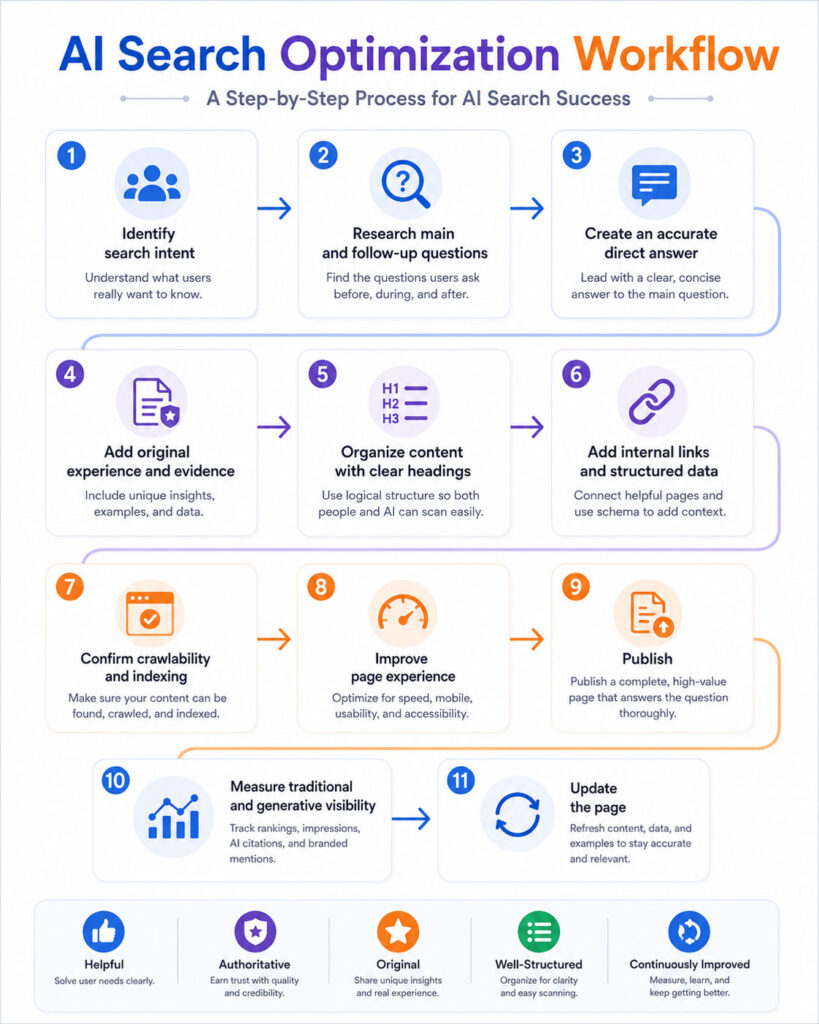
SEO vs AEO vs GEO Implementation Workflow
A practical strategy should combine all three areas within one content and technical process.
- Identify the audience and main search intent.
- Choose one clear topic for the page.
- Research the main question and relevant follow-up questions.
- Create an accurate direct answer.
- Add examples, evidence, experience, and limitations.
- Organise the page with descriptive headings.
- Add relevant internal and external links.
- Confirm crawlability, indexability, and canonical settings.
- Apply supported structured data when appropriate.
- Test mobile usability and page performance.
- Publish and request indexing only when necessary.
- Monitor visibility, clicks, engagement, and conversions.
- Update the page when information changes.
This workflow supports traditional listings, answer surfaces, and generative search without creating separate versions of the same article.
How to Measure Traditional SEO
Traditional SEO measurement commonly includes:
- Search impressions.
- Organic clicks.
- Click-through rate.
- Average search position.
- Indexed pages.
- Organic landing-page sessions.
- Conversions and enquiries.
- Revenue or business value.
However, rankings alone do not show whether visitors find the content useful.
Therefore, connect search performance with engagement and business outcomes.
How to Measure AEO
AEO measurement can include visibility for direct questions and answer-focused searches.
Depending on the platform and available tools, teams may review:
- Featured snippet visibility.
- Search impressions for question-based queries.
- Clicks to pages with concise answers.
- Voice or assistant referrals when identifiable.
- Engagement with FAQ and instructional content.
- Conversions from answer-focused landing pages.
Nevertheless, some answer surfaces provide limited reporting. Therefore, avoid promising a level of attribution that the platform does not provide.
How to Measure GEO
Generative search measurement remains less standardised than traditional search reporting.
Useful signals may include:
- Visibility inside AI search features.
- URLs shown as supporting sources.
- Referral traffic from AI platforms.
- Brand searches after AI exposure.
- Mentions and citations.
- Engagement from generative-search visitors.
- Leads, sales, or subscriptions from those visits.
As reporting improves, teams should record both visibility and business outcomes.
Search Console and AI Search Reporting
Search Console remains an important tool for checking indexing, queries, pages, countries, devices, and search performance.
Google has also started introducing dedicated generative AI performance reports for a subset of websites.
These reports can show:
- How often website URLs appeared in generative AI features.
- Which pages received visibility.
- Countries where the URLs appeared.
- Devices used for Search visibility.
- Performance changes across selected dates.
However, the feature may not yet appear for every property. Therefore, continue monitoring the standard Performance and indexing reports as well.
Should You Track AI Referral Traffic?
Yes, when the analytics platform identifies the source reliably.
Create a reporting group for known AI and generative-search referrals. Afterwards, compare their engagement, conversions, and landing pages with other channels.
However, some visits may appear as direct traffic or another referral source. Consequently, referral reporting may not represent every AI-influenced visit.
Common SEO, AEO, and GEO Myths
| Myth | Reality |
|---|---|
| SEO no longer matters | AI search still depends heavily on discoverable, indexed, and useful web content |
| AEO requires a separate version of every page | Clear answers can be added naturally to the main useful page |
| GEO guarantees AI citations | No optimisation can guarantee inclusion in a generated response |
| Every paragraph needs an exact keyword | Search systems can understand meaning, context, and synonyms |
| Special AI schema is required | Use supported structured data for applicable search features |
| AI content is automatically penalised | Quality, originality, value, and policy compliance matter more than the production tool alone |
| A high word count improves AI visibility | Content should be as detailed as the reader and topic require |
Do You Need an llms.txt File?
An llms.txt file has been proposed as a way to provide selected website information to some AI-related systems.
However, Google states that its Search systems do not use the file for ranking or generative search visibility.
Therefore, creating one does not improve or harm visibility in Google Search.
A website may still maintain the file for another platform that explicitly supports it. Nevertheless, the file should not replace a sitemap, internal links, crawlable HTML, or standard SEO work.
Do You Need to Rewrite Content for AI?
No special writing style guarantees inclusion in generative answers.
Natural language, descriptive headings, concise answers, and useful examples can improve readability. However, avoid repetitive definitions created only for machines.
Search systems can understand related terms and synonyms. Therefore, write naturally instead of repeating the exact focus keyphrase throughout the article.
Should Every Page Include FAQs?
No. Add questions only when they help visitors understand the subject.
An FAQ section can be useful for short follow-up questions that do not fit naturally elsewhere.
However, repeating sections already covered in the main article creates duplication.
Also, FAQ structured data should only be used when the page and website meet the applicable search guidelines.
Should You Create Hundreds of Long-Tail Pages?
Creating a separate page for every minor keyword variation can lead to thin and repetitive content.
Instead, group related questions when one comprehensive resource can answer them clearly.
For example, one strong page about eSIM activation can cover compatibility, conversion, transfer, travel, security, and troubleshooting.
Separate pages become useful only when each topic has distinct intent and enough original value.
Can Small Websites Appear in AI Search?
Small websites can create valuable content that larger sites do not provide.
For example, a specialist website may offer detailed local knowledge, practical implementation experience, original testing, or direct answers for a narrow audience.
Therefore, smaller publishers should focus on depth and genuine expertise rather than copying broad topics from larger competitors.
How Local Businesses Can Prepare
Local businesses should keep their website and business listings accurate.
Review:
- Business name.
- Address and service areas.
- Phone number.
- Opening hours.
- Services.
- Customer-support information.
- Images.
- Reviews and responses.
- Structured business details.
In addition, create useful pages for the actual services and questions customers have.
How E-Commerce Websites Can Prepare
Product information should remain complete, current, and consistent.
Therefore, maintain:
- Product names and descriptions.
- Prices.
- Availability.
- Images.
- Specifications.
- Shipping information.
- Return policies.
- Reviews.
- Product feeds.
- Supported structured data.
AI-generated summaries cannot correct incomplete or conflicting product data reliably.
How Bloggers Can Prepare
Bloggers should go beyond generic summaries.
Add personal experience, original examples, screenshots, practical mistakes, comparisons, and clear recommendations.
Furthermore, update old articles and connect them through meaningful internal links.
For example, a cybersecurity article can link to related guides about phishing, passkeys, two-factor authentication, and password managers.
How Service Businesses Can Prepare
Service websites should clearly explain what they provide, who they help, how the process works, and what customers can expect.
Useful pages may include:
- Individual service details.
- Process and delivery steps.
- Frequently asked questions.
- Case studies.
- Pricing approach.
- Technology or methodology.
- Support and maintenance information.
Consequently, search and AI systems receive clearer information about the business.
WordPress SEO for AI Search
WordPress websites do not need a special AI-search plugin merely to become eligible for generative search.
Instead, review the existing foundation:
- Confirm that the page is published and indexable.
- Use one canonical URL.
- Include the page in the appropriate XML sitemap.
- Create a clear title and meta description.
- Use descriptive headings and paragraphs.
- Add relevant internal links.
- Optimise images and alternative text.
- Remove unnecessary duplicate pages.
- Check mobile layout and performance.
- Validate supported structured data.
- Keep WordPress, the theme, and plugins updated.
Afterwards, monitor Search Console for indexing and performance issues.
SEO vs AEO vs GEO Checklist
| Area | Recommended Check |
|---|---|
| Search Intent | Does the page solve the visitor’s real problem? |
| Direct Answer | Is the main answer easy to find? |
| Original Value | Does the page add experience, evidence, or unique insight? |
| Topic Coverage | Does it answer useful follow-up questions? |
| Sources | Are important claims verified through reliable references? |
| Crawlability | Can search engines access the page and its resources? |
| Indexing | Is the URL indexable and canonical? |
| Snippets | Do robots controls allow suitable snippets? |
| Structured Data | Does supported markup match visible content? |
| Internal Links | Can users discover related pages naturally? |
| Page Experience | Is the page fast, responsive, stable, and mobile-friendly? |
| Measurement | Are visibility, traffic, engagement, and conversions monitored? |
Which Approach Should You Prioritise?
SEO should remain the foundation because crawlability, indexing, relevance, and quality support every search experience.
Next, apply AEO principles by answering important questions clearly and structuring information for easy understanding.
Finally, strengthen GEO readiness through original insight, verifiable information, complete topic coverage, and content that can support complex AI-generated responses.
Therefore, the best approach is not SEO or AEO or GEO. It is one integrated search strategy centred on useful content and strong technical implementation.
Final Verdict
SEO improves overall search discoverability and visibility.
AEO helps search systems identify direct and useful answers. Meanwhile, GEO focuses on whether generative search systems can retrieve and reference trustworthy website content.
However, the three approaches depend on the same fundamental qualities: accessible pages, clear information, original value, reliable evidence, and a good visitor experience.
Conclusion
SEO vs AEO vs GEO is not a choice between old and new search practices.
AI search expands how people ask questions and how search platforms present information. Nevertheless, websites still need strong SEO before they can gain dependable visibility.
Therefore, create content for people, make the main answers clear, provide unique and reliable information, and maintain a crawlable technical structure.
Most importantly, avoid short-term AI optimisation tricks. A website that genuinely helps visitors has the strongest foundation for traditional results, answer engines, and generative search.

AboutTPJ Technical Team
The Project Jugaad Technical Team creates practical, easy-to-follow content on software development, web technologies, artificial intelligence, cybersecurity, cloud platforms, and digital tools. Our articles are informed by more than 13 years of hands-on experience with .NET, Angular, SQL Server, AWS, WordPress, Linux hosting, application deployment, and real-world troubleshooting. Each guide is researched, reviewed, and updated to provide accurate, useful, and actionable information for developers, businesses, and everyday technology users.