

Web Development
React vs Angular vs Vue is one of the most common comparisons in frontend development. All three technologies help developers build interactive, component-based web applications. However, they use different approaches to project structure, state management, routing, forms, and development tools.
React focuses mainly on building user interfaces and gives teams freedom to choose supporting libraries. Angular provides a complete framework with many built-in features. Meanwhile, Vue offers a progressive approach that developers can introduce gradually or use for complete applications.
Therefore, no single option is best for every project. The right choice depends on your experience, team size, application complexity, existing technology, and long-term maintenance requirements.
What Is React?
React is a JavaScript library for building user interfaces from reusable components.
Developers commonly write React components with JavaScript or TypeScript and JSX. Components can receive data through properties, manage state, respond to events, and render parts of the interface.
React focuses on the user-interface layer rather than providing every application feature itself. As a result, teams usually choose additional solutions for routing, advanced data fetching, state management, testing, and full-stack rendering.
For new applications, the official React documentation recommends starting with a suitable React framework. However, developers can still build React projects from scratch when they need more control or want to learn the fundamentals.
What Is Angular?
Angular is a complete web application framework maintained by Google.
It includes components, dependency injection, routing, forms, HTTP tools, server-side rendering, testing support, development tools, and a command-line interface.
Angular uses TypeScript as its standard development language. In addition, modern Angular applications use standalone components by default, while Signals provide a reactive way to manage and track application state.
Because Angular provides strong conventions and integrated tools, it can help larger teams follow a consistent project structure.
What Is Vue?
Vue is a progressive JavaScript framework for building user interfaces.
It builds on standard HTML, CSS, and JavaScript. Therefore, developers with basic web knowledge can understand its template syntax and component structure relatively quickly.
Teams can add Vue to an existing page without creating a complete single-page application. Alternatively, they can use Vue with routing, TypeScript, testing tools, server rendering, and a full build process.
This incremental approach makes Vue suitable for both small interface improvements and complete frontend applications.
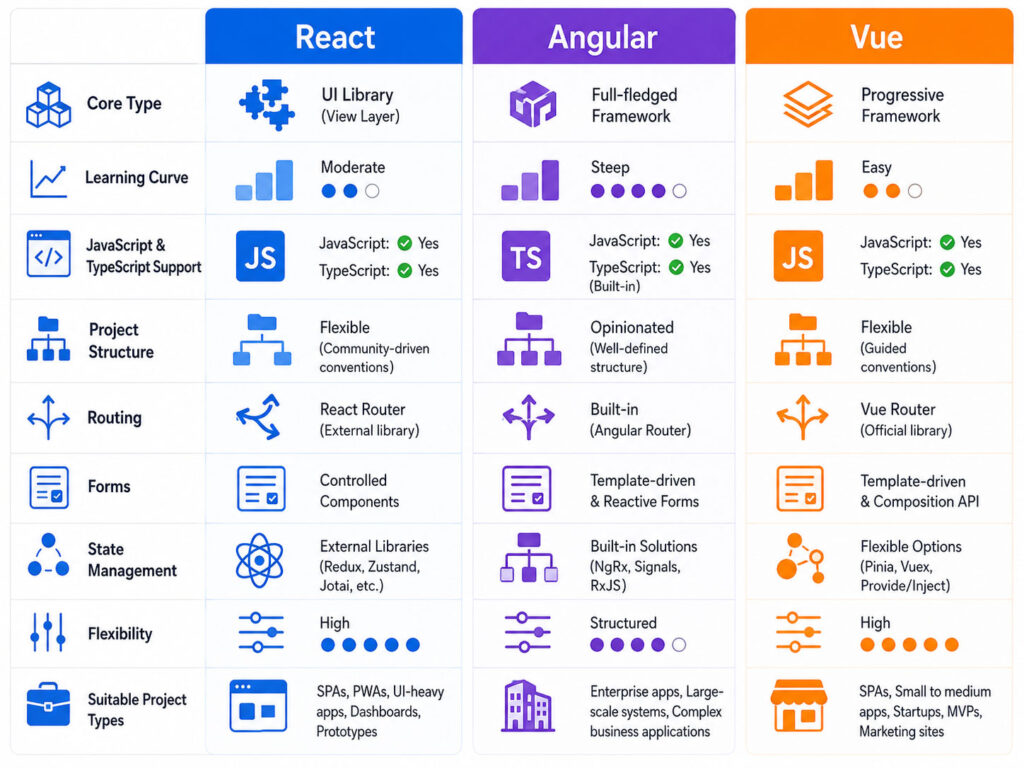
React vs Angular vs Vue: Quick Comparison
| Point | React | Angular | Vue |
|---|---|---|---|
| Core Type | User-interface library | Complete web framework | Progressive web framework |
| Common Language | JavaScript or TypeScript with JSX | TypeScript with HTML templates | JavaScript or TypeScript with templates |
| Project Structure | Flexible and ecosystem-driven | Structured and convention-based | Flexible with official supporting tools |
| Routing | Added through a framework or routing library | Built-in official router | Official router available |
| Forms | Handled with React patterns or external libraries | Built-in forms systems | Template bindings with optional libraries |
| Learning Start | Simple components, followed by ecosystem choices | More concepts at the beginning | Approachable for HTML, CSS, and JavaScript users |
| Best Fit | Flexible applications and custom technology stacks | Structured applications and larger teams | Progressive adoption and balanced development |
Simple React Component
function Welcome({ name }) {
  return <h2>Welcome, {name}!</h2>;
}

export default Welcome;
React uses JSX, which places markup-like syntax inside JavaScript or TypeScript.
Simple Angular Component
import { Component } from '@angular/core';
@Component({
   selector: 'app-welcome',
   template: 'Welcome, {{ name }}!'
})
export class WelcomeComponent {
   name = 'Developer';
}
Angular combines a TypeScript component class with component metadata and an HTML template.
Simple Vue Component
import { h } from 'vue';
export default {
props: {
   name: String
},
setup(props) {
return () => h(
   'h2',
   `Welcome, ${props.name}!`
);
}
};
This Vue component uses a render function to create the heading. Vue Single-File Components can also keep component logic, templates, and styles together in one file.
Which One Is Easier to Learn?
Vue usually provides the smoothest starting point for developers who already understand HTML, CSS, and basic JavaScript.
Its templates look similar to standard HTML, while its reactive data and event syntax remain easy to recognise. Therefore, beginners can often build a small interactive interface without learning many additional concepts.
React also has a manageable starting point. Developers can learn components, properties, state, events, and Hooks gradually. However, larger React applications require additional decisions about routing, data fetching, state management, and project structure.
Angular introduces more concepts early. For example, learners may need to understand TypeScript, components, templates, dependency injection, routing, reactive programming, forms, and application architecture.
Still, Angular’s clear conventions can reduce uncertainty after developers understand the framework.
Which One Provides the Most Structure?
Angular provides the strongest built-in structure.
Its official tools cover common application needs, including routing, forms, HTTP communication, dependency injection, server rendering, and command-line operations. Consequently, different Angular projects often follow familiar architectural patterns.
React provides more freedom. A team can choose a lightweight client application, a full-stack React framework, or a custom collection of libraries. This flexibility supports many project types, although teams must make more architectural decisions.
Vue sits between these approaches. Its core remains focused and flexible, while official tools support routing, state management, development, and testing.
React vs Angular vs Vue for TypeScript
All three technologies support TypeScript.
Angular uses TypeScript throughout its normal development experience. Therefore, interfaces, classes, decorators, typed services, and typed dependency injection commonly appear in Angular applications.
React works well with TypeScript, although JavaScript remains an option. Developers can type component properties, events, state, API responses, and reusable Hooks.
Vue also provides TypeScript support inside Single-File Components. In addition, its official editor tooling can understand component templates and TypeScript code together.
The best TypeScript experience depends partly on the project configuration and coding practices rather than the framework alone.
How Does State Management Differ?
React components can manage local state through Hooks. For shared or complex state, teams may use context, framework features, server-state tools, or external state-management libraries.
Angular supports component state, services, RxJS, and Signals. Signals track where state appears in the application and allow Angular to update related interface areas efficiently.
Vue uses a reactive data system with tools such as ref, reactive, and computed. For larger shared stores, developers can use an official state-management solution.
Therefore, all three can manage complex state. However, their syntax and recommended patterns differ.
Routing and Navigation
Angular includes an official router with route parameters, guards, lazy loading, data resolution, and nested navigation.
Vue provides an official router for single-page applications. As a result, teams can add structured navigation while staying within the Vue ecosystem.
React itself does not include a complete routing system. Instead, a React framework or routing library normally handles navigation.
Forms and Validation
Angular provides built-in template-driven and reactive form approaches. Reactive forms suit applications that need structured validation, dynamic fields, and testable form models.
React usually manages forms through component state, native form features, framework actions, or specialised form libraries. Consequently, teams can choose a simple or advanced solution based on the application.
Vue uses directives and reactive state to connect fields with component data. For complex validation, developers may add a dedicated library.
Which One Has Better Performance?
React, Angular, and Vue can all deliver fast production applications.
Real performance depends on application architecture, bundle size, rendering strategy, network requests, images, third-party scripts, state updates, and developer decisions.
Vue uses a compiler-optimised reactive rendering system. Meanwhile, Angular combines fine-grained Signals with compile-time optimisation and supports modern rendering features such as server rendering and hydration.
React supports client rendering, server rendering, static generation, Server Components through compatible frameworks, and build-time optimisation through the React Compiler.
Therefore, selecting a framework by a small benchmark alone can produce the wrong decision. Teams should test their actual interface, data, devices, and deployment environment.
Server-Side Rendering and SEO
Public websites often benefit from server-rendered or pre-rendered HTML because users and search engines can receive meaningful content sooner.
React applications normally use a compatible framework for server rendering, static generation, routing, and related production features.
Angular provides official server-side rendering and static-site generation support. It also supports hydration so the browser can make server-rendered pages interactive.
Vue provides server-rendering APIs and works with full-stack frameworks designed for Vue. Additionally, teams can pre-render static content when the page data does not change for every request.
However, the framework alone does not guarantee strong SEO. Developers still need useful content, semantic HTML, metadata, accessible navigation, fast pages, and correct indexing controls.
Benefits of React
React gives developers considerable flexibility.
- Its component model supports reusable user-interface elements.
- Teams can use JavaScript or TypeScript.
- Developers can choose tools that match the project.
- Compatible frameworks support full-stack and server-rendered applications.
- React knowledge can also support native application development through related technologies.
- The ecosystem offers solutions for many specialised requirements.
Therefore, React suits teams that value flexibility and want control over their technology choices.
Limitations of React
React’s flexibility can also create challenges.
- React does not provide every application feature by itself.
- Teams must choose routing, state, data, and form solutions.
- Project structures can differ significantly.
- Frequent ecosystem changes may require regular learning.
- Poor component and state design can create unnecessary complexity.
As a result, teams should define architectural standards before a large React project grows.
Benefits of Angular
Angular provides an integrated development platform.
- It includes routing, forms, HTTP tools, dependency injection, and SSR support.
- TypeScript provides clear contracts for application data.
- The CLI supports project creation, builds, tests, and updates.
- Strong conventions help multiple teams follow similar patterns.
- Standalone components simplify modern application structure.
- Signals provide a focused reactive state model.
Consequently, Angular works well for structured applications that require consistent architecture.
Limitations of Angular
Angular requires developers to understand more concepts at the beginning.
- The initial learning path can feel larger.
- Simple projects may not need the complete framework.
- Teams must understand Angular-specific patterns and tooling.
- Major applications still require careful performance and architecture planning.
- Upgrading older projects may involve migrations.
However, Angular provides official migration tools and guidance for adopting newer patterns incrementally.
Benefits of Vue
Vue combines approachable syntax with flexible application design.
- Templates build on familiar HTML concepts.
- Teams can adopt Vue gradually.
- Single-File Components keep related code together.
- Vue supports JavaScript and TypeScript.
- Official tools cover routing, state management, development, and testing.
- The same framework can support small widgets and complete applications.
Therefore, Vue can provide a balanced option for teams that want structure without adopting a larger framework immediately.
Limitations of Vue
Vue also requires project-level decisions.
- Large applications still need clear architecture and coding standards.
- Teams must choose suitable supporting libraries.
- Developers moving from another framework need to learn Vue-specific reactivity.
- Some specialised enterprise tools may target other ecosystems first.
- Minor updates can include TypeScript definition changes that teams should review.
Even so, careful version management and testing can reduce upgrade risks.
React vs Angular vs Vue for Small Projects
Vue can work well for gradually adding interactivity to an existing website. It can even run as a standalone script when the page does not require a full build process.
React also suits focused widgets and small interfaces. However, teams should avoid adding an unnecessarily complex stack for a simple requirement.
Angular can build small projects, although its complete feature set may provide more structure than a basic page needs.
React vs Angular vs Vue for Large Applications
All three can support large applications when teams apply suitable architecture and testing.
Angular provides many integrated features and conventions, which can help larger teams maintain consistency.
React offers flexibility for complex applications, but teams should agree on routing, state, data fetching, folder structure, and testing standards.
Vue can also scale effectively. However, developers should establish clear component, state, routing, and TypeScript patterns before the codebase becomes large.
Which One Is Better for Beginners?
Vue provides an approachable starting point for learners who already know HTML, CSS, and JavaScript.
React also works well for beginners who want to understand component-based interfaces and modern JavaScript patterns.
Angular becomes easier after learners understand TypeScript, classes, dependency injection, components, and reactive concepts.
Regardless of the choice, beginners should learn JavaScript fundamentals before depending heavily on a framework.
Which One Is Better for Enterprise Applications?
Angular often fits enterprise applications that value standardisation, TypeScript, dependency injection, built-in routing, structured forms, and official migration support.
However, React and Vue can also support enterprise systems. Their success depends on team experience, architecture, governance, testing, accessibility, and long-term ownership.
Therefore, the word “enterprise” does not automatically make Angular the only option.
Which One Should You Learn?
| Your Goal | Recommended Starting Point |
|---|---|
| Learn component-based frontend development | React or Vue |
| Work with a structured TypeScript framework | Angular |
| Add interactivity to an existing website gradually | Vue |
| Choose supporting libraries and architecture freely | React |
| Use built-in routing, forms, dependency injection, and tooling | Angular |
| Balance approachable syntax with official ecosystem tools | Vue |
| Join an existing project | Learn the framework that project already uses |
Recommended Learning Path
- Learn HTML, CSS, and modern JavaScript.
- Understand modules, promises, asynchronous functions, and APIs.
- Learn TypeScript fundamentals.
- Choose one framework instead of learning all three together.
- Build components, forms, routing, and API integration.
- Learn testing, accessibility, performance, and security.
- Create one complete production-style project.
- Explore another framework only after understanding the first one.
This approach builds transferable frontend skills instead of framework syntax alone.
Questions to Ask Before Choosing
- Which framework does the team already understand?
- Does the project need strong built-in conventions?
- Will the application use JavaScript or TypeScript?
- Does the website need server rendering or static generation?
- How complex are the forms, routing, and state requirements?
- Which libraries and design systems must the project support?
- Who will maintain the application over several years?
Answers to these questions provide more value than choosing the most discussed framework.
Final Verdict
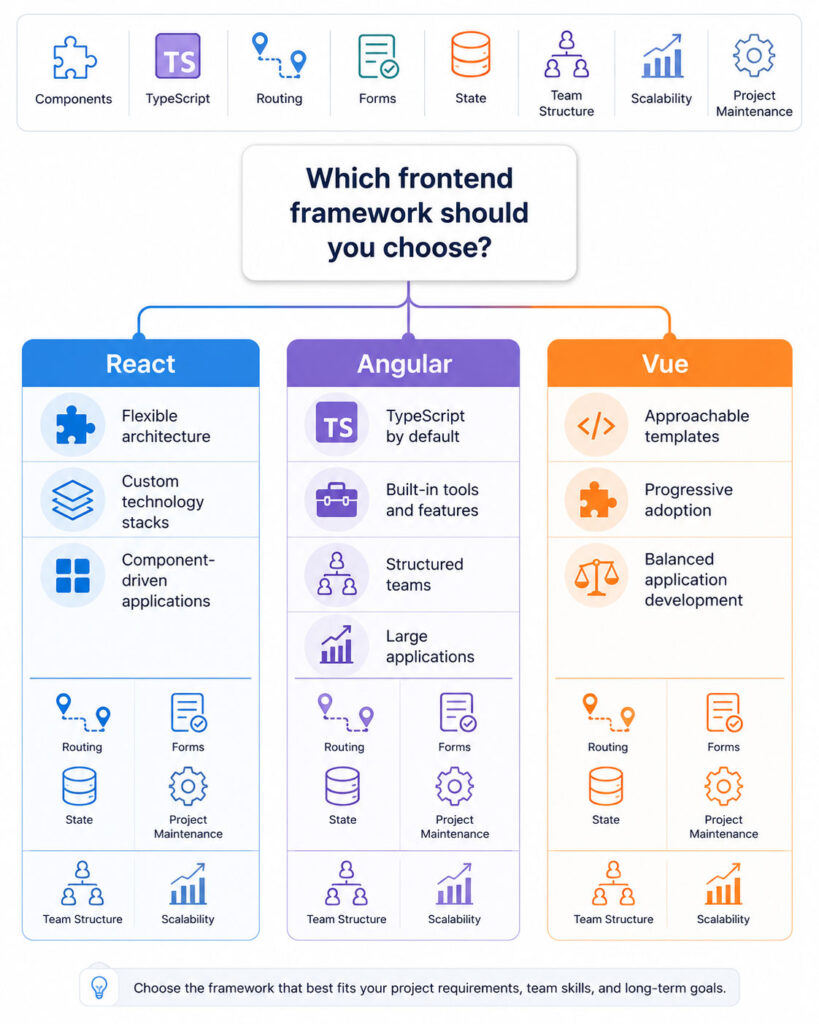
React is a strong choice when teams want flexible architecture and broad control over supporting tools.
Angular is a strong choice when teams need an integrated framework, consistent structure, TypeScript, and built-in application features.
Vue is a strong choice when developers want approachable syntax, progressive adoption, and a balanced official ecosystem.
Therefore, the best frontend framework is the one that matches the project and the people responsible for building and maintaining it.
Conclusion
React vs Angular vs Vue does not have one universal winner.
React provides flexibility, Angular provides an integrated platform, and Vue provides progressive adoption with approachable development.
Before choosing, compare the project size, team experience, TypeScript needs, routing, forms, rendering strategy, and long-term support requirements.
Most importantly, learn web fundamentals first. Strong JavaScript, TypeScript, HTML, CSS, accessibility, testing, and performance skills remain useful across all three technologies.

AboutTPJ Technical Team
The Project Jugaad Technical Team creates practical, easy-to-follow content on software development, web technologies, artificial intelligence, cybersecurity, cloud platforms, and digital tools. Our articles are informed by more than 13 years of hands-on experience with .NET, Angular, SQL Server, AWS, WordPress, Linux hosting, application deployment, and real-world troubleshooting. Each guide is researched, reviewed, and updated to provide accurate, useful, and actionable information for developers, businesses, and everyday technology users.