
Software Development
Monolith vs Microservices is an important architectural decision for teams building web applications, mobile backends, software platforms, and business systems.
Both approaches can support reliable and scalable applications. However, they organise code, deployment, data, communication, and team ownership differently.
A monolithic application usually runs as one deployable system. In contrast, a microservices architecture divides business capabilities into independently developed and deployed services.
Therefore, the right choice depends on product complexity, team size, release frequency, scaling needs, operational experience, budget, and long-term maintenance goals.
What Is a Monolithic Architecture?
A monolithic architecture combines the main application features within one deployable unit.
For example, an e-commerce application may include customer accounts, products, orders, payments, inventory, and administration inside the same application codebase.
The application may still contain separate layers, modules, classes, and projects. However, teams usually build and deploy those parts together.
Monolithic Application
├── User Management
├── Product Catalogue
├── Orders
├── Payments
├── Inventory
├── Notifications
└── Administration
In many cases, the complete application connects to one primary database.
How a Monolithic Application Works
A client sends a request to the application. Next, the relevant module processes the request, accesses the shared database, and returns a response.
Web or Mobile Client
          ↓
Monolithic Application
          ↓
Shared Database
Because the modules run inside one process, they can often communicate through direct method calls.
As a result, developers do not need to create a network API for every internal interaction.
What Is a Microservices Architecture?
A microservices architecture divides an application into smaller services that represent separate business capabilities.
For example, one service may manage products, while another handles orders. Additional services may support payments, inventory, customers, and notifications.
Client Application
        ↓
API Gateway
        ↓
├── Customer Service
├── Product Service
├── Order Service
├── Payment Service
├── Inventory Service
└── Notification Service
Each service can have its own codebase, deployment pipeline, runtime, and data store. However, the exact level of independence depends on the architecture.
How Microservices Work
Services communicate through network-based mechanisms.
For synchronous operations, they may use HTTP, REST, GraphQL, or remote procedure calls. Meanwhile, asynchronous workflows may use messages or events.
Order Service
      ↓
Order Created Event
      ↓
├── Inventory Service
├── Payment Service
└── Notification Service
This structure reduces direct code-level coupling. Nevertheless, it introduces network failures, retries, timeouts, message handling, and distributed-data challenges.
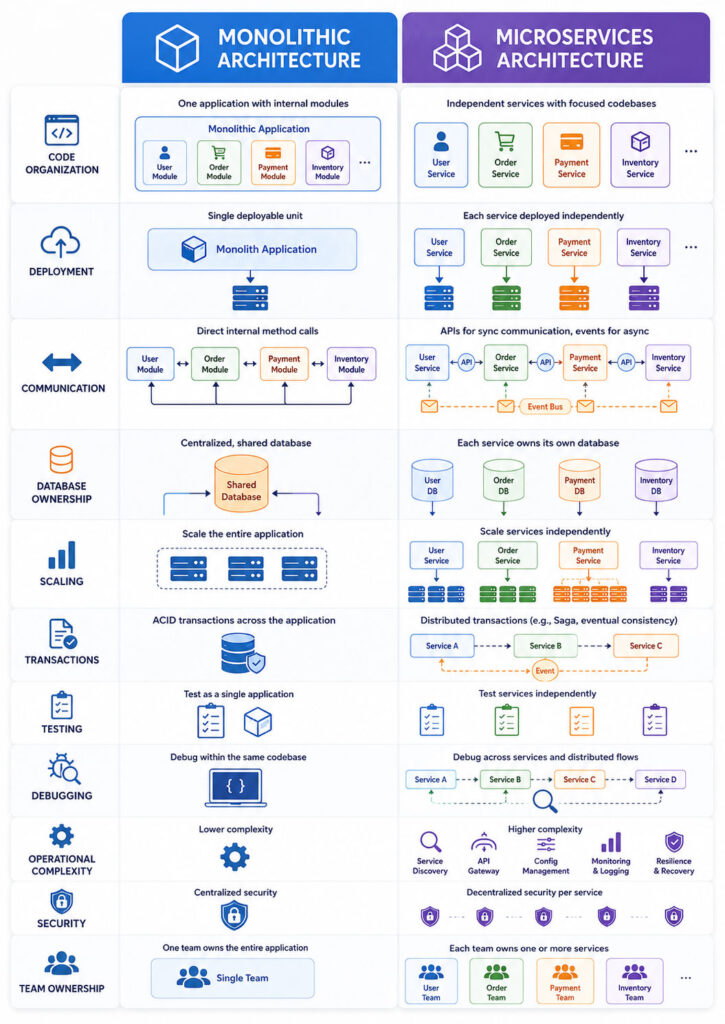
Monolith vs Microservices: Quick Comparison
| Point | Monolithic Architecture | Microservices Architecture |
|---|---|---|
| Deployment | Application modules are commonly deployed together | Services can usually be deployed independently |
| Code Organisation | Features remain inside one main application | Features are divided across separate services |
| Communication | Often uses in-process method calls | Uses network calls, messages, or events |
| Database | Commonly uses one shared database | Services may own separate databases |
| Scaling | Usually scales the complete application | Can scale selected services independently |
| Testing | End-to-end testing can be simpler initially | Requires service, contract, integration, and system testing |
| Operations | Fewer deployments and runtime components | More services, pipelines, logs, alerts, and infrastructure |
| Team Ownership | Several teams may work in one shared application | Teams may own individual business services |
| Initial Complexity | Usually lower | Usually higher |
| Best Fit | Smaller products, early-stage systems, and simpler domains | Large platforms with clear boundaries and mature operations |
This comparison provides a useful starting point. Still, an application does not become successful only because it uses one particular architectural style.
What Is a Modular Monolith?
A modular monolith keeps one deployable application while enforcing clear boundaries between business modules.
For example, the order module should not directly modify the internal tables or private code of the inventory module. Instead, it should use defined interfaces or application-level messages.
Single Deployment
├── Customers Module
│   ├── Public Interface
│   └── Private Implementation
├── Orders Module
│   ├── Public Interface
│   └── Private Implementation
└── Inventory Module
    ├── Public Interface
    └── Private Implementation
Therefore, a modular monolith can provide stronger maintainability without introducing the full operational cost of distributed services.
Monolith Does Not Mean Unstructured Code
A monolithic application can still follow strong design practices.
Teams can use modules, layers, domain boundaries, dependency rules, automated tests, and clear interfaces.
However, a poorly structured monolith can become tightly coupled. As the codebase grows, a change in one area may unexpectedly affect another.
Consequently, architecture inside the application matters as much as the deployment model.
Microservices Do Not Automatically Create Independence
Separating code into several services does not guarantee loose coupling.
For example, services may still share one database, require coordinated deployments, call each other repeatedly, or depend on internal implementation details.
In that situation, the organisation may gain the complexity of distributed systems without receiving true service independence.
Therefore, effective microservices require clear ownership, stable contracts, independent data management, and controlled communication.
The Most Important Difference: Deployment Boundaries
The main distinction is not simply the number of repositories or folders.
In a monolithic system, teams usually release application modules together. By contrast, microservices should allow teams to release individual services without rebuilding and redeploying the entire platform.
This independence can speed up delivery for large organisations. However, it also requires automated deployment, monitoring, versioned contracts, and reliable operational processes.
Simple E-Commerce Example
Consider an online store with products, orders, payments, inventory, and shipping.
In a monolith, the checkout process may call application modules directly:
Checkout
  → Validate Cart
  → Create Order
  → Reserve Inventory
  → Record Payment
  → Schedule Shipping
  → Send Confirmation
In a microservices system, the same workflow may cross several network boundaries:
Checkout Service
      ↓
Order Service
      ↓
Payment Service
      ↓
Inventory Service
      ↓
Shipping Service
      ↓
Notification Service
The second design offers independent services. Nevertheless, the team must handle partial failures when one step succeeds and another fails.
Benefits of a Monolithic Architecture
A monolithic application can provide significant advantages, especially during early product development.
1. Simpler Initial Development
Developers can build features inside one solution without first creating service contracts, gateways, message infrastructure, or distributed authentication.
As a result, a small team can focus on product requirements instead of complex platform engineering.
2. Easier Local Development
A developer can often run the complete application and database on one computer.
Therefore, debugging a workflow may require fewer tools and less environment configuration.
3. Straightforward Transactions
When modules share one database, a transaction can update several related records atomically.
For example, the application may create an order and reduce inventory inside one database transaction.
Begin Transaction
  Create Order
  Reserve Inventory
  Record Payment Reference
Commit Transaction
If one operation fails, the database can roll back the complete transaction.
4. Fewer Network Failures
Internal modules often communicate through direct function or method calls.
Consequently, the application avoids many timeouts, unavailable services, network retries, and serialization problems.
5. Simpler Deployment
A team may need only one primary build and deployment pipeline.
Although the application can still require background workers and supporting services, the overall release process often remains easier than managing many independent services.
6. Easier End-to-End Debugging
Logs, breakpoints, and stack traces can remain within one application process.
Therefore, developers may trace a request from the controller to the business layer and database without combining logs from several systems.
7. Lower Operational Cost
A monolith may require fewer servers, containers, pipelines, dashboards, alerts, and infrastructure components.
This simplicity can reduce hosting and maintenance costs for smaller applications.
Limitations of a Monolithic Architecture
A monolith becomes difficult when business growth and code coupling increase faster than the team’s ability to maintain boundaries.
1. Large Deployments
A small change may require rebuilding, testing, and deploying the complete application.
As a result, release pipelines can become slower as the codebase grows.
2. Shared Failure Risk
A memory leak, unhandled exception, or heavy workload in one module may affect the entire process.
However, good isolation, background processing, resource limits, and defensive coding can reduce this risk.
3. Coarse-Grained Scaling
Teams usually scale the full application even when only one feature needs additional capacity.
For example, a product-search feature may receive heavy traffic while the administration module remains mostly idle. Nevertheless, both features may be duplicated when the application scales horizontally.
4. Growing Code Coupling
Without strict module boundaries, developers may call internal classes directly, share database tables, and create circular dependencies.
Consequently, future changes become harder to understand and test.
5. Slower Team Coordination
Several teams working in one codebase may create merge conflicts, shared release dependencies, and unclear ownership.
Still, strong modular design and code ownership can keep a large application manageable.
Benefits of Microservices Architecture
Microservices can provide value when an organisation has clear business boundaries and mature engineering operations.
1. Independent Deployment
Teams can release one service without deploying the complete system.
Therefore, a payment-service update does not necessarily require a product-catalogue release.
2. Independent Scaling
A heavily used service can receive additional computing resources without scaling every other component.
For example, a search or media-processing service may scale separately during peak traffic.
3. Clear Team Ownership
A team can own a service from development through production monitoring.
This ownership may include its code, database, deployment, alerts, documentation, and support procedures.
As a result, large organisations can reduce coordination across unrelated business areas.
4. Failure Isolation
A failure in one service does not always stop the complete platform.
For example, recommendation features may become temporarily unavailable while customers continue browsing and purchasing products.
However, this resilience requires timeouts, fallback behaviour, circuit breakers, queues, and graceful degradation.
5. Technology Flexibility
Different services may use different programming languages, frameworks, or databases when a real requirement justifies the choice.
Nevertheless, excessive technology diversity increases training, security, monitoring, and maintenance costs.
Therefore, organisations should prefer a small set of supported technologies.
6. Smaller Codebases per Service
Each team can work within a narrower business context.
Consequently, developers may understand and release a service without learning every internal detail of the entire platform.
Limitations of Microservices Architecture
Microservices solve some organisational and scaling problems by introducing distributed-system complexity.
1. Network Communication
A method call inside a monolith is usually fast and reliable. In contrast, a service call can fail because of timeouts, network issues, unavailable dependencies, or invalid responses.
Therefore, every important call needs clear timeout, retry, and failure-handling rules.
2. Distributed Data
Each service may own its database to preserve independence.
However, a business workflow may need data from several services. Consequently, teams must decide how to copy, query, synchronise, and validate that information.
3. Eventual Consistency
Distributed workflows cannot always use one database transaction.
For example, an order may be created before inventory and payment services finish processing their steps.
Order Created
      ↓
Inventory Reserved
      ↓
Payment Confirmed
      ↓
Order Approved
During processing, different services may temporarily hold different states.
Therefore, teams must design pending states, retries, compensation actions, and user-facing status messages.
4. More Operational Components
Every service may need a deployment pipeline, runtime configuration, logs, metrics, alerts, access rules, secrets, and health checks.
As the service count grows, platform engineering becomes essential.
5. Harder Debugging
One user request may travel through several services and message queues.
Consequently, developers need correlation IDs, distributed tracing, centralised logging, and consistent monitoring to follow the workflow.
6. More Complex Testing
Teams must test individual services and their interactions.
Useful test levels may include:
- Unit tests.
- Service integration tests.
- API contract tests.
- Message contract tests.
- End-to-end tests.
- Resilience and failure tests.
However, large end-to-end suites can become slow and unreliable. Therefore, teams should keep most tests closer to the service boundary.
7. Higher Infrastructure Cost
Microservices may require container platforms, gateways, service discovery, queues, observability systems, secret management, and additional environments.
As a result, operational costs can exceed those of a simpler application.
Database Design in a Monolith
A monolith commonly uses one database schema for many modules.
This setup simplifies joins and transactions. However, unrestricted table access can create strong coupling.
A modular design should define which module owns each table and how other modules request its data.
Database per Service
In a microservices architecture, each service should control its own data.
For example:
Customer Service → Customer Database
Order Service    → Order Database
Payment Service  → Payment Database
Inventory Service → Inventory Database
Another service should not directly update those private tables.
Instead, it should use the owning service’s API or consume published events.
Why a Shared Database Can Reduce Independence
When several services read and write the same tables, a schema change may affect all of them.
Therefore, teams may need coordinated releases even though the code runs as separate services.
This design is sometimes called a distributed monolith because deployment and operational complexity increase while service independence remains limited.
Synchronous Communication
Synchronous communication gives the caller an immediate response.
Order Service
      ↓ HTTP Request
Inventory Service
      ↓ HTTP Response
Order Service
This method can be simple for user-facing requests. However, the caller becomes dependent on the availability and response time of the other service.
Asynchronous Communication
Asynchronous messaging allows a service to publish an event or command without waiting for every consumer to finish.
Order Service
      ↓
Message Broker
      ↓
├── Inventory Service
├── Analytics Service
└── Notification Service
This design can improve decoupling and resilience. Nevertheless, teams must handle duplicate messages, delayed delivery, failed processing, ordering, and monitoring.
Scaling Monoliths and Microservices
A monolithic application can scale vertically by using a larger server or horizontally by running several instances.
For many systems, this approach remains sufficient and cost-effective.
Microservices allow selected services to scale independently. However, a service should be separated because of clear architectural or organisational needs rather than only a theoretical possibility of future traffic.
Monolith vs Microservices Performance
A monolith often provides faster internal communication because modules call each other within one process.
Microservices add network, serialization, authentication, and infrastructure overhead to service interactions.
However, independently scalable services can improve performance when one business area receives much more traffic than others.
Therefore, teams should measure real workloads instead of assuming that one architecture is always faster.
Deployment Comparison
| Deployment Area | Monolith | Microservices |
|---|---|---|
| Release Unit | Complete application | Individual service |
| Pipeline Count | Usually fewer pipelines | Potentially one pipeline per service |
| Rollback | Rollback the application version | Rollback the affected service and verify contracts |
| Coordination | Modules may share one release schedule | Services should release independently |
| Operational Effort | Lower initially | Higher because of multiple runtime components |
Independent deployment provides value only when service contracts remain compatible.
API and Event Versioning
Microservices should avoid breaking consumers unexpectedly.
Therefore, teams may add new fields while keeping existing fields available, support older message versions temporarily, or provide explicit API versions when necessary.
Before removing a field or event, identify every active consumer and provide a migration period.
Security in a Monolithic Application
A monolith can centralise authentication, authorisation, validation, and auditing.
However, one vulnerable component may expose a large part of the application if internal boundaries remain weak.
Therefore, teams should still apply least privilege, secure coding, dependency scanning, logging, and module-level access rules.
Security in Microservices
Microservices create more network endpoints, service identities, credentials, and communication paths.
As a result, teams must secure:
- External APIs.
- Service-to-service communication.
- Message brokers.
- Secrets and certificates.
- Container images.
- Deployment pipelines.
- Individual databases.
- Administrative tools.
In addition, every service should verify authorisation instead of trusting a request only because it came from inside the network.
Observability Requirements
A monolith may begin with application logs, error tracking, and server metrics.
A distributed system requires broader observability.
- Centralised logs.
- Metrics for each service.
- Distributed tracing.
- Correlation identifiers.
- Health and readiness checks.
- Queue and event monitoring.
- Dependency dashboards.
- Alerting and incident response.
Without these tools, diagnosing a production failure can become extremely difficult.
Team Structure and Architecture
Architecture should support how teams communicate and own software.
A small team can often work efficiently within one modular application.
By contrast, a large organisation may benefit from services that align with independent business teams.
However, creating many services without clear ownership can increase coordination rather than reduce it.
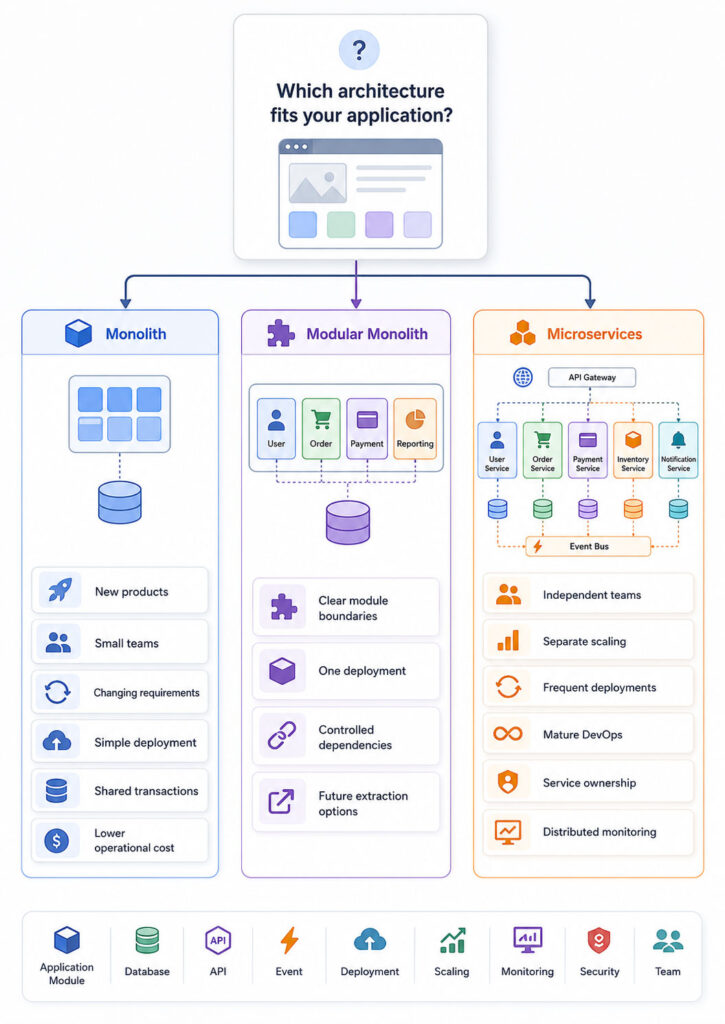
When Should You Choose a Monolith?
A monolithic or modular-monolithic architecture provides a strong starting point when:
- The product is new and requirements may change quickly.
- The development team is small.
- The business domain remains manageable.
- Independent scaling is not yet necessary.
- The organisation has limited DevOps experience.
- Simple transactions provide important value.
- Fast initial delivery matters more than service independence.
- The application can run efficiently as one deployable system.
In these situations, microservices may create unnecessary cost and operational risk.
When Should You Choose Microservices?
Microservices can provide value when:
- The platform has clear and stable business boundaries.
- Several independent teams own different capabilities.
- Services need different scaling patterns.
- Frequent independent releases provide business value.
- Some components require stronger failure isolation.
- The organisation already has mature deployment automation.
- Centralised monitoring and tracing are available.
- The team understands distributed data and messaging.
Even then, begin with a small number of meaningful services rather than creating one service for every table or screen.
When Should You Choose a Modular Monolith?
A modular monolith often provides the best balance for growing applications.
It supports clear business boundaries, controlled dependencies, and one operational deployment.
Later, teams can extract a module when independent deployment or scaling becomes necessary.
Therefore, a modular monolith can preserve future options without paying the full microservices cost immediately.
How to Identify Service Boundaries
A service boundary should represent a business capability rather than a technical layer.
Good examples may include orders, billing, inventory, customer identity, or shipping.
Poor service boundaries often divide systems into controller, validation, database, and utility services. These technical services communicate constantly and provide little business independence.
Useful boundary questions include:
- Which team owns the capability?
- Which data belongs to it?
- Can it release independently?
- Can it continue working when another capability fails?
- Does it have a clear business purpose?
- Does separating it reduce or increase communication?
Avoid Services That Are Too Small
A service should not exist only because one class or table exists.
Very small services can create excessive APIs, deployments, logs, alerts, and network calls.
Consequently, the system may become harder to change than the original monolith.
Start with broader business capabilities and split them only when evidence supports the change.
How to Migrate from a Monolith to Microservices
Do not rewrite the complete application at once.
Instead, identify one capability that has clear boundaries and a strong reason for independent operation.
A controlled migration may follow these steps:
- Improve module boundaries inside the monolith.
- Add automated tests around the selected capability.
- Define a stable API or event contract.
- Separate data ownership carefully.
- Route new requests to the extracted service.
- Monitor behaviour and performance.
- Remove the old implementation only after verification.
This gradual approach reduces migration risk.
What Is the Strangler Pattern?
The strangler pattern replaces parts of an existing application gradually.
Client Request
      ↓
Routing Layer
   ├── Existing Monolith
   └── New Service
Initially, most requests continue reaching the monolith. Afterwards, selected capabilities move to new services.
Eventually, the old implementation can be removed when the replacement remains stable.
When Not to Migrate
A migration may not be worthwhile when the current application remains reliable, maintainable, and affordable.
In addition, avoid migration when:
- The business cannot define clear service boundaries.
- Automated testing remains weak.
- The team lacks deployment and monitoring automation.
- The application has little traffic or scaling pressure.
- The main problem comes from poor code quality rather than deployment structure.
- The migration has no measurable business outcome.
Refactoring the monolith may deliver more value than distributing it.
Common Monolithic Architecture Mistakes
- Allowing every module to access every database table.
- Creating circular dependencies.
- Mixing business logic with controllers and user-interface code.
- Deploying without automated tests.
- Keeping obsolete modules and dependencies.
- Ignoring performance until the application becomes difficult to profile.
- Assuming the only future option is a complete rewrite.
Common Microservices Architecture Mistakes
- Creating services before understanding the business domain.
- Sharing one database across every service.
- Making long chains of synchronous calls.
- Using too many programming languages and platforms.
- Skipping contract testing.
- Ignoring message duplication and retry behaviour.
- Deploying services without central monitoring and tracing.
- Creating a separate service for every small function.
- Migrating only because microservices appear modern.
Architecture Cost Comparison
| Cost Area | Monolith | Microservices |
|---|---|---|
| Initial Development | Usually lower | Usually higher |
| Infrastructure | Fewer runtime components | More services and supporting platforms |
| Testing | Simpler initially | Requires broader contract and integration testing |
| Monitoring | Fewer systems to observe | Requires distributed observability |
| Team Coordination | Can become difficult as the team grows | Can improve with strong service ownership |
| Scaling | May scale more components than necessary | Can scale selected services |
Therefore, evaluate the complete lifecycle cost rather than only the first development estimate.
Architecture Decision Checklist
- How many developers and independent teams will work on the system?
- Are the business boundaries clear?
- Does any feature need independent scaling?
- Do teams need independent deployment schedules?
- Can the organisation operate many production services?
- Is distributed tracing and central logging available?
- Can the business accept eventual consistency?
- How will services authenticate and communicate securely?
- What is the total infrastructure and support budget?
- Would a modular monolith solve the current problem more simply?
Monolith or Microservices: Which One Should You Choose?
| Your Situation | Recommended Starting Point |
|---|---|
| New product with changing requirements | Monolith or modular monolith |
| Small development team | Monolith or modular monolith |
| Simple business workflows | Monolith |
| Clear modules but limited DevOps capacity | Modular monolith |
| Several independent product teams | Microservices may provide value |
| Different services require different scaling | Microservices |
| Frequent independent deployments are essential | Microservices |
| Existing monolith remains maintainable | Keep and improve it |
| Only one module creates scaling problems | Extract that capability gradually |
Final Verdict
A monolithic architecture offers simpler development, transactions, deployment, testing, and operations.
Microservices offer independent deployment, scaling, ownership, and failure isolation. However, they also require stronger automation, monitoring, security, messaging, and distributed-data management.
Therefore, smaller teams and new products should usually begin with a well-structured monolith or modular monolith. Larger organisations should adopt microservices only when clear business and operational needs justify the additional complexity.
Conclusion
Monolith vs Microservices does not have one universal winner.
Choose a monolith when simplicity, rapid development, and straightforward operations matter most. Alternatively, choose microservices when independent teams, deployments, scaling, and business boundaries provide measurable value.
Most importantly, select the simplest architecture that can meet the current requirements while leaving a practical path for future change.

AboutTPJ Technical Team
The Project Jugaad Technical Team creates practical, easy-to-follow content on software development, web technologies, artificial intelligence, cybersecurity, cloud platforms, and digital tools. Our articles are informed by more than 13 years of hands-on experience with .NET, Angular, SQL Server, AWS, WordPress, Linux hosting, application deployment, and real-world troubleshooting. Each guide is researched, reviewed, and updated to provide accurate, useful, and actionable information for developers, businesses, and everyday technology users.