
Artificial Intelligence
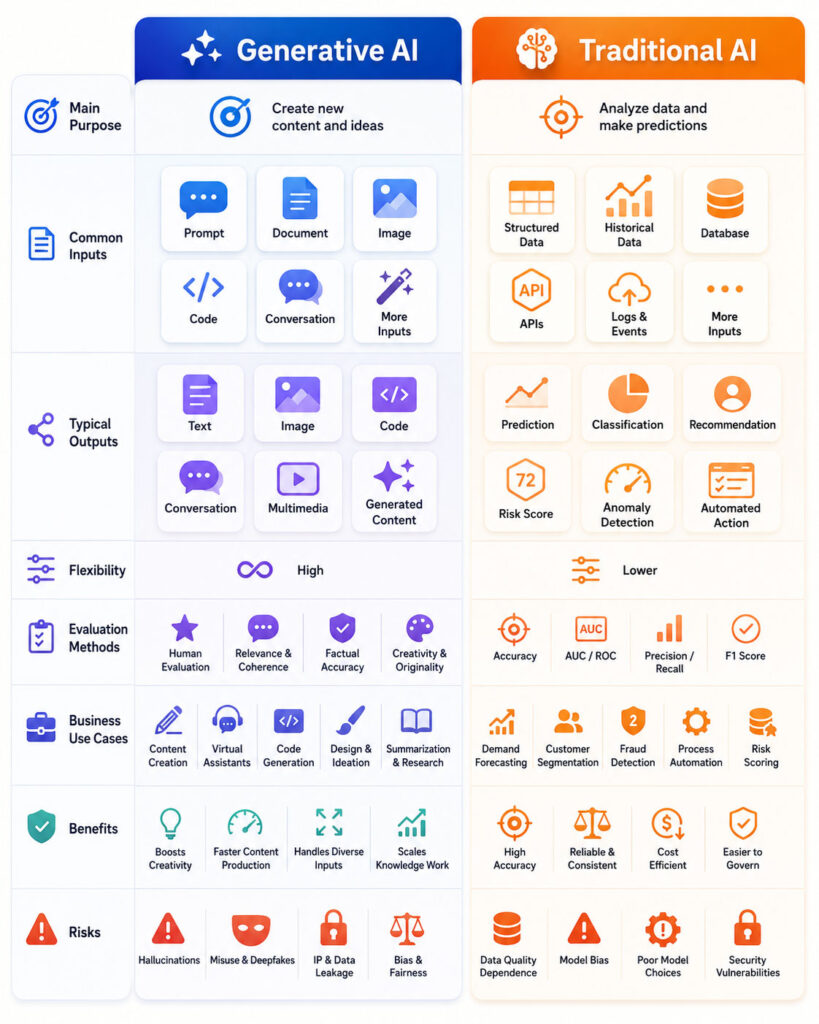
The Generative AI vs Traditional AI comparison helps explain how modern artificial intelligence systems solve different types of problems. Traditional AI commonly predicts, classifies, recommends, detects, or follows defined rules. In contrast, generative AI creates new content such as text, images, code, audio, summaries, and structured data.
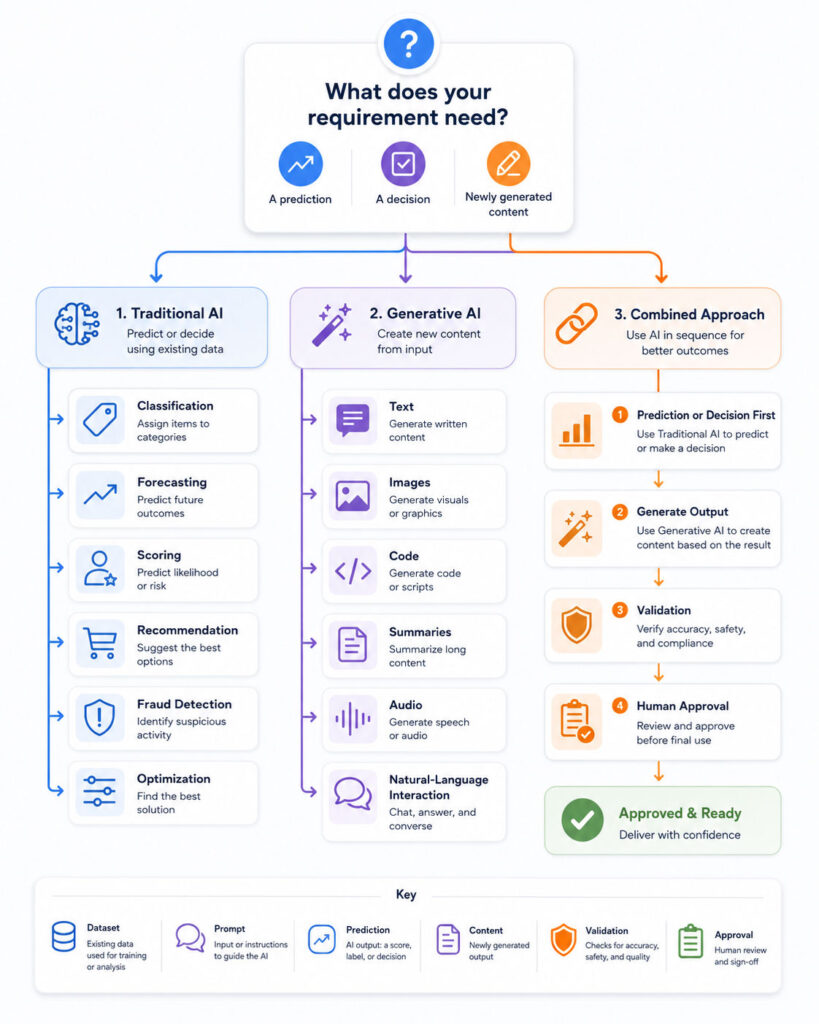
Both approaches can analyse data and support automation. However, the right choice depends on whether the application needs a prediction or decision from existing information, or newly generated content based on instructions and context.
What Is Traditional AI?
Traditional AI is a broad practical term for systems designed to perform specific analytical, predictive, or decision-making tasks.
For example, a traditional AI system may classify an email as spam, predict demand, detect suspicious transactions, recommend a product, recognise an object, or optimise a route.
Common Traditional AI Tasks
- Spam and fraud detection.
- Demand forecasting.
- Product recommendations.
- Risk scoring.
- Image classification.
- Route optimisation.
- Equipment-failure detection.
What Is Generative AI?
Generative AI creates new content based on patterns learned during training and the context supplied with the current request.
Depending on the model, the output may include text, images, code, audio, video, summaries, reports, designs, or structured data.
However, generated content is not automatically correct. Important material should therefore be reviewed before it is published, sent, deployed, or used for a consequential decision.
How Traditional AI Works
A traditional AI system usually receives defined inputs and produces a specific type of result.
Transaction data
        ↓
Rules or predictive model
        ↓
Risk score
        ↓
Approve, review, or block
The system focuses on producing a reliable result within a defined workflow rather than generating an original paragraph or image.
How Generative AI Works
A generative model receives an instruction together with available context. It then generates an appropriate sequence of words, pixels, sounds, code tokens, or other output elements.
User prompt
        ↓
Instructions and context
        ↓
Generative model
        ↓
New content
        ↓
Review and validation
Generative AI vs Traditional AI: Quick Comparison
| Area | Traditional AI | Generative AI |
|---|---|---|
| Main purpose | Analyse, classify, predict, recommend | Create or transform content |
| Typical output | Score, category, prediction, recommendation | Text, image, code, audio, video, structured content |
| Flexibility | Usually optimised for a defined task | Can support many content-oriented tasks |
| Evaluation | Task-specific accuracy and error metrics | Quality, factuality, relevance, safety |
| Main risk | Incorrect predictions, bias, model drift | Fabricated information, unsafe content, data exposure |
Rule-Based AI vs Machine Learning
Not every traditional AI system learns from data. A rule-based system follows logic created by developers or domain experts, while machine learning learns statistical patterns from historical examples.
Both approaches can work well: rules provide explicit control, whereas machine learning can detect patterns that are difficult to describe manually.
Is Machine Learning Traditional AI or Generative AI?
Machine learning supports both categories. A classification model may predict whether a customer will cancel a service, while a language model can generate a personalised retention message. Therefore, machine learning is a broader technique used to build both predictive and generative systems.
How the Outputs Differ
Traditional AI generally chooses from known outcomes or calculates a value. Generative AI creates an output for the current request.
Traditional AI Output Examples
- Spam or legitimate classification.
- Expected sales forecast.
- Fraud or credit risk score.
- Recommended products.
- Object detection.
- Optimised route.
Generative AI Output Examples
- Emails, reports, articles, and summaries.
- Images and design concepts.
- Functions, tests, and code documentation.
- Speech and audio.
- Generated or edited video.
- Structured transformed data.
How Training and Evaluation Differ
Both traditional and generative AI can learn from historical data, although their objectives differ. A predictive model may learn relationships between input features and a known target. In contrast, a generative model learns patterns that help it create new sequences or representations.
Evaluating Traditional AI
Common metrics include accuracy, precision, recall, false-positive rate, false-negative rate, and processing time.
Evaluating Generative AI
Generative output often requires broader evaluation, including relevance, factual correctness, completeness, safety, consistency, instruction following, and human review.
Benefits and Limitations of Traditional AI
Benefits
- Predictable task scope.
- Clearer measurement.
- Controlled outputs.
- Efficient processing for narrow tasks.
- Strong fit for forecasting, routing, monitoring, and detection.
Limitations
- Often supports only a narrow task.
- New requirements may require new rules or training.
- Historical bias can affect predictions.
- Performance can decline when real-world patterns change.
Benefits and Limitations of Generative AI
Benefits
- Fast content drafting.
- Natural-language interaction.
- Code assistance.
- Flexible personalisation.
- Summarisation and transformation.
Limitations
- Outputs may contain fabricated information.
- Similar prompts can produce different answers.
- Confidential information may be exposed through unsafe usage.
- Generated code can contain bugs or weaknesses.
- Large models can require significant computing resources.
Generative AI Hallucinations
A hallucination occurs when a generative model produces information that sounds plausible but is unsupported, incorrect, or invented.
Traditional AI does not hallucinate in the same content-generation sense, but it can still make incorrect predictions or classifications. Therefore, both approaches require testing and monitoring.
Privacy and Security Considerations
Traditional and generative AI systems may process customer, employee, business, or operational information. Organisations should understand what data is collected, where it is processed, how long it is retained, and who can access it.
Generative AI introduces additional risks when prompts include confidential information or when external content attempts to manipulate the model through prompt injection.
Passwords, private keys, access tokens, and production credentials should never be unnecessarily provided to an AI system.
Generative AI vs Traditional AI Use Cases
| Business Requirement | Recommended Starting Point |
|---|---|
| Predict customer demand | Traditional AI |
| Generate a marketing draft | Generative AI |
| Detect suspicious transactions | Traditional AI |
| Summarise customer feedback | Generative AI |
| Recommend existing products | Traditional AI |
| Create product descriptions | Generative AI |
| Classify support tickets | Traditional AI |
| Draft support replies | Generative AI |
Can Generative AI and Traditional AI Work Together?
Yes. Many practical systems combine predictive models, rules, search, automation, and content generation.
For example, an insurance workflow may use traditional AI to classify a request and estimate risk. Afterwards, generative AI can create a plain-language explanation for an employee to review.
Customer request
        ↓
Classification model
        ↓
Risk or priority score
        ↓
Generative response draft
        ↓
Policy validation
        ↓
Human approval
Which Approach Is More Accurate?
Neither approach is universally more accurate. Accuracy depends on the task, model, data, training process, context, evaluation method, and production environment.
A specialised predictive model may outperform a general-purpose generative model on a narrow classification task. In contrast, generative AI can handle flexible language requests that a fixed classifier cannot support easily.
When Should You Use Traditional AI?
- You need classification, detection, scoring, forecasting, or recommendation.
- The workflow has clear inputs and outputs.
- You need consistent automated decisions.
- Standard performance metrics can measure success.
- You do not need newly generated content.
When Should You Use Generative AI?
- You need to draft, rewrite, summarise, or translate content.
- Users need a conversational interface.
- The application creates code, images, audio, or structured content.
- Different requests require different response formats.
- Important output can be reviewed and verified.
Questions to Ask Before Choosing
- Do we need a prediction or newly generated content?
- Can the correct result be defined clearly?
- What information will the system process?
- How will quality be measured?
- What happens when the AI produces the wrong result?
- Does a person need to approve important output?
- What privacy and security requirements apply?
- Could a simpler rule-based solution solve the problem?
Common AI Implementation Mistakes
- Using generation when a simple rule would work.
- Publishing generated output without verification.
- Sharing confidential information unnecessarily.
- Allowing sensitive actions without approval.
- Ignoring model drift in predictive systems.
- Automating important decisions without sufficient review.
Frequently Asked Questions
Is Generative AI Better Than Traditional AI?
No single approach is better for every task. Traditional AI is often more suitable for prediction, classification, detection, and optimisation, while generative AI is designed for content creation and transformation.
Is Machine Learning the Same as Generative AI?
No. Machine learning is a broader field that includes predictive, classification, recommendation, and generative models.
Can Businesses Use Both?
Yes. In many workflows, traditional AI handles classification, prediction, or validation while generative AI creates explanations, summaries, or drafts.
Choosing the Right AI Approach
Generative AI vs Traditional AI is mainly a comparison between flexible content generation and task-focused prediction, classification, recommendation, or decision support.
Choose the simplest technology that solves the business problem reliably. In many real applications, combining both approaches provides the strongest result.

AboutTPJ Technical Team
The Project Jugaad Technical Team creates practical, easy-to-follow content on software development, web technologies, artificial intelligence, cybersecurity, cloud platforms, and digital tools. Our articles are informed by more than 13 years of hands-on experience with .NET, Angular, SQL Server, AWS, WordPress, Linux hosting, application deployment, and real-world troubleshooting. Each guide is researched, reviewed, and updated to provide accurate, useful, and actionable information for developers, businesses, and everyday technology users.