
Artificial Intelligence
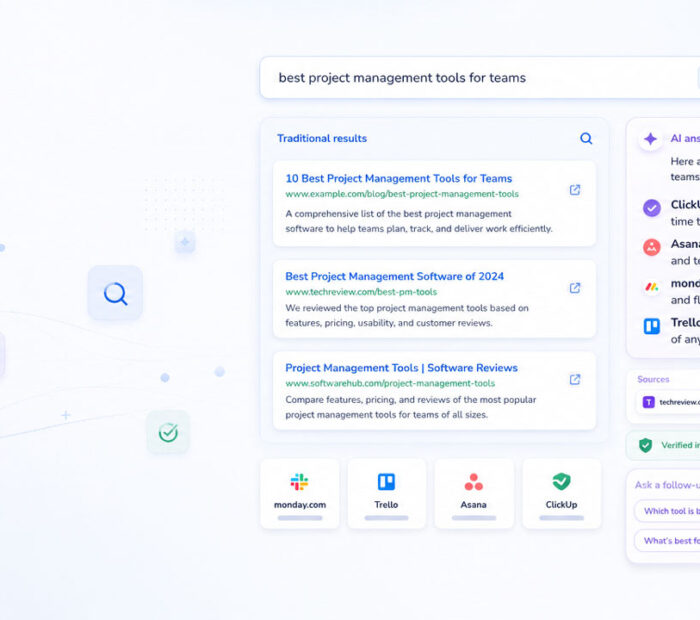
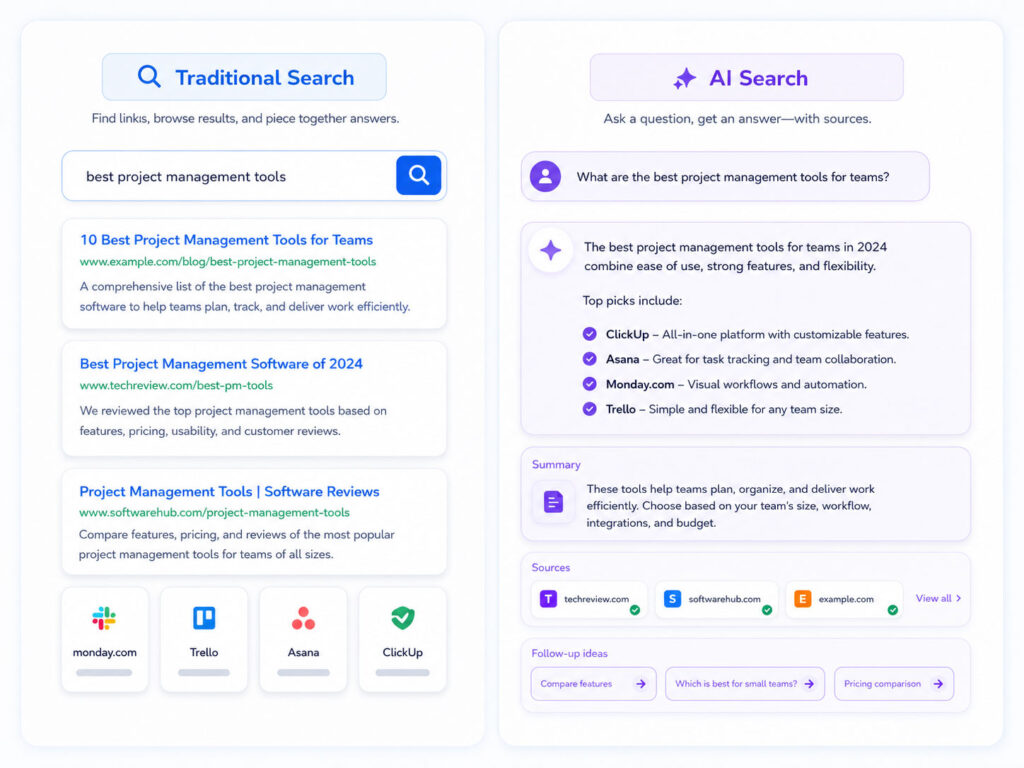
AI Search vs Google Search is becoming an important topic because the way people find information online is changing. Earlier, users mostly typed a query, checked a list of links, and opened different websites to compare answers.
Now, AI search tools can understand questions in a more conversational way and provide direct answers, summaries, comparisons, and follow-up suggestions.
This does not mean traditional search is gone. However, it does mean users now have more than one way to search, learn, compare, and decide.
What Is Traditional Google Search?
Traditional Google search helps users find web pages related to their search query.
For example, if you search for a topic, Google may show website links, snippets, videos, images, maps, shopping results, news, and other useful results. Users then choose which result to open and read.
In simple words, traditional search is mainly link-based. It helps you find sources where the answer may be available.
What Is AI Search?
AI search uses artificial intelligence to understand a question and generate a direct answer or summary.
Instead of only showing links, AI search may explain the topic, compare options, summarize information, or guide the user step by step.
For example, if you ask, “Which laptop storage is better for students, SSD or HDD?”, AI search may give a direct comparison instead of only showing website links.
Quick Difference Between AI Search and Google Search
The easiest way to understand the difference is this: traditional search helps you find sources, while AI search helps you understand answers faster.
| Point | Traditional Google Search | AI Search |
|---|---|---|
| Main Output | List of links and search results | Direct answer, summary, or explanation |
| User Effort | User opens and compares multiple pages | User gets a summarized answer faster |
| Best For | Finding websites, official pages, products, local results, and news | Understanding topics, comparing ideas, and getting quick explanations |
| Conversation | Usually query-based | Supports follow-up questions |
| Risk | Users may choose low-quality sources | AI may give incorrect or incomplete answers |
How Traditional Search Works
Traditional search engines scan and organize web pages so users can find relevant information.
When you enter a query, the search engine tries to show the most useful results based on many signals. These signals may include relevance, content quality, page structure, location, freshness, links, and user intent.
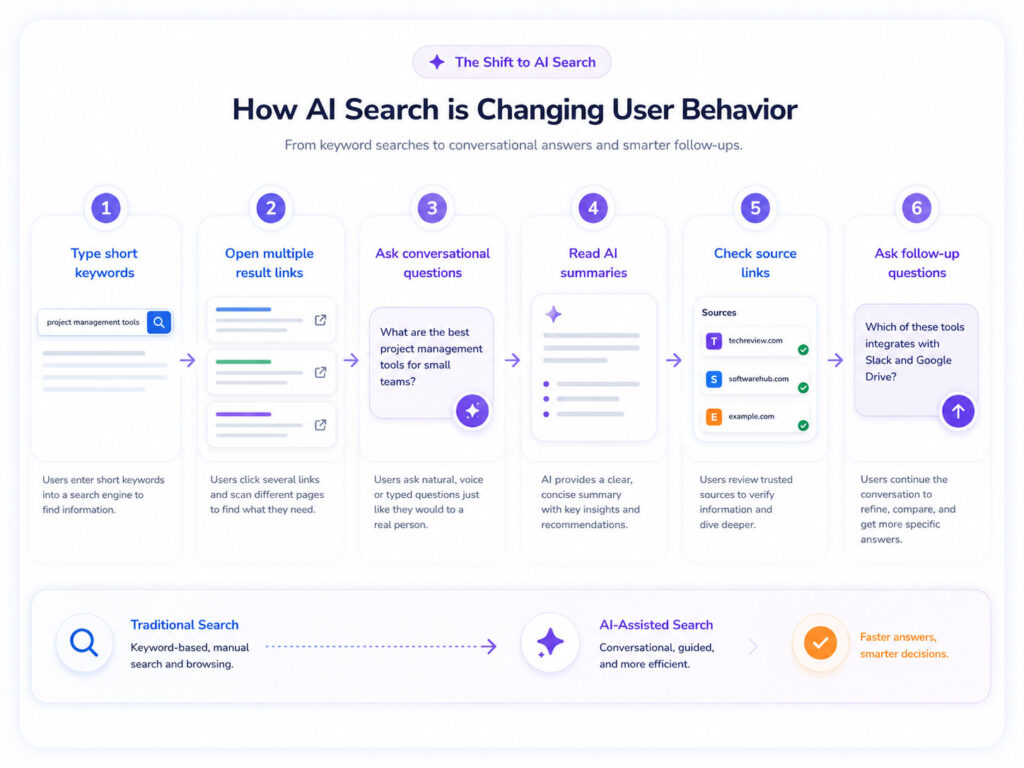
A simple traditional search flow looks like this:
User enters query → Search engine finds matching pages → Results are ranked → User opens pages → User compares informationThis approach is useful because users can visit original sources and check details directly.
How AI Search Works
AI search works differently because it tries to understand the meaning behind the question.
It may read or process information, identify the main points, and create a direct answer. It may also allow follow-up questions, which makes the search experience feel more like a conversation.
A simple AI search flow looks like this:
User asks question → AI understands intent → AI prepares answer →User asks follow-up → AI refines responseThis approach is useful when users want quick understanding instead of opening many pages.
Where AI Search Is Helpful
AI search can be helpful for learning, comparison, planning, and summarizing.
- Explaining technical topics in simple words.
- Comparing two or more options.
- Creating step-by-step guides.
- Summarizing long topics quickly.
- Generating ideas for content, study, or work.
- Answering follow-up questions in the same context.
Because of this, AI search is useful when users want clarity and direction quickly.
Where Traditional Search Is Still Better
Traditional search is still very useful in many situations.
- Finding official websites and documents.
- Checking latest news and live updates.
- Searching local businesses, maps, and directions.
- Comparing products, prices, and reviews.
- Finding original sources and references.
- Researching topics where source verification is important.
Therefore, AI search and traditional search can work together instead of replacing each other completely.
Accuracy Matters in AI Search
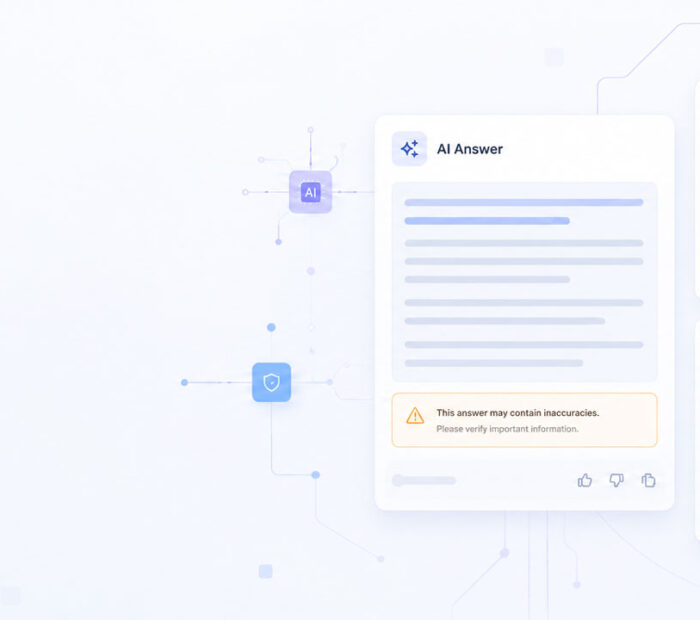
AI search can save time, but users should still check important information carefully.
Sometimes, AI may misunderstand a question, miss context, use outdated information, or produce an answer that sounds correct but is not fully accurate.
This is why AI search should be used with source checking, especially for health, finance, legal, security, technical, or business decisions.
How AI Search Changes SEO
AI search may also change how website owners think about SEO.
Earlier, many websites focused mainly on ranking for keywords. Now, content also needs to answer real user questions clearly and directly.
Helpful content should include simple explanations, useful examples, structured headings, comparison tables, FAQs, and trustworthy information. This can make content easier for both users and AI systems to understand.
What Type of Content Can Perform Better?
Content that solves user problems clearly may become more valuable.
- Beginner-friendly guides.
- Step-by-step tutorials.
- Comparison articles.
- Practical examples.
- Checklists and safety tips.
- FAQ-style answers.
- Updated and accurate explanations.
As a result, websites should focus less on keyword stuffing and more on helpful answers.
How Users Should Search Smarter
Users can get better results by combining AI search and traditional search.
| Need | Better Approach |
|---|---|
| Understand a topic quickly | Use AI search for a simple explanation |
| Verify facts | Check official websites or trusted sources |
| Compare options | Use AI summary, then confirm with real reviews or details |
| Find local services | Use traditional search and maps |
| Make important decisions | Use both AI answers and source verification |
Will AI Search Replace Google Search?
AI search may change search behavior, but traditional search still has strong value.
Users still need links, official pages, local results, product details, videos, maps, reviews, and original sources. AI search is helpful for summaries and explanations, but source-based search is still important for verification.
So, the future may not be AI search versus traditional search. Instead, users may use both depending on the situation.
Conclusion
AI Search vs Google Search is not only a technology comparison. It shows how online information discovery is changing.
Traditional search is useful for finding links, sources, websites, local results, and official information. AI search is useful for quick answers, summaries, comparisons, and follow-up questions.
The smartest approach is to use AI search for understanding and traditional search for verification. This balance can help users save time while still making informed decisions.

AboutTPJ Technical Team
The Project Jugaad Technical Team creates practical, easy-to-follow content on software development, web technologies, artificial intelligence, cybersecurity, cloud platforms, and digital tools. Our articles are informed by more than 13 years of hands-on experience with .NET, Angular, SQL Server, AWS, WordPress, Linux hosting, application deployment, and real-world troubleshooting. Each guide is researched, reviewed, and updated to provide accurate, useful, and actionable information for developers, businesses, and everyday technology users.