
Cyber Security
VPN vs Proxy is a common comparison when users want more privacy, safer browsing, or access control while using the internet.
Both VPNs and proxies can hide your original IP address from websites. However, they do not work in the same way. A proxy usually works for a specific app or browser, while a VPN protects internet traffic at the device or network level.
Because of this, it is important to understand the difference before choosing one.
What Is a VPN?
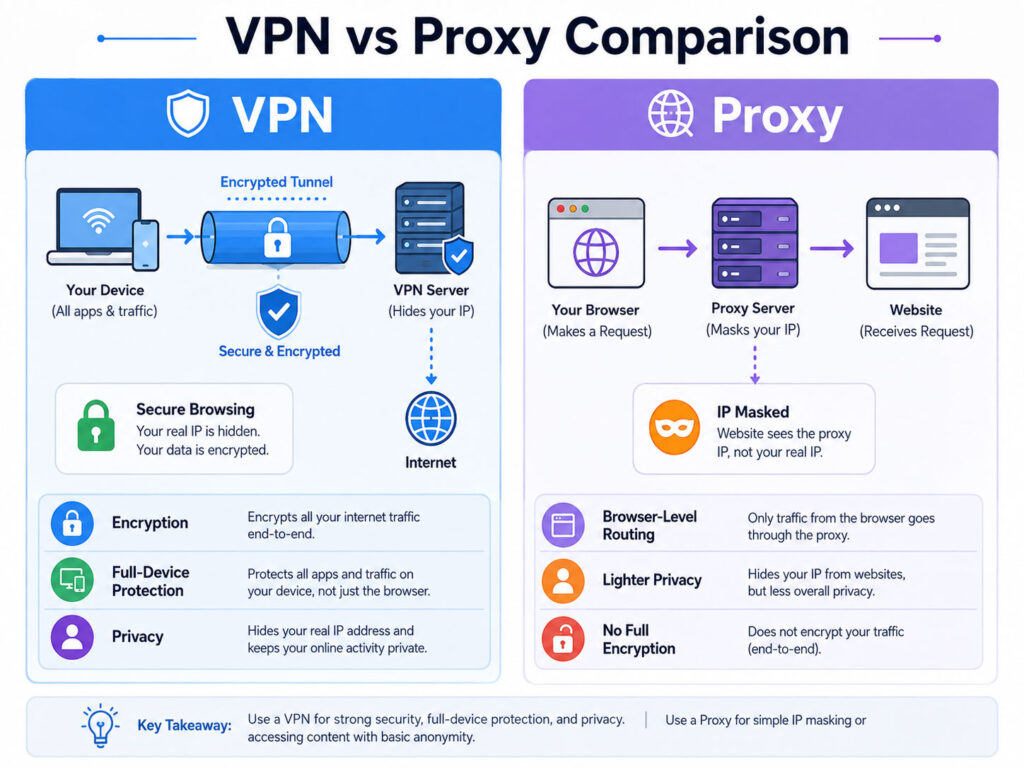
A VPN, or Virtual Private Network, creates a secure connection between your device and a VPN server.
When you use a VPN, your internet traffic goes through the VPN server before reaching websites or online services. As a result, websites usually see the VPN server IP address instead of your original IP address.
A VPN also encrypts traffic between your device and the VPN server. This can help protect your browsing activity on public Wi-Fi or untrusted networks.
What Is a Proxy?
A proxy works like a middle layer between your device and the website you want to visit.
When you use a proxy, your request goes to the proxy server first. Then, the proxy server sends the request to the website. The website may see the proxy server IP address instead of your original IP address.
Proxies are often used for browser-level browsing, basic IP masking, content filtering, testing, or managing access. However, many proxies do not encrypt all traffic like a VPN.
Quick Difference Between VPN and Proxy
The easiest way to understand the difference is this: a VPN focuses more on secure private connection, while a proxy focuses more on routing requests through another server.
| Point | VPN | Proxy |
|---|---|---|
| Full Name | Virtual Private Network | Proxy Server |
| Main Purpose | Privacy, encryption, and safer browsing | IP masking, routing, and access control |
| Encryption | Usually encrypts traffic between device and VPN server | May not encrypt traffic by itself |
| Coverage | Can protect most device traffic | Often works for one browser, app, or service |
| Best For | Public Wi-Fi, privacy, secure browsing, remote access | Basic browsing control, testing, filtering, and simple IP masking |
How a VPN Works
A VPN sends your internet traffic through a secure tunnel to a VPN server.
For example, if you connect to a VPN while using public Wi-Fi, your device sends traffic to the VPN server first. Then, the VPN server forwards your request to the website.
This helps reduce the risk of someone on the same public network reading your traffic. However, a VPN does not make you completely anonymous online.
Websites may still identify you through login accounts, cookies, browser fingerprinting, device information, or your online behavior.
How a Proxy Works
A proxy forwards your request through another server.
For example, if your browser uses a proxy, the browser sends website requests to the proxy server. Then, the proxy server requests the website on your behalf.
This can help hide your IP address from that website. However, a proxy may not protect traffic from other apps on your device unless those apps also use the proxy.
Also, a basic proxy does not always encrypt traffic. So, it may not provide the same level of protection as a trusted VPN.
VPN vs Proxy for Privacy
Both VPNs and proxies can hide your IP address from websites. Still, privacy depends on how the service works and how much you trust the provider.
A VPN may offer better privacy for general browsing because it can cover more traffic and encrypt the connection to the VPN server.
A proxy may offer limited privacy because it usually handles only specific traffic. Also, some free proxy services may log activity or show unwanted ads.
| Privacy Point | VPN | Proxy |
|---|---|---|
| Hides IP Address | Yes, usually across device traffic | Yes, usually for selected app or browser traffic |
| Encrypts Traffic | Usually yes | Not always |
| Protects Public Wi-Fi Browsing | Better option when using a trusted VPN | Limited protection |
| Provider Trust Needed | Yes | Yes |
VPN vs Proxy for Speed
Speed depends on the server, provider, distance, encryption, network quality, and website performance.
A proxy may feel faster for simple browsing because it often handles less traffic and may not use full encryption. However, this does not always mean it is safer.
A VPN may reduce speed slightly because it encrypts and routes traffic through a VPN server. Still, many good VPN services provide stable performance for normal browsing, streaming, and remote work.
When Should You Use a VPN?
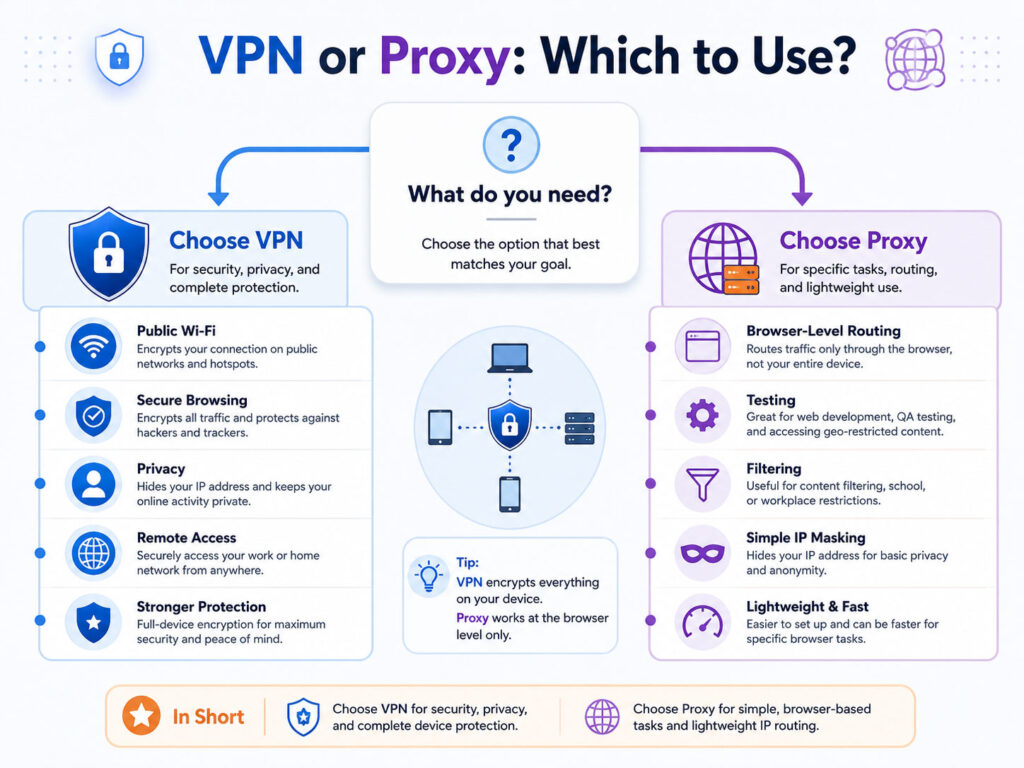
A VPN is useful when you want stronger protection for general internet traffic.
You may consider using a VPN in these situations:
- You use public Wi-Fi at airports, hotels, cafes, or shared places.
- You want to reduce exposure on untrusted networks.
- You need secure remote access for work or private systems.
- You want your websites to see the VPN server IP instead of your original IP.
- You want encrypted traffic between your device and the VPN server.
However, choose a trusted VPN provider. A poor VPN service may create privacy risks instead of solving them.
When Should You Use a Proxy?
A proxy is useful when you need simple request routing for a specific browser, app, or task.
You may use a proxy in these situations:
- You want browser-level IP masking for basic browsing.
- You need content filtering in a network or organization.
- You want to test how a website behaves from another location.
- You need routing for a specific tool, browser, or application.
- You do not need full-device encrypted traffic.
Still, avoid unknown free proxies for sensitive activity. They may log traffic, inject ads, or expose your data.
Common Myths About VPNs and Proxies
Many users expect too much from VPNs and proxies. So, it is important to understand their limits.
| Myth | Reality |
|---|---|
| A VPN makes me fully anonymous | No tool can guarantee complete anonymity |
| A proxy is the same as a VPN | A proxy usually offers less coverage and weaker protection |
| Free VPNs and proxies are always safe | Some free services may log data or create privacy risks |
| VPNs stop all tracking | Websites can still track users through accounts, cookies, and browser signals |
| Proxy encryption is always available | Many proxies do not encrypt traffic by default |
Which One Is Better?
For most users, a trusted VPN is better than a proxy when privacy and security matter.
A VPN can protect more traffic and provide encrypted connection between your device and the VPN server. This makes it more useful for public Wi-Fi, remote work, and general safer browsing.
On the other hand, a proxy can still be useful for simple browser routing, testing, filtering, or basic IP masking.
So, the best option depends on your purpose. Use a VPN for stronger privacy and security. Use a proxy for limited, specific, and less sensitive tasks.
Conclusion
VPN vs Proxy is not only about hiding an IP address. It is about how much protection, coverage, and privacy you need.
A VPN usually provides better security because it can encrypt traffic and protect more apps on your device. A proxy is simpler and can help with selected browsing or routing needs.
If you handle sensitive accounts, use public Wi-Fi, or want safer browsing, a trusted VPN is usually the better option. If you only need basic browser-level routing, a proxy may be enough.

AboutTPJ Technical Team
The Project Jugaad Technical Team creates practical, easy-to-follow content on software development, web technologies, artificial intelligence, cybersecurity, cloud platforms, and digital tools. Our articles are informed by more than 13 years of hands-on experience with .NET, Angular, SQL Server, AWS, WordPress, Linux hosting, application deployment, and real-world troubleshooting. Each guide is researched, reviewed, and updated to provide accurate, useful, and actionable information for developers, businesses, and everyday technology users.