
Software Development
REST API vs GraphQL is an important comparison for developers, architects, students, and businesses that build web or mobile applications.
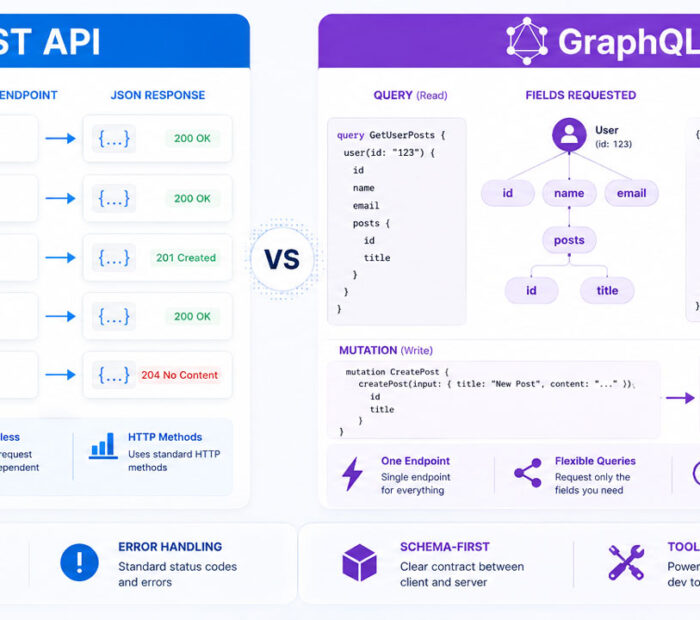
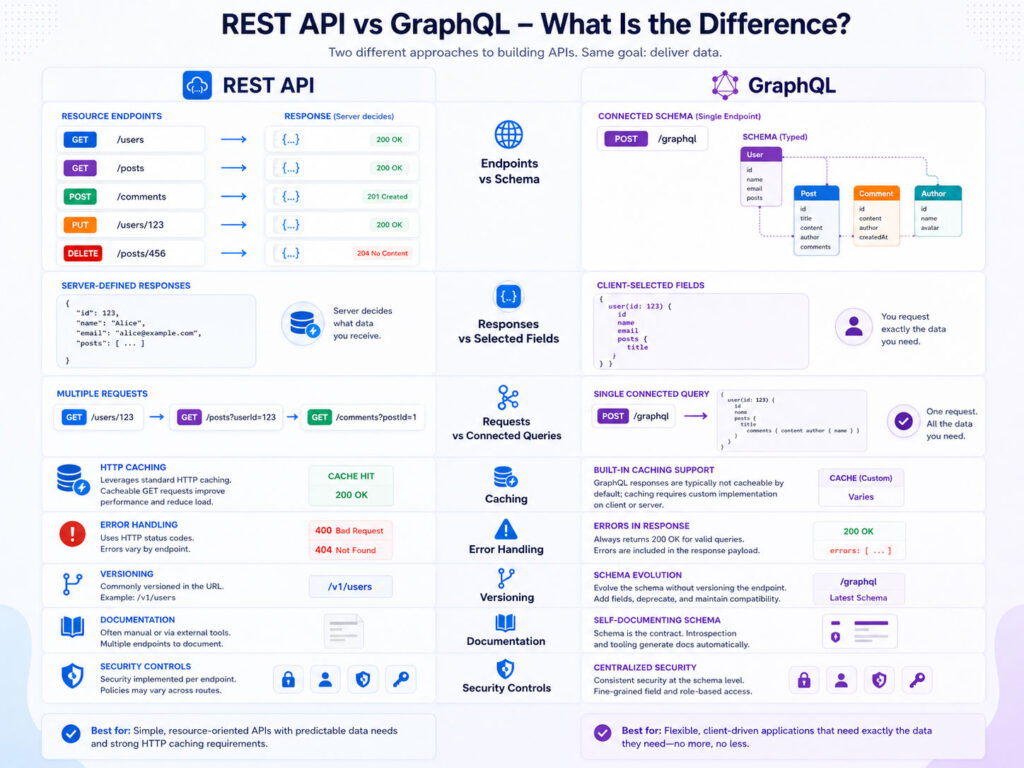
Both approaches allow clients to communicate with servers and access application data. However, REST commonly exposes resources through multiple URLs, while GraphQL lets clients request selected fields through a typed schema.
Therefore, the right choice depends on your data structure, client applications, caching requirements, team experience, security controls, and long-term API strategy.
What Is a REST API?
REST stands for Representational State Transfer.
Rather than being a programming language or database, REST is an architectural style for distributed systems. In most REST-style APIs, the server represents business information as resources and uses standard HTTP methods to work with them.
For example, an application may provide separate URLs for users, products, orders, and payments.
GET /api/products
GET /api/products/42
POST /api/products
PUT /api/products/42
DELETE /api/products/42
Here, the URL identifies the resource, while the HTTP method describes the requested action.
Common HTTP Methods in a REST API
| HTTP Method | Common Purpose |
|---|---|
| GET | Retrieve a resource or collection |
| POST | Create a resource or start an operation |
| PUT | Replace or update a complete resource |
| PATCH | Apply a partial update |
| DELETE | Remove a resource |
Each method has a defined purpose. Therefore, an API should use these methods according to their HTTP semantics instead of treating every request as the same type of operation.
Simple REST API Request
GET /api/products/42After receiving the request, the server may return the following JSON response:
{
  "id": 42,
  "name": "Wireless Keyboard",
  "price": 2499,
  "stockQuantity": 18,
  "category": {
    "id": 7,
    "name": "Computer Accessories"
  }
}
In this case, the server controls the response structure for the endpoint. As a result, every client normally receives the same representation unless the API supports field selection or another custom option.
What Is GraphQL?
GraphQL is a query language for APIs and a runtime for executing those queries against a typed schema.
First, a GraphQL schema describes the available types, fields, relationships, queries, and data-changing operations. Next, the client selects only the fields it needs.
Unlike a database technology, GraphQL does not require a specific storage system. Instead, server-side resolvers can retrieve data from databases, existing REST APIs, files, services, or other systems.
Simple GraphQL Query
query GetProduct {
  product(id: 42) {
    id
    name
    price
    category {
      name
    }
  }
}
Because the client selected specific fields, the server may return only those values:
{
  "data": {
    "product": {
      "id": 42,
      "name": "Wireless Keyboard",
      "price": 2499,
      "category": {
        "name": "Computer Accessories"
      }
    }
  }
}
Consequently, the client can request a response that closely matches the current screen or feature.
REST API vs GraphQL: Quick Comparison
| Point | REST API | GraphQL |
|---|---|---|
| Core Approach | Resource-oriented architectural style | Typed API query language and execution system |
| Request Structure | Uses resource URLs and HTTP methods | Uses queries and mutations against a schema |
| Endpoints | Commonly uses several resource endpoints | Commonly uses one HTTP endpoint |
| Response Shape | Usually defined by the server endpoint | Selected by the client from permitted fields |
| Data Relationships | May require several requests or expanded endpoints | Can request connected data in one operation |
| Caching | Works naturally with standard HTTP caching | Often needs GraphQL-aware client or server caching |
| Error Handling | Commonly relies on HTTP status codes and response bodies | Can return data and field-level errors together |
| Schema | May use documentation such as an API specification | Requires a typed GraphQL schema |
This comparison provides a useful starting point. Still, the final implementation depends on the framework, architecture, and development standards used by the team.
REST Is an Architectural Style
A REST API should follow more than a particular URL format.
For instance, the REST architectural style includes constraints such as client-server separation, stateless communication, cacheability, a uniform interface, and layered systems.
Therefore, adding the word REST to an HTTP service does not automatically make that service fully RESTful.
GraphQL Uses a Typed Schema
A GraphQL API defines which fields clients can query.
type Product {
  id: ID!
  name: String!
  price: Float!
  stockQuantity: Int!
  category: Category
}

type Category {
id: ID!
name: String!
}

type Query {
product(id: ID!): Product
products: [Product!]!
}
The schema acts as a contract between clients and the server. In addition, development tools can use it for validation, navigation, suggestions, and documentation.
How Data Fetching Differs
REST and GraphQL give clients different levels of control over data retrieval.
A REST endpoint normally returns a server-defined response. By contrast, a GraphQL operation selects fields from the schema.
However, flexible selection does not automatically make every GraphQL request faster. Database queries, resolver design, caching, network conditions, and response size still affect performance.
What Is Overfetching?
Overfetching happens when an API returns more data than the client needs.
For example, a product-list screen may need only the product ID, name, price, and thumbnail. Nevertheless, a REST endpoint might also return the description, inventory history, supplier details, and audit information.
GraphQL can reduce this problem because the client selects specific fields.
query GetProductList {
  products {
    id
    name
    price
    thumbnailUrl
  }
}
Still, a well-designed REST API can also provide compact list responses, field filters, or dedicated resource representations.
What Is Underfetching?
Underfetching happens when one response does not contain enough information for the client.
For instance, a REST client may request an order and then make additional requests for the customer, payment, and order items.
GET /api/orders/5001
GET /api/customers/18
GET /api/orders/5001/items
GET /api/payments/981
Instead, a GraphQL operation can request those connected fields together:
query GetOrder {
  order(id: 5001) {
    id
    status
    customer {
      id
      name
    }
    items {
      productName
      quantity
      price
    }
    payment {
      status
    }
  }
}
As a result, the client may need fewer network round trips. However, the server still needs efficient data access to fulfil the complete request.
REST Endpoints vs a GraphQL Endpoint
A REST API commonly creates separate URLs for different resource types.
/api/users
/api/products
/api/orders
/api/payments
Meanwhile, GraphQL over HTTP commonly accepts operations through one endpoint:
POST /graphqlThe operation body determines which fields and actions the client requests. Even so, GraphQL remains transport-independent at the specification level, while HTTP serves as its most common transport for web APIs.
Queries, Mutations, and Subscriptions
GraphQL defines different operation types.
| Operation | Common Purpose |
|---|---|
| Query | Retrieve data |
| Mutation | Create, update, delete, or perform another data-changing action |
| Subscription | Receive ongoing updates from supported server infrastructure |
A query should not change server data. Meanwhile, mutations communicate that the operation may create a side effect.
Simple GraphQL Mutation
mutation CreateProduct(
  $name: String!
  $price: Float!
) {
  createProduct(
    input: {
      name: $name
      price: $price
    }
  ) {
    id
    name
    price
  }
}
In addition, variables can carry dynamic input values separately from the operation document.
REST API Caching
REST can work naturally with HTTP caching because resource URLs and HTTP methods carry standard semantics.
For example, servers can use cache headers, validators, modification dates, and intermediary caches for suitable GET responses.
Therefore, REST may provide a straightforward caching model for public resources and content-focused APIs.
GraphQL Caching
GraphQL caching often requires more application awareness because different operations may use the same endpoint and request different field combinations.
For instance, GraphQL clients can normalise returned objects by type and ID. Servers may also cache resolver results, persisted operations, database queries, or complete responses.
However, the team must design cache identity, invalidation, permissions, and freshness rules carefully.
HTTP Status Codes and Errors
REST APIs commonly use HTTP status codes to describe the overall request result.
| Status Code | Common Meaning |
|---|---|
| 200 | The request succeeded |
| 201 | The server created a resource |
| 204 | The request succeeded without a response body |
| 400 | The client sent an invalid request |
| 401 | The request lacks valid authentication |
| 403 | The authenticated user lacks permission |
| 404 | The requested resource was not found |
| 500 | The server encountered an unexpected problem |
A GraphQL server also uses HTTP status codes for transport-level outcomes. However, a valid operation may return a response containing both data and field-level errors.
{
  "data": {
    "product": null
  },
  "errors": [
    {
      "message": "Product was not found.",
      "path": [
        "product"
      ]
    }
  ]
}
Therefore, GraphQL clients should inspect the response body instead of relying only on the HTTP status code.
API Versioning
REST APIs often use URL, header, or media-type versioning when a breaking change becomes necessary.
/api/v1/products
/api/v2/products
GraphQL teams, on the other hand, often evolve one schema by adding fields and deprecating older ones.
This approach can reduce full API-version changes. However, removing an old field still requires planning, usage tracking, communication, and a migration period.
Documentation and Development Tools
REST APIs can provide structured documentation through an API description format and interactive documentation tools.
Similarly, GraphQL schemas expose types, fields, arguments, and descriptions to compatible development tools. As a result, clients can receive query validation and field suggestions while creating an operation.
In both approaches, teams should document authentication, permissions, errors, limits, examples, and business rules.
REST API Security
REST APIs need authentication, authorisation, validation, rate limiting, secure headers, logging, and safe error handling.
Moreover, every endpoint should verify that the authenticated user can access the requested resource.
Therefore, teams should never assume that hiding a URL or disabling a button provides adequate protection.
GraphQL Security
GraphQL requires the same basic API security controls. However, flexible queries introduce additional concerns.
- Deeply nested queries can consume excessive resources.
- Large selection sets may create expensive database work.
- Aliases can repeat costly fields inside one operation.
- Unrestricted introspection may reveal schema details.
- Field-level access must follow business permissions.
- Subscriptions require secure connection and resource controls.
Therefore, GraphQL servers may need query-depth limits, complexity analysis, timeouts, pagination, request limits, persisted operations, and resolver-level monitoring.
Most importantly, the business layer should enforce authorisation consistently regardless of how clients request the data.
Benefits of REST APIs
REST provides a familiar approach that uses established web standards.
- Resource URLs can remain simple and predictable.
- HTTP methods clearly communicate request intent.
- Standard HTTP caching works well for suitable resources.
- Browsers, proxies, gateways, and monitoring tools understand HTTP behaviour.
- Teams can build small APIs without a specialised query runtime.
- REST works well for public, resource-focused, and file-based services.
Therefore, REST remains a practical starting point for many applications.
Limitations of REST APIs
REST can create challenges when clients need many connected resources or different response shapes.
- One screen may require several network requests.
- Standard endpoints may return more data than one client needs.
- Mobile, web, and partner clients may need different representations.
- API versioning can become difficult across many consumers.
- Client teams may depend on backend changes for new response fields.
- Large numbers of endpoints require consistent documentation and governance.
However, careful resource design, filtering, expansion, pagination, and caching can reduce these problems.
Benefits of GraphQL
GraphQL gives clients controlled flexibility within a typed schema.
- Clients can select the fields they need.
- One operation can request connected data.
- The schema creates a clear and discoverable contract.
- Strong development tools can validate operations before execution.
- Teams can add fields without immediately creating a new API version.
- Several backend data sources can appear through one graph.
As a result, GraphQL can work well for applications with complex screens and multiple client types.
Limitations of GraphQL
GraphQL introduces additional server and operational complexity.
- HTTP caching becomes less direct.
- Flexible queries can create unpredictable workloads.
- Resolvers may cause repeated database requests.
- File uploads and downloads may need separate handling.
- Monitoring requires operation and field-level visibility.
- Schema design and governance need experienced ownership.
- Simple CRUD services may not need the extra layer.
Therefore, GraphQL should solve a real client or data-composition problem rather than follow a trend.
What Is the N+1 Query Problem?
The N+1 query problem occurs when a server loads a list and then runs an additional database query for every item.
For example, a GraphQL resolver may load 100 orders and then query the customer separately for each order.
1 query to load 100 orders
+
100 queries to load customers
=
101 database queries
Consequently, this pattern can reduce performance quickly.
To address the problem, teams can batch and cache related lookups, improve database queries, or load relationships more efficiently.
REST API vs GraphQL Performance
Neither approach is always faster.
GraphQL may reduce response size and network requests for complex screens. However, one GraphQL operation can trigger expensive server-side work.
By contrast, REST may require several requests for connected data. Still, predictable resource endpoints can support efficient caching and simpler database access.
Therefore, performance depends on:
- Database design and indexes.
- Resolver or endpoint implementation.
- Network latency.
- Response size.
- Caching strategy.
- Pagination.
- Authentication and authorisation work.
- Application access patterns.
Teams should measure actual workloads instead of relying on general claims.
REST API vs GraphQL for Mobile Apps
Mobile applications often work across slower or less reliable networks.
GraphQL can help a mobile screen request selected fields and connected data in one operation. Consequently, it may reduce unnecessary response data and network round trips.
However, a compact and well-designed REST API can also support mobile clients effectively.
Ultimately, the better choice depends on screen complexity, offline behaviour, caching, battery usage, and backend capacity.
REST API vs GraphQL for Web Applications
REST works well when pages map clearly to stable resources and standard server responses.
Meanwhile, GraphQL can help dashboards, admin panels, social applications, and complex product interfaces that combine several connected data types.
Still, simple websites may gain little from a GraphQL layer. In those cases, REST can remain easier to build, cache, monitor, and maintain.
REST API vs GraphQL for Microservices
Microservices can communicate through REST, GraphQL, messaging, or other protocols.
For example, a GraphQL gateway may combine data from several backend services into one client-facing graph. This approach can simplify client access while keeping the services separate.
However, the gateway can become a critical dependency. Therefore, teams need ownership, performance controls, observability, failure handling, and schema governance.
REST API vs GraphQL for Public APIs
REST often provides a familiar model for public APIs, webhooks, downloads, and integrations.
Resource URLs and HTTP methods remain easy to test with common tools. In addition, standard caching can help public read-heavy services.
GraphQL can also support external developers. However, the provider must carefully control query cost, permissions, pagination, schema changes, and usage limits.
REST API vs GraphQL for File Uploads
REST commonly handles files through dedicated upload and download endpoints.
These endpoints can use standard HTTP content types, streaming, caching, and range requests where appropriate.
Meanwhile, GraphQL teams often keep metadata operations in GraphQL while using separate URLs or object-storage workflows for file transfer.
Therefore, an application does not need to force every operation through GraphQL.
Can REST and GraphQL Work Together?
Yes, many systems use both approaches.
For instance, an application may keep existing REST services and add a GraphQL layer for web and mobile clients.
Web and mobile clients
          ↓
    GraphQL gateway
          ↓
REST services, databases, and other systems
At the same time, the platform may continue using REST for webhooks, authentication callbacks, file downloads, and simple integrations.
This combined approach can provide flexibility. However, it also adds another technology that teams must secure, monitor, test, and maintain.
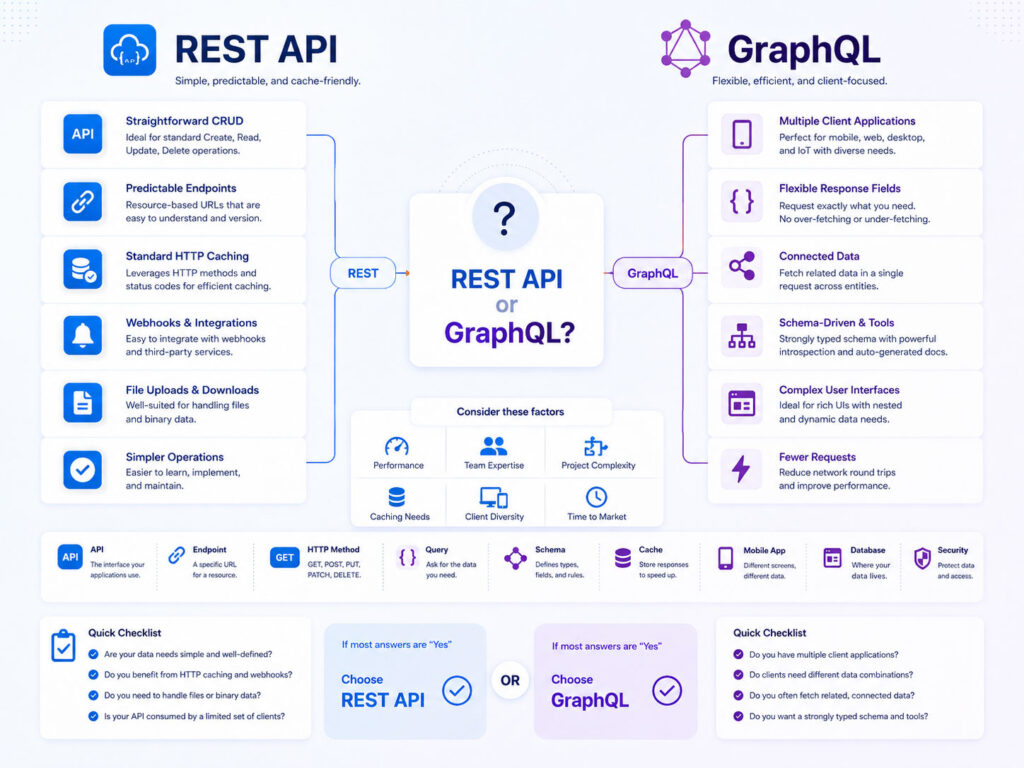
When Should You Use REST?
REST provides a strong starting point when resources and operations remain clear.
- The API mainly supports straightforward CRUD operations.
- HTTP caching provides significant value.
- The service exposes files, streams, or public resources.
- Clients need stable and predictable responses.
- The development team wants a simpler operational model.
- Existing infrastructure already follows REST conventions.
In these cases, adding GraphQL may create complexity without enough benefit.
When Should You Use GraphQL?
GraphQL can provide value when clients need flexible access to connected data.
- Web and mobile screens require different field combinations.
- One feature combines data from several services.
- Client teams need more control over response shapes.
- The domain contains many connected entities.
- Rapid interface development requires frequent field additions.
- Strong schema-driven development tools benefit the team.
However, the team should also have the skills to manage schema design, query cost, security, caching, and resolver performance.
Questions to Ask Before Choosing
- How many different client applications will use the API?
- Do those clients need different data shapes?
- Does one screen combine several related resources?
- How important is standard HTTP caching?
- Will the API support files, webhooks, or streaming?
- Can the team monitor and limit query cost?
- Who will own the API schema and governance?
- Does the existing architecture already use REST effectively?
- What security and authorisation rules apply?
- Which option can the team maintain over several years?
These questions provide more value than selecting a technology simply because it appears popular.
Common REST API Mistakes
- Using verbs in every resource URL without a clear need.
- Ignoring HTTP method semantics.
- Returning inconsistent error structures.
- Skipping pagination for large collections.
- Exposing database entities directly.
- Creating breaking changes without a migration plan.
- Applying authentication without resource-level authorisation.
Fortunately, clear conventions can prevent these problems across the API.
Common GraphQL Mistakes
- Creating the schema directly from database tables.
- Allowing unlimited query depth or complexity.
- Ignoring repeated database requests inside resolvers.
- Exposing sensitive fields without proper authorisation.
- Returning unlimited collections without pagination.
- Using GraphQL for every file and integration operation.
- Removing deprecated fields before clients migrate.
Instead, a successful schema should represent the business domain rather than the database structure alone.
Which One Should Beginners Learn First?
Beginners should usually learn HTTP and REST-style API fundamentals first.
This path introduces URLs, request methods, headers, status codes, JSON, authentication, caching, and client-server communication.
Afterwards, learners can study GraphQL schemas, types, queries, mutations, variables, resolvers, pagination, and query security.
As a result, understanding both approaches helps developers choose based on requirements rather than preference.
REST API or GraphQL: Which One Should You Choose?
| Your Requirement | Recommended Starting Point |
|---|---|
| Simple resource-based CRUD API | REST |
| Standard HTTP caching | REST |
| File downloads and webhooks | REST |
| Different response shapes for several clients | GraphQL |
| Complex connected data | GraphQL |
| Schema-driven client development | GraphQL |
| Existing stable REST services | Keep REST unless a clear requirement justifies change |
| Mixed platform requirements | Use REST and GraphQL together when justified |
Final Verdict
REST provides a mature and familiar approach based on resources, HTTP methods, URLs, status codes, and caching.
In contrast, GraphQL provides a typed schema that lets clients select fields and request connected data through flexible operations.
Therefore, REST often suits simple, predictable, and cache-friendly services, while GraphQL often suits complex interfaces, multiple clients, and connected data requirements.
Conclusion
REST API vs GraphQL does not have one universal winner.
Choose REST when resource endpoints, standard HTTP behaviour, and operational simplicity match the application. Alternatively, choose GraphQL when clients need flexible response shapes and efficient access to connected data.
Most importantly, evaluate security, performance, caching, team experience, and long-term maintenance before choosing either approach.

AboutTPJ Technical Team
The Project Jugaad Technical Team creates practical, easy-to-follow content on software development, web technologies, artificial intelligence, cybersecurity, cloud platforms, and digital tools. Our articles are informed by more than 13 years of hands-on experience with .NET, Angular, SQL Server, AWS, WordPress, Linux hosting, application deployment, and real-world troubleshooting. Each guide is researched, reviewed, and updated to provide accurate, useful, and actionable information for developers, businesses, and everyday technology users.