
Artificial Intelligence
AI Agents Explained is an important topic because artificial intelligence is moving beyond simple question-and-answer tools. Many AI tools can now plan steps, use tools, complete tasks, and work with less manual input.
A normal AI tool usually waits for your prompt and gives an answer. However, an AI agent can take a goal, break it into smaller steps, and try to complete the task by using available tools or information.
Because of this, AI agents are becoming useful for productivity, automation, customer support, research, coding, data work, and business workflows.
What Is an AI Agent?
An AI agent is a software system that can understand a goal, make decisions, and take actions to complete a task.
For example, instead of only asking AI to write an email, an AI agent may help collect details, prepare the email, check the tone, suggest improvements, and get it ready for review.
In simple words, an AI agent does not only answer. It can also act based on the goal and available tools.
AI Agent vs Normal AI Chatbot
Many users confuse AI agents with AI chatbots. They are related, but they are not exactly the same.
| Point | AI Chatbot | AI Agent |
|---|---|---|
| Main Role | Answers user questions | Works toward a goal |
| Input Style | Usually needs direct prompts | Can plan steps from a larger task |
| Action Ability | Mostly gives text-based responses | May use tools, data, or workflows |
| Best For | Questions, writing, summaries, and explanations | Task automation, planning, monitoring, and workflow support |
| Human Role | User asks and reviews answer | User gives goal, reviews progress, and approves important actions |
The simple difference is this: a chatbot responds, while an AI agent can work through a task.
How AI Agents Work
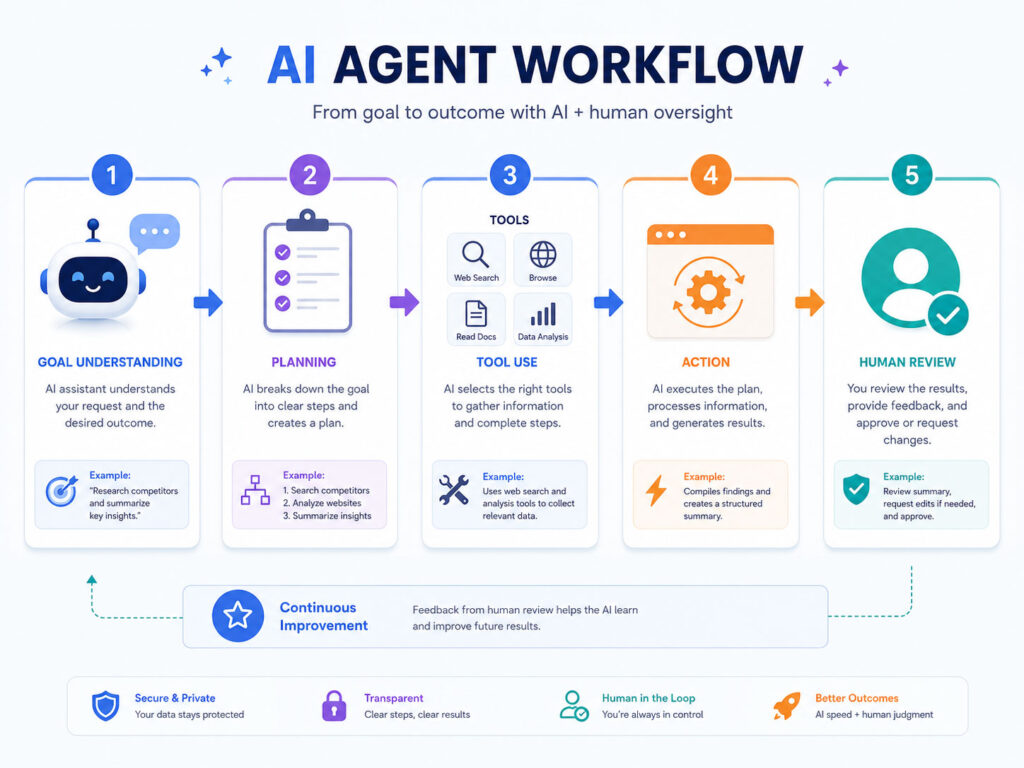
An AI agent usually works through a few common steps.
| Step | What Happens |
|---|---|
| Goal Understanding | The agent understands what the user wants to achieve |
| Planning | It breaks the task into smaller steps |
| Tool Use | It may use search, files, APIs, apps, or other tools |
| Action | It performs the required steps or prepares outputs |
| Review | The user checks the result and approves important decisions |
As a result, AI agents can reduce repeated manual effort and support more complex work.
Simple Example of an AI Agent
Let’s say you want to prepare a weekly work report.
A normal AI chatbot may help you write the report if you provide all details. However, an AI agent may go one step further. It may collect task updates, organize points, identify missing information, create a draft, and ask you to review it.
A simple AI agent flow may look like this:
User goal → Agent creates plan → Agent collects information → Agent prepares output → User reviews resultThis does not mean the AI should work without control. Instead, the best approach is to let AI support the task while a human reviews the final output.
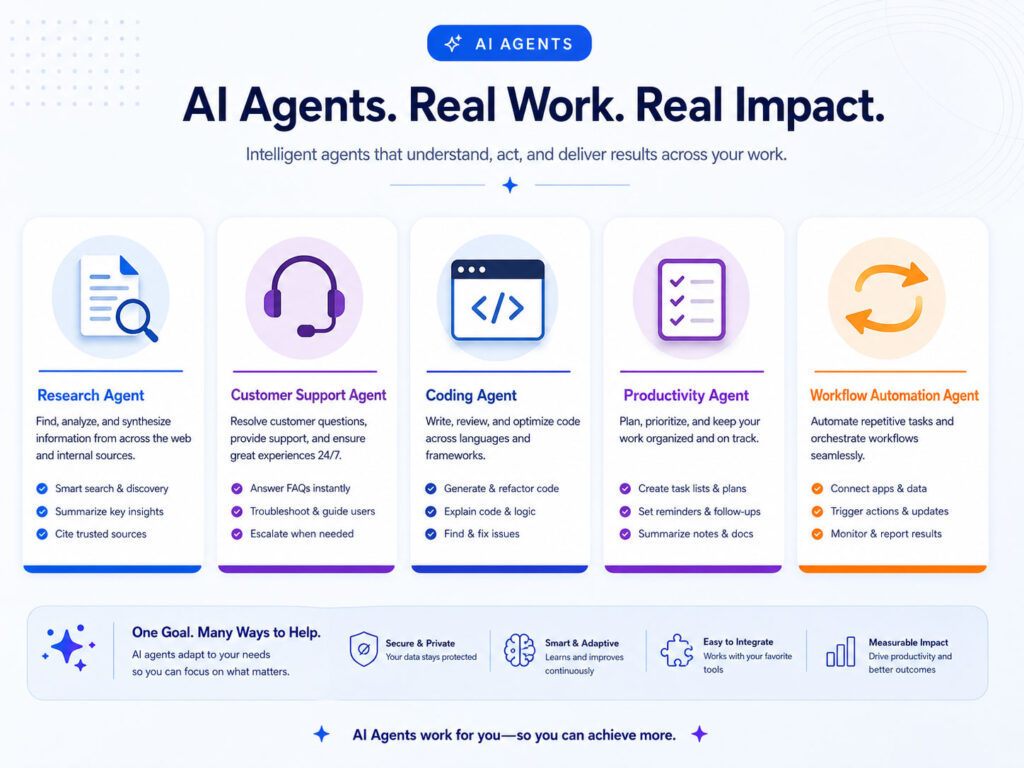
Common Types of AI Agents
AI agents can be used in different ways depending on the task.
| Agent Type | Example Use |
|---|---|
| Research Agent | Collects information and prepares summaries |
| Customer Support Agent | Answers common questions and routes complex issues |
| Coding Agent | Helps write, review, or debug code |
| Productivity Agent | Creates plans, reminders, drafts, and task summaries |
| Workflow Agent | Connects tools and automates repeated business steps |
Where AI Agents Can Be Useful
AI agents can support many daily and professional tasks.
- Preparing reports and summaries.
- Managing customer support questions.
- Creating content drafts and ideas.
- Helping with software development tasks.
- Monitoring alerts, tickets, or workflow updates.
- Organizing research notes and action items.
- Connecting different tools in an automation workflow.
Because of this, AI agents can save time in tasks that need repeated steps, information processing, or structured follow-up.
Benefits of AI Agents
AI agents are useful because they can handle more than one small prompt at a time.
- They can reduce repetitive work.
- They can help organize complex tasks.
- They can speed up research and drafting.
- They can support workflow automation.
- They can help users move from idea to action faster.
However, the value of an AI agent depends on clear goals, reliable tools, good instructions, and proper review.
Limitations of AI Agents
AI agents can be powerful, but they also have limitations.
They may misunderstand goals, use incomplete information, make wrong assumptions, or create outputs that need correction. Sometimes, they may also depend on tools that return outdated or incorrect data.
Therefore, users should not treat AI agents as fully independent decision-makers.
Risks of Using AI Agents Without Review
AI agents can create problems if users allow them to act without proper control.
- They may send incorrect information.
- They may make decisions based on weak context.
- They may expose private or sensitive data if configured poorly.
- They may perform repeated wrong actions if the workflow is not checked.
- They may create outputs that sound correct but still need fact-checking.
Because of this, human review is important, especially for financial, legal, medical, security, business, or customer-facing tasks.
Best Practices for Using AI Agents
Follow these habits to use AI agents more safely and effectively:
- Give clear goals and instructions.
- Limit access to only the tools and data the agent needs.
- Review important actions before they are completed.
- Check facts before publishing or sharing outputs.
- Do not share unnecessary private or confidential information.
- Start with small tasks before using agents for larger workflows.
- Track agent activity when it connects with real systems.
These practices help users get benefits from AI agents while reducing risk.
AI Agents and the Future of Work
AI agents may change how people work with software tools.
Instead of manually moving between many apps, users may give a goal and allow an AI agent to help with planning, drafting, checking, and workflow steps.
Still, human judgment will remain important. AI agents can assist, but people should decide, review, and take responsibility for final outcomes.
Conclusion
AI Agents Explained in simple words means understanding AI systems that can work toward goals, plan steps, use tools, and support task completion.
They are different from normal chatbots because they can do more than answer questions. They can help manage workflows, research, coding, support, productivity, and automation.
However, AI agents should be used with clear instructions, limited access, fact-checking, and human review. When used carefully, they can save time and make daily work more efficient.

AboutTPJ Technical Team
The Project Jugaad Technical Team creates practical, easy-to-follow content on software development, web technologies, artificial intelligence, cybersecurity, cloud platforms, and digital tools. Our articles are informed by more than 13 years of hands-on experience with .NET, Angular, SQL Server, AWS, WordPress, Linux hosting, application deployment, and real-world troubleshooting. Each guide is researched, reviewed, and updated to provide accurate, useful, and actionable information for developers, businesses, and everyday technology users.