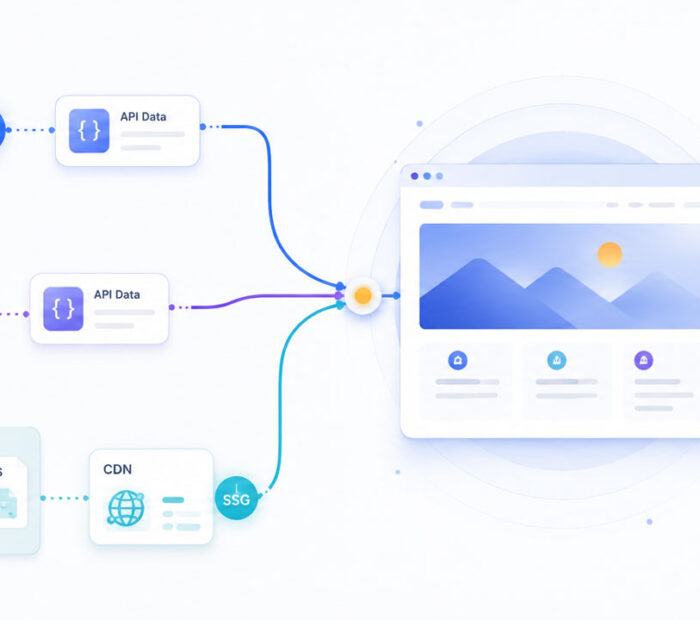

Web Development
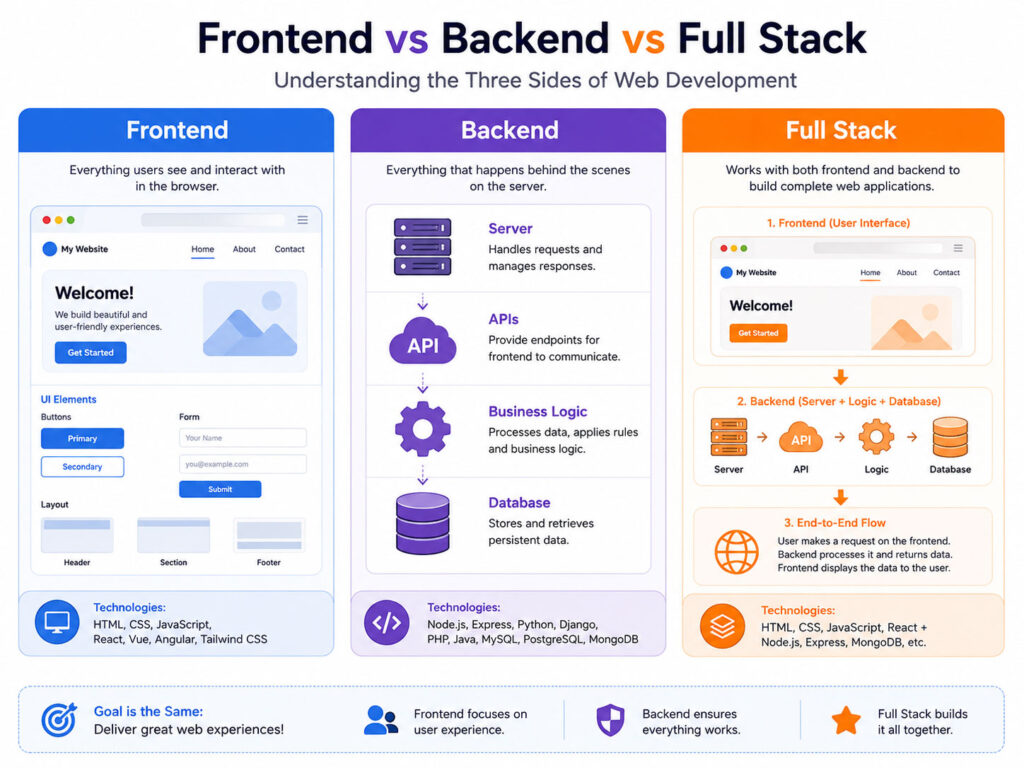
Frontend vs Backend vs Full Stack Development is an important topic for anyone who wants to understand how websites and web applications are built.
When you open a website, you see buttons, menus, forms, images, text, and pages. However, many things also happen behind the screen, such as saving data, checking login details, processing requests, and connecting with databases.
Frontend, backend, and full stack development describe different parts of this complete web development process.
What Is Frontend Development?
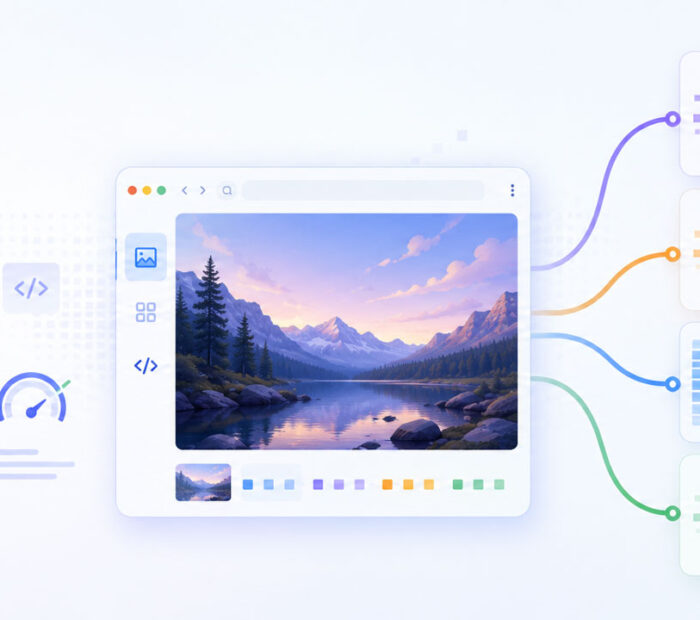
Frontend development focuses on the part of a website or application that users can see and interact with.
For example, when you click a button, open a menu, fill a form, or view a dashboard, you are using the frontend part of the application.
Frontend developers work on layout, design implementation, responsiveness, user experience, and browser-based functionality.
What Is Backend Development?
Backend development focuses on the server-side part of an application.
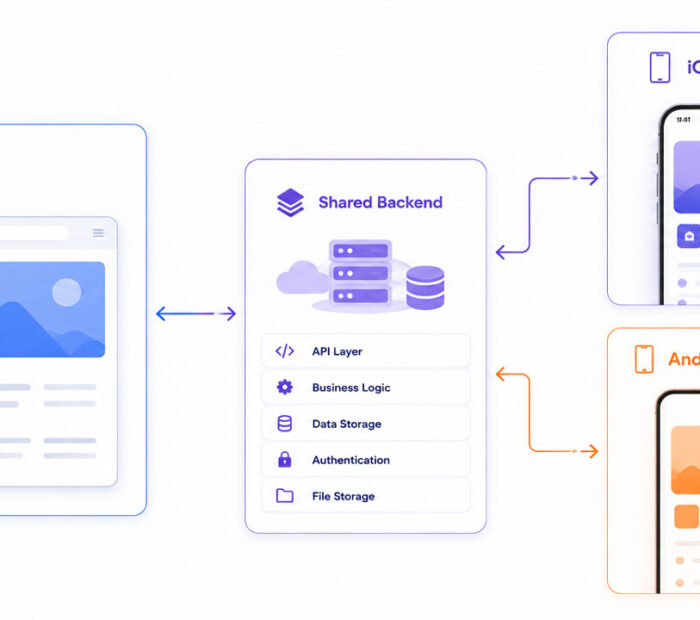
It handles data, business logic, authentication, APIs, database operations, and communication between different systems.
For example, when you log in to a website, the backend checks your details, verifies your account, and returns the correct response to the frontend.
What Is Full Stack Development?
Full stack development includes both frontend and backend development.
A full stack developer can work on user interface, server-side logic, APIs, databases, and sometimes deployment-related tasks as well.
In simple words, full stack development covers the complete flow from what users see on the screen to how data works behind the screen.
Quick Difference Between Frontend, Backend, and Full Stack
The easiest way to understand the difference is this: frontend is what users see, backend is how the system works, and full stack connects both sides.
| Development Type | Main Focus | Simple Example |
|---|---|---|
| Frontend | User interface and user experience | Login form, buttons, menus, and pages |
| Backend | Server, database, APIs, and business logic | Login validation, saving data, and sending response |
| Full Stack | Both frontend and backend | Complete login page with UI, API, and database |
Frontend Development Responsibilities
Frontend developers create the visible part of a website or web application.
They make sure the interface looks good, works smoothly, and responds properly on different screen sizes.
Common frontend responsibilities include:
- Creating website layouts and page structure.
- Making pages responsive for mobile, tablet, and desktop.
- Building buttons, forms, menus, tables, and dashboards.
- Connecting frontend pages with backend APIs.
- Improving user experience and page performance.
- Handling browser-based interactions and validations.
Frontend development is important because users directly interact with this part of the application.
Common Frontend Technologies
Frontend development usually uses technologies that run in the browser.
| Technology | Purpose |
|---|---|
| HTML | Creates the structure of a web page |
| CSS | Controls design, spacing, colors, and layout |
| JavaScript | Adds interactivity and dynamic behavior |
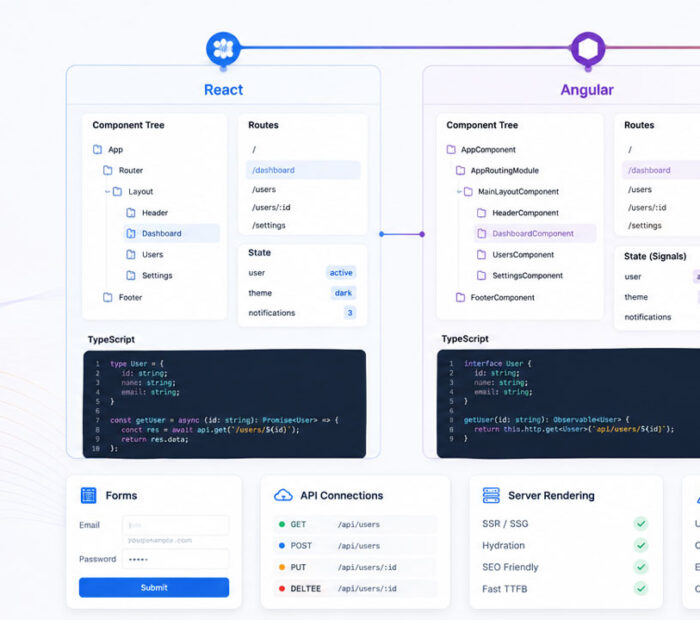
| Angular | Helps build structured frontend applications |
| React | Helps build reusable user interface components |
| Vue | Helps create interactive frontend applications |
Backend Development Responsibilities
Backend developers build and manage the logic that runs behind the application.
They make sure data moves correctly between the frontend, server, database, and other services.
Common backend responsibilities include:
- Creating APIs for frontend and mobile apps.
- Managing databases and data storage.
- Handling login, authentication, and authorization.
- Writing business logic and validation rules.
- Connecting with third-party services.
- Improving security, performance, and reliability.
Backend development is important because it controls how the application processes and stores information.
Common Backend Technologies
Backend development can use different programming languages, frameworks, and databases.
| Technology | Purpose |
|---|---|
| Node.js | Runs JavaScript on the server side |
| .NET | Builds APIs, web apps, and enterprise systems |
| Java | Used for large-scale backend applications |
| Python | Used for APIs, automation, data work, and web apps |
| SQL Server | Stores and manages relational data |
| PostgreSQL | Stores structured data with strong database features |
How Frontend and Backend Work Together
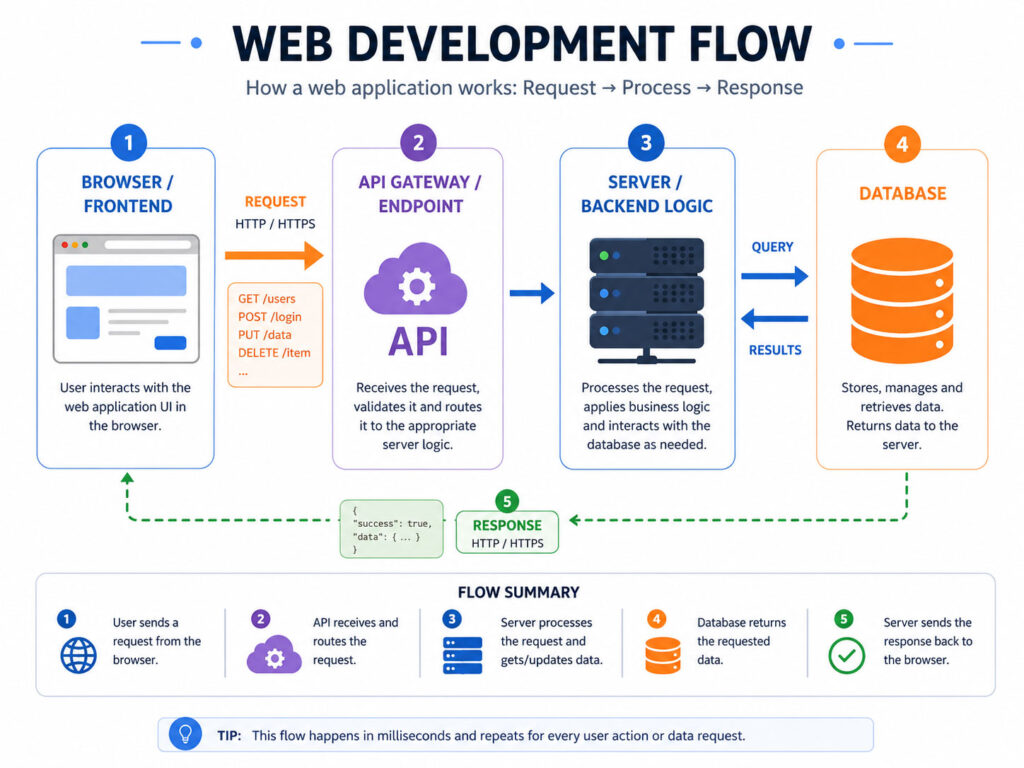
Frontend and backend work together to complete a user action.
For example, when a user submits a login form, the frontend collects the email and password. Then, it sends the details to the backend through an API.
The backend checks the details, verifies the user, and sends a response. After that, the frontend shows the correct message or redirects the user to the dashboard.
User action → Frontend request → Backend API → Database check → Backend response → Frontend updateThis flow happens in many common features, such as login, registration, search, payment, booking, file upload, and report generation.
What Does a Full Stack Developer Do?
A full stack developer works across both frontend and backend areas.
For example, a full stack developer may create a page design, connect it with an API, write backend logic, update the database, and test the complete feature.
Full stack developers are useful because they understand the complete application flow. However, full stack development still requires clear planning, good structure, and proper testing.
Frontend vs Backend vs Full Stack Skills
Each development role needs a different skill focus.
| Role | Important Skills |
|---|---|
| Frontend Developer | HTML, CSS, JavaScript, responsive design, UI frameworks, API integration |
| Backend Developer | Server-side programming, APIs, databases, authentication, security, business logic |
| Full Stack Developer | Frontend, backend, database, API integration, debugging, deployment basics |
Which One Should You Learn First?
If you are a beginner, start with frontend basics because you can see the output quickly in the browser.
After that, learn backend basics to understand how data, APIs, and server-side logic work. Once you understand both sides, full stack development becomes easier.
A simple learning path can look like this:
- Learn HTML, CSS, and JavaScript.
- Build simple web pages and forms.
- Learn one frontend framework such as Angular or React.
- Understand APIs and HTTP requests.
- Learn backend basics with a language or framework.
- Learn database basics and CRUD operations.
- Build small full stack projects.
Conclusion
Frontend vs Backend vs Full Stack Development becomes simple when you understand the role of each part.
Frontend development handles what users see and interact with. Backend development handles server logic, APIs, databases, and data processing. Full stack development connects both sides and covers the complete application flow.
If you are learning web development, understand frontend first, then backend, and finally combine both with practical projects. This approach can help you build stronger web development skills step by step.

AboutTPJ Technical Team
The Project Jugaad Technical Team creates practical, easy-to-follow content on software development, web technologies, artificial intelligence, cybersecurity, cloud platforms, and digital tools. Our articles are informed by more than 13 years of hands-on experience with .NET, Angular, SQL Server, AWS, WordPress, Linux hosting, application deployment, and real-world troubleshooting. Each guide is researched, reviewed, and updated to provide accurate, useful, and actionable information for developers, businesses, and everyday technology users.